
In September 2024, Lisbon’s first children’s play space with childcare, a café, and a coworking area for parents opened under the name SandCastle. Many parents said they were eagerly awaiting its opening, but in the end the investment by Israeli entrepreneurs Stas Kaminsky and Antonina Aaron didn’t pay off. Xpat.Land spoke with the business owners about why this format hasn’t caught on with Lisbon locals and expats, and how bureaucracy in Portugal differs from that in Israel.
"We need something like this!"
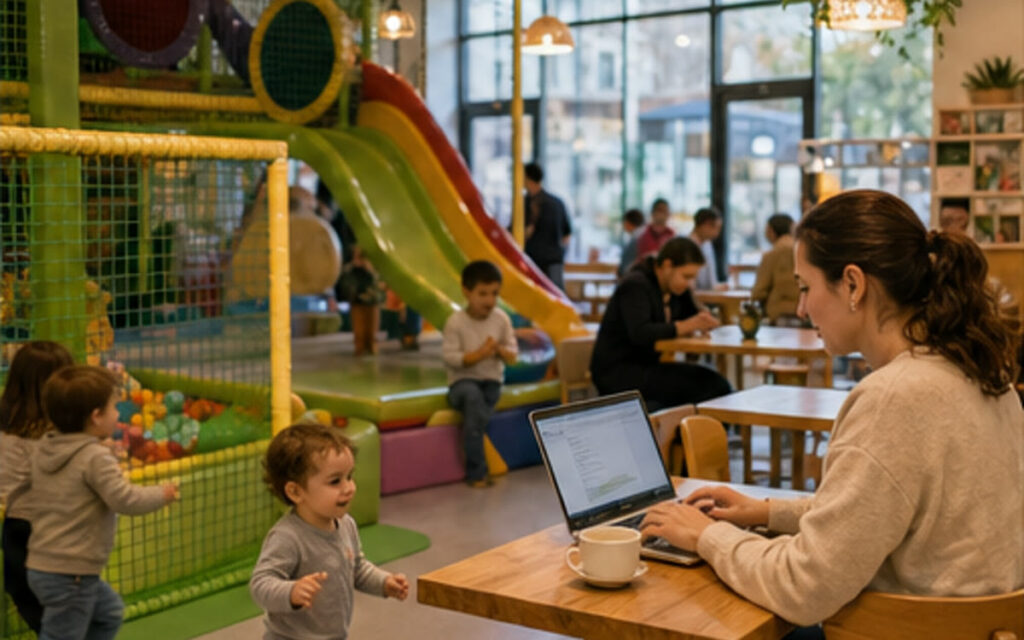
SandCastle is located in Saldanha, a popular and affluent neighborhood. The play space is unique for Lisbon: the city has almost no indoor play rooms with childcare where you can drop off your kid for a couple of hours at any time of day. The space is divided into three parts: a small café with a few tables at the entrance; beyond a wall, a kids’ area with a sandbox, a slide, drawing and reading corners, a kids’ beauty salon, a toy workshop, and plenty of toys for different ages; and, through a narrow hallway, a small coworking area with screens constantly streaming footage from the play area’s security cameras so parents can keep an eye on their kids.
Under the venue’s rules, children under four can only be in the play area if a parent is nearby in one of the adjoining spaces — the café or the coworking area. Kids older than that can be left for a few hours while parents go run errands.
Despite how unique the space is for Lisbon, on a warm summer evening it’s not crowded: three kids aged 3–4 are playing with a nanny in the sandbox, a one-year-old is fascinated by a plush dinosaur, a few people are drinking coffee at the tables, and someone’s dad is working on a laptop in the coworking area.
"At first we had a lot of hope that there was nothing like this in Lisbon, and that it was definitely needed," says Stas Kaminsky. "We talked to friends with kids, to parents at playgrounds, and everyone said, ‘Yes, of course, we need this.’ I did some research, set up an Instagram account for the play space before it was even built, drove traffic to that page, and asked followers to fill out a survey in English or Portuguese about how relevant this service was to them and how much they’d be willing to pay. Based on that research, our assumptions were confirmed — parents really were missing a place like this."
By fall 2024, SandCastle already had several thousand Instagram followers waiting for it to open. On opening day, even more people showed up than the owners expected, but the flow of customers slowed down over time.
"After the first year, it became clear that on warm days, Portuguese families really only want parks and the ocean. We could only really count on people bringing their kids in cold, rainy weather, or when daycare was closed. So we started actively building out the café and coworking space to give people other reasons to come — to meet up with friends as a group, and so on," Stas recalls.
Even before opening, the founders were counting on both local parents and expats from various countries, so they ran the Instagram account in Portuguese from the start, rather than limiting themselves to the Russian-speaking community. That turned out to be the right call. According to Antonina, the audience in winter is currently 70% Portuguese, with the rest being expats. In summer, it’s closer to a 50/50 split between Portuguese and other nationalities, with tourists often stopping by to entertain a kid who’s tired of sightseeing.
Pricier than a nanny
The place has a 4.8 out of 5 rating on Google Maps and plenty of glowing reviews. But occasionally there are complaints about the price being too high. One hour in the play area costs €13 per child, a day pass is €50, and there’s also a monthly unlimited pass for €350, a 10-visit pack for €100, or a 20-visit pack for €180. Discounts apply for a second and third child.
Given that the average hourly rate for a nanny in Lisbon is around €10, the pricing does look steep, but Antonina and Stas say they made that choice deliberately.
"For the most part, the people who come to us can afford this kind of leisure activity for their kid. It’s upper-class Portuguese, well-off people, executives, business owners. We once had a Benfica footballer here with his son. Popular influencers or footballers’ wives come by. There’s also a category of guests who treat themselves to a visit once a year — Portuguese families living on the outskirts, for whom coming here every weekend would be expensive. But they might come once a year as a group with their kids to celebrate a birthday, for example," says Antonina, simultaneously resolving a dispute between her one-year-old daughter Kai and her three-year-old son Kip.
Antonina has been on her own with three kids for a few weeks while Stas is in Israel. Her oldest daughter Kim has just left for acrobatics practice. On top of the kids, Antonina is also running the entire business — dealing with staff, the café’s food supplier, clients, and a couple of her own side projects. How she manages it all while staying calm and sane is anyone’s guess.
Good weather is bad for business
Initial investment in the lease, construction, furniture, equipment, toys, and first employee salaries came to about €100,000: €40,000 of that from Antonina and Stas, and another €60,000 from partners who later exited the business, disillusioned with how slowly it was growing.
The entrepreneurs originally expected the business to break even within a year, though they knew that forecast wasn’t very reliable.
"We were prepared for the play space to take about a year to gain traction, but it was hard to predict exactly, because this was a new concept for Lisbon and we had no experience in this field. We thought it could suddenly take off, but we also understood it could attract very few people. As it turned out, it was the latter," says Antonina.
Whatever they managed to earn over the first two years, the entrepreneurs reinvested into the project: buying furniture, a coffee machine for the café, spending on advertising. Monthly expenses run about €8,000, covering rent, staff salaries, taxes, and food supplies for the café. Revenue ranges from €6,000 to €12,000 a month.
"We still haven’t broken even," Antonina says. "There are periods when we’re solidly in the black, and months when we’re in the red. Demand is heavily affected by seasonality and weather. December, January, February are always good — it’s rainy outside, people don’t know what to do with their kids, so we always have a lot of people, especially on weekends, and the register does well. Last year, in March, we had record revenue. This year, that same month, nobody came to the play space at all, because everyone was starved for good weather after the winter storms. July and August are usually good too, because of the heat, school and daycare breaks, and lots of tourists in the city."
The founders attribute their early financial troubles to the fact that the amount they’d planned to invest in renovating and setting up the space wasn’t enough, since the landlords asked for six months’ rent upfront plus a deposit equal to another two months.
"That’s a huge sum for us, €20,000, and it just got frozen. That obviously cut into our options and how we wanted to open. In the end, by opening day, only the play area itself was really finished — even the lobby was pretty rough, and we finished building out the café and coworking space as we went."
Pizza and an escape room: reinventing the play space
Even though the business still isn’t generating steady income, the entrepreneurs aren’t giving up and are hoping to boost revenue with new ideas — or rather, forgotten old ones. Before moving to Portugal, they built an escape room chain from scratch in Israel, and now they’re planning to build something similar within SandCastle.
According to Antonina, the first escape room in Israel was "put together literally from stuff we found in the trash." It was themed as a serial killer’s basement, so any broken furniture or appliances worked perfectly.
"After we launched the first escape room, we just got swamped," they recall. "In the first month alone, every TV channel that could show up, did. The idea really took off, and we suddenly started making very good money. At one point we were making ten thousand euros per person, money we’d never seen before. We traveled a lot and put the money back into the business, built more rooms. We didn’t save anything, even though we could easily have bought an apartment."
A few years later, that one escape room had grown into a chain with 20 franchises across Israel. The founders have since exited that business after failing to see eye to eye with former partners, keeping only one location in Haifa, which they run remotely and which provides their main income today.
In Lisbon, in one of the empty rooms at SandCastle, they’re planning to build an escape-room-style pizzeria. They may need to take out a loan or find an investor to do it.
"We understand we need diversification, we need to develop other directions. In the space we rent, there’s a lot of room that isn’t really being used for anything. Besides the play area, there are three more rooms and a big terrace, but we just don’t have time to develop all of it. We’ve gradually started working with various instructors — we added adult vocal lessons, and we’re collaborating with an artist who runs art therapy sessions and painting classes here for kids and adults. In one of the rooms, we want to build a cooking-themed escape room, where people have to actually bake a real pizza as part of the game," Antonina shares. "We did some research, and pizza and cooking workshops are pretty popular with the Portuguese, so we’re confident it’ll do well. We’re hoping to build it all quickly, within a month and a half to two months."
Should you open a kids’ play space in Portugal?
On this question, the founders have a clear answer: if you don’t already have relevant experience, don’t do it.
"Honestly, I’d only recommend this to people who know they can offer some kind of big, compelling concept that will have mass appeal," says Antonina.
At the same time, initial investment should be budgeted at two to three times what Antonina and Stas put in:
"With €100,000, it’s doubtful you can build something substantial. We put in €100,000, we have extensive experience building out indoor spaces, we know how to source materials and cut costs — and even then we couldn’t stay within that budget. Everything is very expensive."
Any venue like this can only survive through upselling and raising the average ticket, the entrepreneurs believe.
"It makes sense to build, roughly speaking, a mini entertainment center — a space for both kids and parents to spend time. Somewhere you could hold a birthday party, get some work done, drop off your kid, come with teenagers to play an escape room, go to an art therapy session, and get a good meal at the café," Antonina reflects. "That’s when it would pay off."
Portugal vs. Israel: fewer approvals, higher taxes
Both founders agree that it’s easier to operate above-board in Israel, and they complain about unreasonably high Portuguese taxes for local businesses.
"The tax curve here climbs very fast. You pay an employee a €2,000 salary, and once you factor in all the employer contributions, it actually costs you almost €2,500. In Israel, that same burden only kicks in around a €5,000–6,000 salary," Antonina compares.
On the other hand, they say dealing with government approvals is easier in Portugal.
"Things are handled more simply here. For example, we paid €600 for fire safety compliance — they came, installed all the extinguishers, issued the license, and that was it, everything was in order. In Israel, getting that same license took us six months, and we paid a lot of money to redo the electrical panel, remove doors, and bring various things up to code. We could have built another escape room with that money," she shares.
The same easygoing approach applies to food service in Portugal, according to Antonina. Officially, their venue isn’t a café but a coffee shop — without a full kitchen, meaning they don’t need a food preparation license. They’re not allowed to cook proper dishes under the rules, so they simply order everything pre-made and reheat it, which is permitted.
But Antonina and Stas never managed to get a handle on Portugal’s financial bureaucracy. The entrepreneurs had planned to apply for a grant under the Portugal 2030 program, but ultimately decided not to spend time navigating the paperwork and waiting for approval — they took the risk and invested their own money instead.
"I’m confident this place will turn a profit and everything will work out. We’ve been through this before with the escape rooms in Israel, where we operated at a loss, it was hard, but we still found a way through. The main sign is that people are having a great time, the place is cool and they like it here, we get really good reviews," Antonina shares.