
In October, Chega returned to first place in Aximage’s monthly poll for Diário de Notícias (one of the country’s oldest daily newspapers, unaffiliated with any party): 30.7% of voters say they would vote for it, compared with 28.9% for the Socialists and 21.7% for the ruling AD coalition. Of all the parties in parliament, this right-wing party is the one most likely to affect our lives, and it already has. The toughest migration laws of recent years were put forward by Chega, an opposition party. The party has a face, André Ventura, and according to the polls he is now the most popular candidate to lead the country. Just seven years ago he was a football pundit on a cable channel and the sole MP of his newly founded party. Today he lives with his wife in a small flat in Parque das Nações, an expat-heavy district, promises to change the country, and clashes fiercely with the government in parliament. Ilya Zhegulev explains how a would-be priest and successful football pundit became everything for Portugal, and what the Roma have to do with it.
A seminarian from the Sintra suburbs
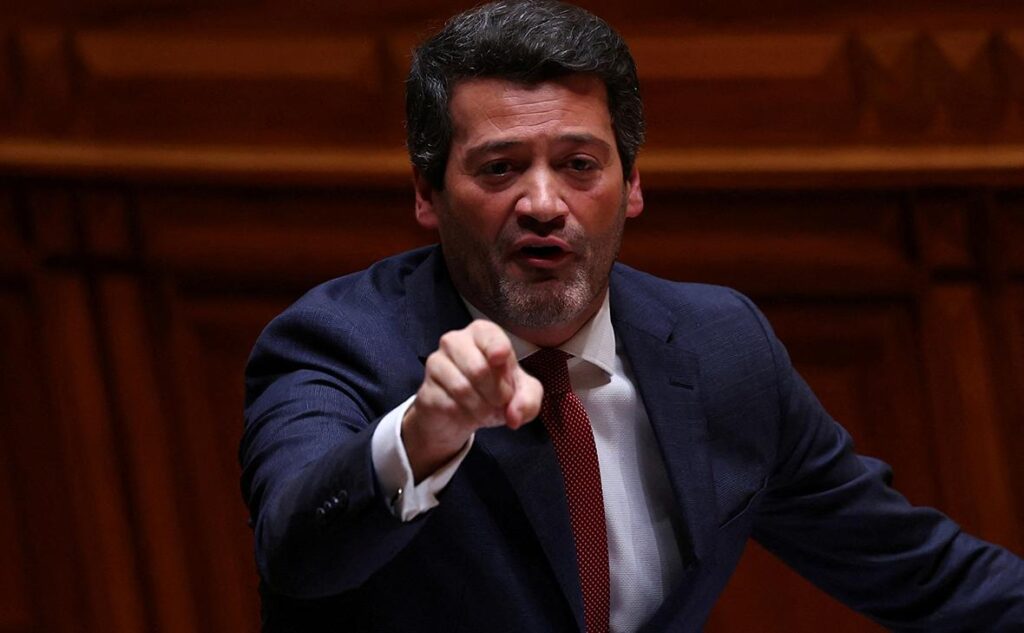
October 2026. At the parliamentary rostrum, a man in a fashionable jacket and a bright red tie holds up newspaper front pages one by one: “Let me tell you what good news we have.” He lists them: next year the country will do nothing to bring down the cost of living; every citizen will have to pay at least €7,000 in taxes; and other headlines hardly flattering to the government. Finally he sums up: “The only good news is that Chega has pulled ahead!” He gives a charming smile. The chamber erupts in triumphant laughter and applause. The prime minister watches his opponent intently. He is in no mood to laugh.
André Ventura is a millennial. The 43-year-old politician grew up in a modest family: his father sold bicycle and motorcycle parts, and his mother was an office worker. Ventura spent his childhood in Algueirão-Mem Martins, a suburb of Sintra that has nothing in common with the town’s beauty, romance, palaces and tourists.
One of the most populous freguesias in the country: blocks of flats along the railway line and a population to match. First came the lower middle class who had moved from the provinces, then Portuguese returnees from the former African colonies, and finally people from the colonies themselves.
Today the area is home to huge communities from Cape Verde, Angola and Guinea-Bissau, as well as from Brazil and South Asia. It is a classic working-class district which, in Ventura’s words, “has started to look like Africa.”
In 1997, the fourteen-year-old boy from Algueirão-Mem Martins decided to be baptised. “I thought I could become a priest: I am a person of faith, and at the time it wasn’t very clear what the meaning of my life was,” he recalled in a TV interview many years later. He also said he had wanted to be a voice for change within the Church. It didn’t last: Ventura fell in love with a classmate, promptly abandoned the priesthood and went into law instead.
He was a brilliant student. He graduated in law from Nova University with an average of 19 out of 20, then went to Ireland, to University College Cork, where he defended a doctoral thesis entitled “Towards a New Model of Criminal Justice in an Era of Globalised Crime.” After returning to Portugal in 2011, Ventura won a competitive post as a lawyer at the Tax Authority. He also taught at two Lisbon universities. His career looked like that of someone heading for the Constitutional Court. But that didn’t suit Ventura’s temperament.
How a football studio turned a tax lawyer into an orator
As a lawyer, Ventura wrote a column for Correio da Manhã, the country’s most-read daily, and commented on criminal law on CMTV, the same tabloid’s cable channel.
He was also passionate about football, so at some point he was invited to comment on that too. It was as a football pundit that he became truly famous. From 2014 to 2020, Ventura appeared every week on the football talk show Pé em Riste (“Foot at the Ready”), where he represented the point of view of Benfica, one of the country’s two most popular clubs.
In Portugal this genre is called a tertúlia: a lawyer and a coach, a club official and a former player argue around one table. As a rule, whoever speaks louder and more simply wins. Historian José Neves of Nova later called Ventura “a hybrid product of the televised football tertúlia.” The same channel also invited him onto programmes about high-profile criminal cases, this time as a legal expert.
In Portugal every big club has “its own” pundits on the channels, and some Benfica fans regarded Ventura as an unofficial part of the club’s PR machine. Pundits are well paid for their appearances. In May 2019, while heading the list of the right-wing Basta coalition in the European elections, Ventura skipped the election debate on the public channel RTP3: at the same time he was sitting in the Pé em Riste studio.
“I live off this, I’m not rich. It’s my profession,” he explained to the Lusa news agency. “I don’t put Benfica above the country.”
Still, the Benfica money mattered a great deal to the ambitious Ventura. In 2016, at 33, he published his first book. It wasn’t about politics but about football: 50 Reasons to Join Benfica. He co-wrote it with a tarot card reader named Maya.
Although fortune-telling has long been a stereotypical attribute of the Roma, he fiercely hated them. Jumping ahead: in 2020 he lost his TV slots after proposing a separate COVID quarantine for the Roma community. Portuguese footballer Ricardo Quaresma, who is of Roma descent, called it “racist populism.” CMTV then took Ventura off the air. The director of the media group explained that Ventura’s views called into question people’s constitutional rights and their equality before the law. But by then Ventura no longer needed the studio: he had parliament and the street.
Loures, the Roma and the birth of Chega
Long before his scandalous dismissal from television, and in parallel with his punditry, Ventura went into politics in the youth wing of the PSD (the centre-right Social Democratic Party). In 2017 the party nominated him as its candidate for mayor of Loures, a suburb north of Lisbon with large Roma communities. During the campaign he claimed that the Roma lived almost entirely on benefits. The PSD’s coalition partner, the conservative CDS, responded by leaving the alliance. But the then PSD leader, Pedro Passos Coelho, backed the candidate. The following year, however, André Ventura fell out with the party. Passos Coelho had stepped down, and the fight against his successor, Rui Rio, came to nothing. In autumn 2018 Ventura launched an internal movement called Chega (Portuguese for “Enough”) and began collecting 2,500 signatures to call an extraordinary congress and oust Rio, accusing the leadership of making concessions to the left. Ironically, in his fight against Rio, Ventura was betting on Luís Montenegro, calling him the only solution for the party. But Montenegro refused to get drawn into the squabble and backed Rio. Having fallen out with everyone and with no leader left to bet on, Ventura said he had been “stabbed in the back” by the local branch, resigned his seat in Loures and left the party, turning the movement into his own party, Chega. Today that same Montenegro is prime minister and Ventura’s main opponent and target.
While building his own party, he earned his living as a consultant at the Lisbon law firm Caiado Guerreiro and as a TV commentator. In 2019 he founded Chega, which describes itself as “conservative, liberal and nationalist.” In its first parliamentary election, only he himself got in.
“For the first time in 45 years, the country was not afraid to vote for a truly right-wing party,” he said on election night, adding: “I guarantee you that in eight years we will be the largest party in Portugal.”
At the time it sounded like the bluster of a football pundit who had essentially failed, having not got a single one of his allies into office. By then even his own club, Benfica, had turned its back on him. A group of well-known Benfica supporters, including Ricardo Araújo Pereira, the country’s most popular comedian, published an open letter saying the club must not allow itself to be used for political PR. It was time to move from football to real politics; after all, he now had some capital: the ability to speak in parliament. And he could speak well. That is what he went on to do: he made active use of the parliamentary rostrum for public speeches, becoming memorable to almost every person in the country, for better and for worse.
By January 2021 he was already running for president. And he used the most unconventional methods. For example, he held Portugal’s first drive-in rally: instead of applause, he was greeted by hundreds of car horns, while supporters shouted “Go, André!” That same day he called the country’s president a coward. The day before, in Braga, his supporters had greeted journalists with whistles, insults and threatening chants, and his campaign had to distance itself publicly.
He lost the election: with the unconditional backing of the notorious French far-right politician Marine Le Pen, who came to Lisbon, he won 11.9% and came third.
How Ventura became a politician
The main thing television gave Ventura was practice in performing for an audience and honing his oratory. Six years of tertúlia taught him to speak fast and in short phrases, to get the main point across before being interrupted, and to interrupt others himself. His style has barely changed since. At the rostrum, Ventura, always immaculately dressed, his slightly greying hair slicked back with gel, reacts in real time to how he is being received, and decides accordingly whether to attack or wait before the next blow. Linguists from Universidade Aberta in Lisbon who analysed his 2021 TV debate with President Marcelo Rebelo de Sousa counted numerous instances of him interrupting his opponent, and noted that he speaks not for himself but on behalf of the viewers, “the Portuguese,” as their representative. Another study of the same debate describes a shift in genre: a traditional politician discusses what should be done, whereas Ventura establishes who is to blame. It is the speech of a prosecutor, and for him the whole country is the courtroom.
His strength lies in his ability to switch registers, another skill he brought from the TV studio, where he was sometimes a lawyer and sometimes a fan. During the 2026 presidential campaign he echoed Giorgia Meloni: anyone uncomfortable next to a crucifix is living in the wrong country. When needed, he can even be a charming blogger. In July 2026 he posted a video shot on his phone in which, on a Friday afternoon, he walks through the empty offices of other parliamentary groups, knocking, peering in and shrugging: “Zero, nobody’s working.” But it isn’t criticism of his colleagues that won people over.
Who votes for Chega
It is easier to describe who listens to him than to explain why. The Chega voter is more often a man (roughly two out of three). He is more often young, lives in the south or in a poor suburb, and doesn’t remember Portugal before the 1974 revolution.
Average income here is among the lowest in the EU, housing is getting more expensive faster than wages, roughly a third of young people leave the country, and the number of immigrants has grown so much in a few years that the migration service could not cope with the queues for years. The two parties that have alternated in power for half a century, the PS and the PSD, offered voters nothing but patience. Ventura offered them someone to blame: “the corrupt system,” the Roma supposedly living on benefits, and migrants who arrived to reap what others had sown. Among his supporters are also Brazilians with Portuguese passports, drawn by the talk of corruption and “traditional values”; the anti-migration part of the programme, they say, doesn’t apply to them.
Chega built up this voter base over five years: 12 MPs in 2022, 50 in 2024. That same year the party won the Faro district in the Algarve with 27% of the vote, and Ventura declared the end of the two-party system.
In the autumn of that year, a police officer in Amadora shot dead Odair Moniz, a Cape Verdean man, triggering one of the most serious outbreaks of street violence in Portugal in recent years. Riots began in Zambujal on the very first night, and then for several nights in a row buses, cars and rubbish bins burned in a dozen municipalities around Lisbon, including Sintra, Odivelas and Loures. “Instead of making this man the accused, we should thank the police officer for his work,” Ventura said. Prosecutors opened an inquiry into incitement to hatred. “Frankly, I think our democracy is getting worse,” he replied, calling it persecution for his opinions.
The next election came a year later: in 2025, Luís Montenegro’s government fell over questions about Spinumviva, his family’s consulting firm. In May, when Ventura was taken ill at a rally in Tavira and rushed to hospital in Faro, the campaign carried on without him. Explaining why Ventura had been given a private room, the leader of his party’s parliamentary group, Pedro Pinto, told journalists that Ventura could not be expected to lie next to a person of Roma ethnicity.
The result of that election: 60 MPs and the second-largest group after the PSD. Since June 2025, Ventura has officially been the leader of the opposition.
How Ventura united the centre-right with the Socialists
In autumn 2025, Ventura led the presidential polls, ahead of the candidates of both the ruling alliance and the Socialists. The presidential palace seemed within his reach. He promised that, if elected, he would be president not of all Portuguese people but only of “decent citizens,” and called himself the only candidate with the courage to say that former Socialist prime minister José Sócrates should be in prison.
On 18 January 2026 he came second with 23.52%, behind Socialist António José Seguro with 31.11%. Ventura won in the poorest municipalities, Seguro in the wealthier ones. Then came what Ventura’s opponents had been counting on.
The PSD’s party barons publicly backed the Socialist candidate so as not to be associated with Ventura, explaining that there are lines that cannot be crossed, a clear reference to his xenophobic and scandalous statements.
Ventura announced in advance that he would lose only because of “the selfishness of the PSD, the Liberal Initiative and other parties that call themselves right-wing.” And so it was: on 8 February Seguro won more than twice as many votes, leaving Ventura with about a third.
The defeat looks different if you look at the numbers. In the first round he more than doubled his 2021 result, attracted around 1.3 million voters, and staked his claim to be the sole leader of the Portuguese right.
How Chega changes laws without being in government
Chega has not yet governed the country, but laws are already changing under its pressure. Montenegro’s government publicly rejects any alliance with Ventura, yet the toughest migration laws of recent years passed precisely thanks to his MPs’ votes.
In autumn 2025, after the Constitutional Court struck down the first version of the foreigners law, parliament passed a new one; the text included three Chega amendments, among them a requirement that an immigrant bringing over their family must have housing in Portugal.
In October of that year, the PSD and Chega voted through a citizenship law with longer residence requirements and a requirement to know the language and culture. “Today Portugal has become a greater Portugal,” said the then Minister of the Presidency, António Leitão Amaro. The Constitutional Court rejected some of its provisions, and in spring 2026 parliament passed the law again, once more with Chega’s votes. In summer 2026, with Chega abstaining, a “return law” was passed speeding up the deportation of undocumented migrants. The party commented: “Fortunately, the government has realised that Chega was right.”
That same summer, Chega passed a law of its own: a ban on wearing face-covering clothing in public places, dubbed the “burqa law” by the press. Violations carry a fine of up to €3,000, and anyone who forces another person to cover their face faces up to two years in prison. Parliament adopted the law on 17 July, and in August it was signed by President Seguro, the same man who had beaten Ventura in the run-off six months earlier. In signing it, he cited the case law of the European Court of Human Rights and called an uncovered face a foundation of public trust.
A one-man party
Chega’s influence in parliament rests almost entirely on one man, and wherever Ventura isn’t on the ballot, it shows immediately. In the October 2025 municipal elections the party won only three town halls, Albufeira in the Algarve, Entroncamento and São Vicente in Madeira, and 137 seats on municipal councils; Ventura admitted he had expected more. In Faro, where Chega wins parliamentary elections, it came third: its list was headed by Pedro Pinto. Within the first four months, seven of the party’s elected councillors left. It was the same after the 2021 elections: of the 19 councillors elected then, only 10 remained in the party.
Ventura was re-elected party president with 98.9% of the vote. American extremism researchers have described Chega as “highly centralised” around him.
Pinto himself, while Ventura was in hospital, assured journalists that Chega was “not just André Ventura’s face” but “a balanced party with a future.”
So far there is little evidence of that. Its MPs remain little known, and the programme shifts with the leader’s mood. If Ventura went back to football punditry tomorrow, it is unclear what would remain of the party that now tops the polls.
Faith, a wife and a flat in Parque das Nações
Outside politics, Ventura’s life still revolves around the Church. “I studied at a seminary, I was married in church, I have always been a believer and I still am,” he said in 2023. The occasion for that statement was painful for him: his confessor, Father Mário Rui Pedras, who had married Ventura, was removed from his parish after his name appeared on a list of alleged sexual abusers compiled by an independent commission. According to its estimate, at least 4,815 children have been abused by priests and church workers since 1950. Ventura was shaken. He demanded that justice be applied equally to everyone.
Since 2016 he has been married to Dina Nunes, a paediatric physiotherapist at a Lisbon hospital. They met after he finished university, in a café near the church they both attended; they have no children. Dina holds no official position in the party, but since the 2017 Loures campaign she has accompanied her husband to every rally and party dinner. She doesn’t talk to the press. On the night of the parliamentary election she prayed beside him in the same church where they were married. Her brother, Miguel Nunes, sits on Chega’s governing bodies.
The couple live in his wife’s flat in a gated condominium with a pool in Parque das Nações; in debates Ventura has called his home modest and said it was only thirty square metres.
An Observador journalist once called Ventura “a man who has been arguing all his life.” It seems that arguing, with the Church, with his own party, with Roma communities, with the whole “system,” has turned out to be his true profession. Publicly he says he rejects Salazar, and yet he has built the largest right-wing force outside the traditional centre since the 1974 revolution. In 2019, Ventura promised that within eight years Chega would become the largest party in Portugal. At the time it was laughable. The deadline runs out in 2027, and the latest polls make that promise look more and more like a forecast.