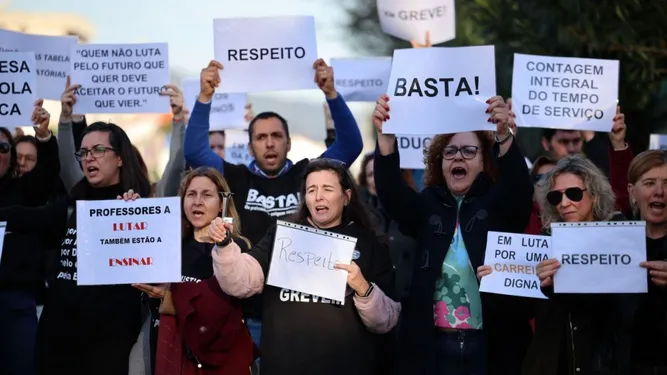
In October 2026, housing activists set up tent camps in central Lisbon and Porto to demand affordable housing. They intend to stay indefinitely, calling for measures to address the housing crisis and bring down the cost of renting and buying property. In Porto, a police operation to dismantle the camp on October 15 escalated into violent clashes. Organizers reported 37 people injured, while police said they had used force because protesters resisted. The activists later rebuilt the camp. In Lisbon, police have so far limited themselves to issuing warnings.
Mass protests and clashes with police are nothing new in Portugal. Over the past several decades, hundreds of thousands of people have taken to the streets, and demonstrations have sometimes ended in violent dispersals, arson and rioting. But the current form of protest — tent camps in the centers of the country’s two largest cities, with activists vowing to remain for an extended period — is virtually unprecedented. As of the morning of October 19, both camps were still in place. It remains to be seen how long they will last and whether the activists will succeed in securing legislative changes.
For Xpat.Land, journalist and Portuguese history researcher Alena Khazinurova looks back at Portugal’s largest protests over the past 50 years.
April 30–May 1, 1982, Porto: The violent breakup of a May Day demonstration
On the eve of May Day, Porto witnessed one of the most tragic episodes in the country’s modern history. The authorities had authorized the UGT trade union confederation to hold a May Day event at Praça Humberto Delgado. Supporters of the rival CGTP confederation also wanted to gather there, but were denied permission. Clashes broke out in the city on the evening of April 30 between members of the two unions, whose political views differed sharply.
By 1982, Portugal had been a democracy for eight years. The Estado Novo dictatorship established by António Salazar had fallen following the Carnation Revolution on April 25, 1974 (Salazar himself had died in 1970). After the revolution, political parties were free to operate and independent trade unions emerged. The labor movement quickly split along political lines. CGTP grew out of the underground Intersindical, founded in 1970, and was closely aligned with the Portuguese Communist Party (PCP). UGT was established in 1978 by the Socialists (PS) and Social Democrats (PSD) to counter communist influence in the labor movement. The rivalry between the two confederations on May Day was therefore, in essence, a political confrontation between the radical left and more moderate forces.
Police intervened forcefully, beating people with batons and assaulting even those who offered no resistance. At least 60 injured people sought hospital treatment, and nine suffered gunshot wounds. Two people were killed: 24-year-old textile worker Pedro Manuel Sarmento Vieira and 17-year-old Mário Emílio Pereira Gonçalves.
Outcome: A prosecutor’s investigation documented serious police misconduct, and the commander of the PSP’s rapid-response unit was dismissed.
April 21, 1989, Lisbon: The “Wet and Dry” police protest
More than 700 PSP officers gathered outside the Ministry of Internal Administration at Praça do Comércio. They demanded the right to union representation, better working conditions and protection of their labor rights.
The demonstration was broken up by their own colleagues from the PSP’s special intervention unit, known as the Corpo de Intervenção. Police used water cannons, batons and police dogs, and six demonstrators were arrested. The protest became known as Secos e Molhados (“Wet and Dry”): the officers dispersing the demonstration stayed dry, while the protesters were soaked by water cannons.
The incident went down in history as the only time Portuguese police have used water cannons against people. It had never happened before and has not happened since.
Outcome: In 1990, the authorities allowed police officers to form professional associations. Full-fledged police unions did not become legal until 2002.
1993, Lisbon: Student clashes with police
As the government pushed through education reforms, it sharply increased university tuition fees, sparking widespread anger among young people.
Student protests swept the country throughout 1993, sometimes erupting into violent clashes with police. The most serious incidents took place on May 4 outside the Ministry of Education and on October 21 in front of Parliament. Officers used batons to disperse students and kicked demonstrators who had fallen to the ground. Dozens of people were injured, including police officers.
Outcome: The heavy-handed crackdown and the imposition of tuition fees seriously undermined the standing of the center-right PSD government. In autumn 1995, the ruling party lost the parliamentary election. The incoming Socialist government led by António Guterres reached a compromise and temporarily froze tuition increases. However, Portugal’s system of paid higher education was never abolished.
June 24, 1994, Lisbon: The blockade of the 25 de Abril Bridge
In June 1994, motorists protested against a 50% increase in the toll on the 25 de Abril Bridge over the Tagus, from 100 to 150 escudos. For several days, drivers staged buzinões — slow-moving convoys that clogged the bridge while sounding their horns. On the morning of June 24, several trucks blocked access to the toll booths, and other drivers joined them. The bridge was brought to a complete standstill for the entire day, with traffic jams stretching up to 50 kilometers.
When police tried to restore traffic, clashes broke out. Drivers and passengers built barricades, lit fires and threw stones and other objects at officers. Members of the GNR (National Republican Guard) were ordered to break up the protest forcefully. They used batons, beat demonstrators and dragged people out of their cars. At one point, police opened fire with live ammunition. One bullet struck a young man named Hugo Pereira in the spine, leaving him permanently paralyzed. Others were injured and arrested.
Outcome: The protest remains one of the clearest examples of mass public pressure forcing the authorities to back down. The government froze the toll increase and introduced discounts for frequent bridge users.
March 12, 2011, across Portugal: Protests against poor living standards
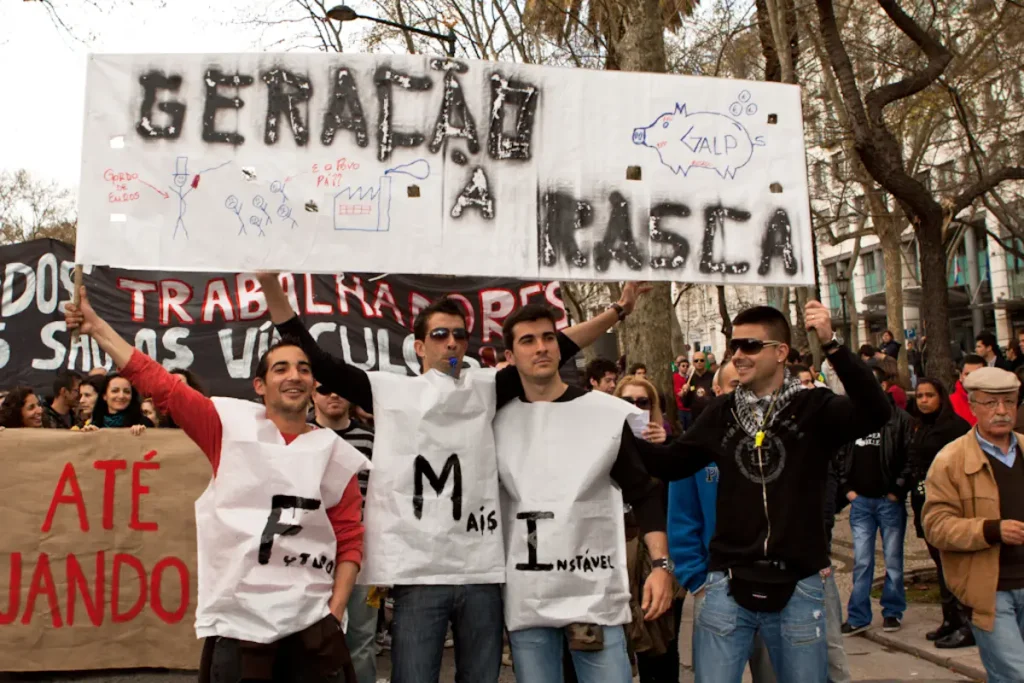
Hundreds of thousands of people took to the streets in Lisbon, Porto and other cities to protest unemployment, low wages and precarious employment. The demonstrations became known as Geração à Rasca (“Generation in Distress”). They were organized by young people frustrated by the lack of career prospects and opportunities to build a decent life. One of the movement’s defining features was that the call to protest spread through social media, driven by a small group of activists with no ties to political parties or trade unions.
There were no clashes with police this time, but the scale of the demonstrations and the public attention they attracted were remarkable.
Outcome: On March 23, 2011, Parliament rejected the government’s proposed deficit-reduction plan, which included pension cuts and reductions in tax benefits. Prime Minister José Sócrates resigned the same day. However, the Portuguese public saw few tangible improvements. In the years that followed, the labor market crisis deepened, and strikes and protests continued.
May 20–June 4, 2011, Lisbon: A tent camp at Rossio Square
Later that year, members of the Indignados (“Outraged”) movement, inspired by the similarly named movement in Spain, set up a tent camp in Lisbon’s Rossio Square.
Outcome: The camp lasted about two weeks. Police dismantled it on the eve of the parliamentary election, arresting three people.
September–November 2012, Lisbon and across Portugal: Protests against tax increases
Amid Portugal’s financial crisis, mass demonstrations took place against tax hikes, spending cuts and deteriorating living standards. According to organizers, around one million people took part in protests across the country on September 15, 2012. The demonstrations became associated with the slogan Que se lixe a troika! Quero a minha vida! (“Screw the troika! I want my life back!”).
The term “troika,” borrowed from Russian, referred to Portugal’s three main international creditors: the European Commission, the European Central Bank and the International Monetary Fund. Public sentiment toward them was overwhelmingly negative. In 2011, Portugal, which was on the brink of bankruptcy, received a €78 billion bailout in exchange for measures to reduce its budget deficit. The authorities sought to meet those conditions by cutting spending on healthcare, education and public-sector salaries, as well as raising taxes — measures that naturally angered ordinary people.
The most serious clashes occurred on November 14, the day of a general strike that escalated into rioting by evening. Outside Parliament in Lisbon, protesters threw pieces of calçada, Portugal’s traditional cobblestone paving, at police, tore down barriers and set rubbish bins on fire. Officers used batons and dispersed crowds in the surrounding streets. Around 50 people, both protesters and police officers, were injured, and seven people were arrested.
Outcome: In 2013, the government abandoned some of its plans for further tax increases. The Constitutional Court also ruled several austerity measures unconstitutional, including the cancellation of the 13th and 14th monthly salary payments for public-sector workers and pensioners.
2013–2014, Lisbon: Clashes outside Parliament during police protests
In 2013 and 2014, police officers took part in large demonstrations against working conditions and changes to their social benefits. During a protest in March 2014, demonstrators tried to push past the barriers outside Parliament and climb the building’s steps. Ten people sustained minor injuries in the clashes — four demonstrators and six police officers — while two others were taken to hospital.
Outcome: The police cordon showed solidarity with their protesting colleagues and allowed them to reach the parliamentary steps with virtually no resistance. Shortly afterward, PSP Director Manuel Quintela resigned.
January 2019, Lisbon: Protests against police brutality
In January 2019, a video showing police officers using excessive force against residents of Bairro da Jamaica triggered widespread outrage. The neighborhood was an informal settlement in the municipality of Seixal, on the southern outskirts of Greater Lisbon, where people from Portugal’s former African colonies had settled. Police had been called to deal with a domestic dispute, but officers ended up violently assaulting local residents.
Several hundred people took part in a spontaneous demonstration against police brutality and discrimination against Afro-Portuguese people on Lisbon’s Avenida da Liberdade. Police used rubber bullets, and arrests were made. In the following nights, riots broke out in the suburbs of Odivelas and Loures, as well as in Setúbal, with cars and buses set on fire.
Outcome: The case went to court. In 2022, the court found both sides guilty: one police officer received a suspended sentence for abuse of authority and physical violence, while members of the affected family received suspended sentences for resisting the authorities. The incident also prompted the government to accelerate its program to demolish informal settlements. By early 2024, Bairro da Jamaica had been completely demolished, and all 244 families who had lived there had been rehoused in social housing elsewhere.
October 2024, Lisbon: Riots following the death of Odair Moniz
On October 21, 2024, a police officer shot and killed Odair Moniz, a 43-year-old Cape Verdean man, in Amadora. His death sparked widespread outrage among both migrant communities and Portuguese activists.
Over the next several nights, riots broke out in Lisbon and the surrounding area. Protesters set buses and cars on fire and threw stones at police stations. Sixteen people were arrested over the course of several days. On October 26, thousands of people took to the streets in central Lisbon to demonstrate against police brutality.
Outcome: Moniz’s death was investigated, and the officer who fired the shot was charged with murder. The court ruled that he had exceeded the limits of necessary self-defense and sentenced him to three years and six months in prison, suspended, while also ordering him to pay the victim’s family €90,000 in compensation. The ruling has not yet become final: the family has appealed, seeking an actual prison sentence and higher compensation.