Danish company LEGO Group is to build its first factory in Portugal. It will be located in Estarreja, in the Aveiro district, between Porto and Aveiro. The company will invest around €1 billion and create more than 1,000 jobs. Construction is due to begin in the first half of 2027, with production scheduled to start in 2030. It will be LEGO’s eighth factory worldwide and its fourth in Europe, after those in Denmark, Hungary and the Czech Republic.
The investment was announced at Estarreja Town Hall on 23 November. Those attending included Prime Minister Luís Montenegro, Economy Minister Manuel Castro Almeida and LEGO Chief Operating Officer Carsten Rasmussen. According to Rasmussen, the project is “just the beginning” of a long-term partnership with Portugal.
What the factory will produce
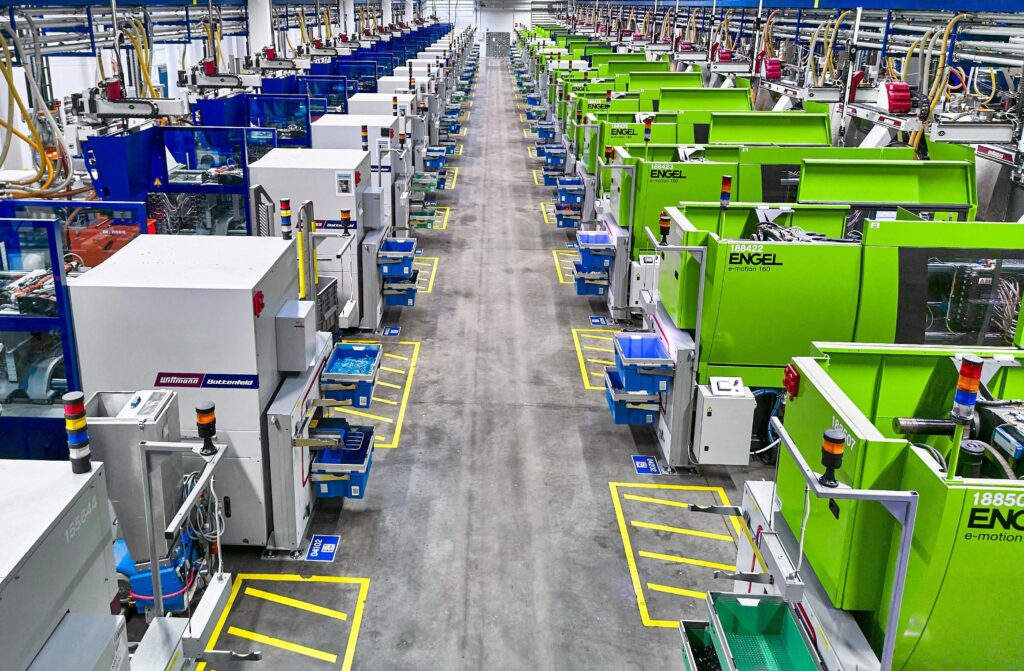
The factory will handle the entire production process, from moulding and decorating individual pieces to packaging finished sets. The buildings will cover 115,000 sq m, while the entire site will span 60 hectares – roughly the equivalent of 120 football pitches.
Products will be shipped to Europe, the Middle East and Africa. LEGO describes the facility as the most automated and technologically advanced in its global network. As a result, it will employ significantly fewer people than the company’s older factories.
LEGO’s factory in Nyíregyháza, Hungary, for example, employs 4,300 people, while the Portuguese facility’s buildings will occupy less than half the area of the Hungarian plant. In an interview with Lusa, Rasmussen clarified that the investment could reach €1 billion by 2035. Once operating at full capacity, the factory will employ “1,000, perhaps a little more” skilled workers.
Why Portugal?
Rasmussen cited four reasons for choosing Portugal: proximity to markets, transport and logistics infrastructure, the country’s commitment to sustainability and the availability of skilled workers. The University of Aveiro is also nearby.
According to Observador, negotiations lasted around a year. They were led by AICEP, Portugal’s state investment promotion agency, with the municipality joining in February. Hundreds of meetings took place during that time.
All the parties involved signed non-disclosure agreements, including the town hall, AICEP, electricity grid operator E-Redes, regional water utility AdRA and telecommunications regulator Anacom. According to a source quoted by the newspaper, Portugal beat Spain and Poland to secure the investment. Rasmussen did not name any competing countries, saying only that LEGO had “looked at many other locations”.
What Portugal is offering LEGO
AICEP president Ana Casaca said the company had been offered tax incentives and assistance with the costs of travelling to Portugal. According to her, such incentives are available to any investor in an EU country. The amounts involved have not been disclosed.
The municipality has already acquired 45 hectares of land and plans to resell them to LEGO. Another 15 hectares will be needed for the first phase, while the full project could require 116 hectares. The authorities have not ruled out expropriation – the compulsory acquisition of private land by the state – although they describe it as an undesirable option.
The factory will be built on land earmarked for the expansion of the local Eco Parque Empresarial business park. The site has seen failed projects before: plans for factories belonging to ceramics manufacturer CINCA and off-road vehicle maker INEOS were previously announced, but both investors eventually pulled out.
“Don’t let me down”
Montenegro addressed the public authorities responsible for issuing permits, telling them: “Não me deixem ficar mal” (“Don’t let me down”).
He urged them to tackle the “remnants of excessive bureaucracy” and shorten approval times wherever possible. According to the prime minister, the speed of administrative procedures will affect both foreign investors’ confidence in Portugal and the country’s ability to retain its young people.
Environmental commitments
The factory is expected to run entirely on renewable energy. Around 80% of its energy needs will be met by solar panels and energy storage systems installed on site. Plans also include collecting and reusing rainwater and obtaining LEED Platinum green building certification.
Why LEGO needs another factory
LEGO is growing faster than the toy market as a whole. In 2025, its revenue rose by 12% to €11.2 billion. In the first half of 2026, it increased by a further 21%, reaching a record 41.9 billion Danish kroner (€5.6 billion).
In April 2025, LEGO opened a factory in Vietnam. A new plant in Virginia, USA, is due to begin operations in 2027, while in September the company announced a $400 million expansion of its factory in Monterrey, Mexico.
LEGO has been present in Portugal since 1975, but until now its activities in the country have been limited to selling toys.
Job openings will be announced closer to the factory’s launch. AICEP and LEGO are currently looking for organisations in Portugal that can train future employees, both Portuguese nationals and foreign residents.