
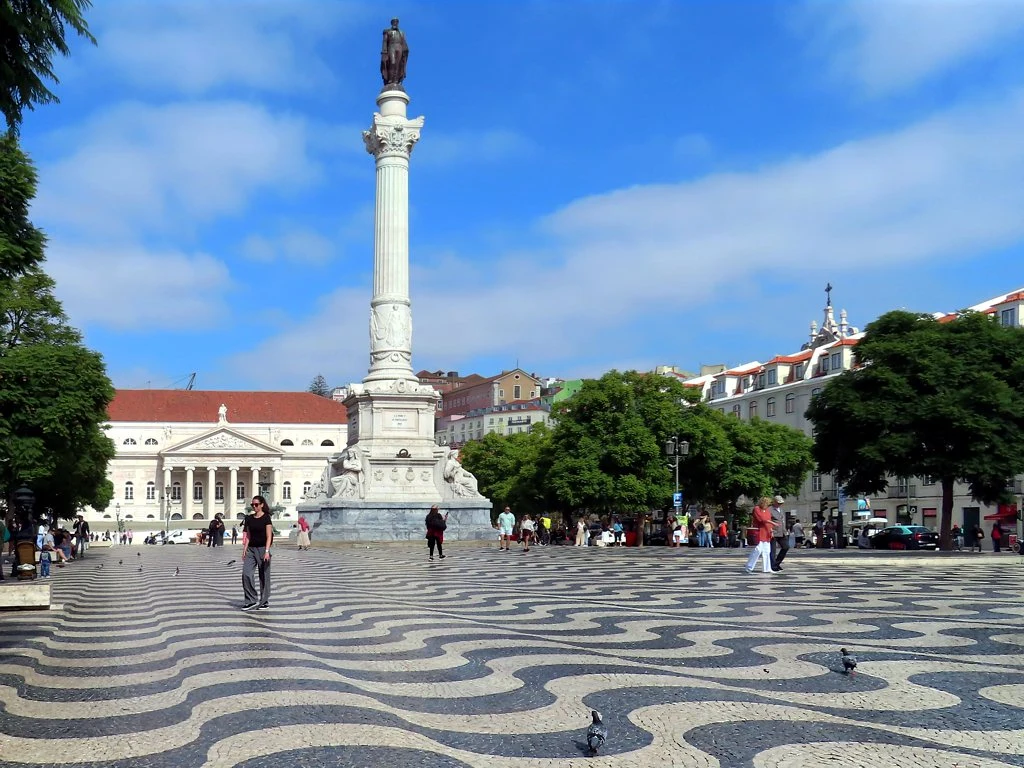
On Rossio Square, the sea starts right under your feet. Black and white bands run across the square so that from one edge they look almost straight, and from the other they fold into waves. The pattern is called Mar Largo, “the open sea”. Behind it is a story that began in a prison yard and carries on along the pavements we walk every day.
On 26 November, Lisbon’s Teatro Aberto is hosting a conference on calçada portuguesa, the Portuguese stone pavement. It marks the 40th anniversary of the city’s schools for paviours and gardeners. Speakers will discuss the symmetry of the patterns, the choice of stone, and the portrait of the singer Amália Rodrigues that the artist Vhils laid in the pavement. Here is where the patterns underfoot came from, why they can be hard to walk on, and how Lisbon is keeping its pavement while it rebuilds its sidewalks.
How the pattern moved from the castle to the square
In 1842, Eusébio Furtado, who ran the prison in São Jorge Castle, had its yard paved with small white and black stones. The work was done by prisoners. Lisbon residents liked the zigzags in the castle. Meanwhile, the centre of Rossio had been closed to carriages and riders, and the city decided to pave it. Furtado proposed black-and-white waves, and in 1848 the city approved his design. Prisoners worked there too, and municipal paviours finished the job.
The pattern you see on Rossio today reproduces the 19th-century design. From a distance, you see the waves running across the square. Up close, you see that each line is held together by dozens of small stones fitted to one another.
How a pattern is set in stone
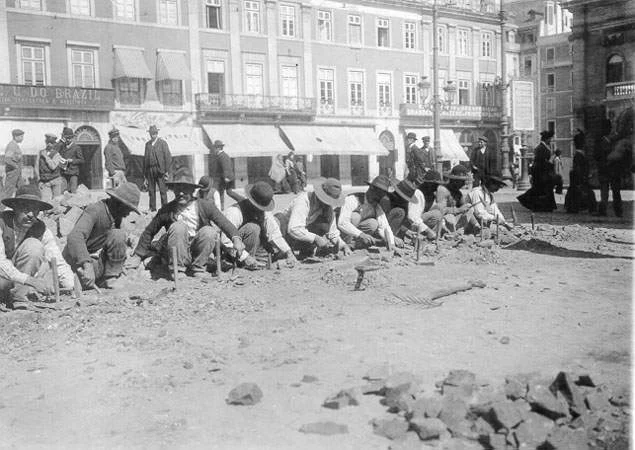
Calçada portuguesa is a pavement made of small stones fitted together. In Lisbon it is easy to recognise by its light background and dark pattern, though everyday paving also has plain single-colour stretches. Individual stones show how a pattern is built: where a line curves, the paviour picks or trims each piece to fit on the spot.
The stones are still cut and laid by hand. For repeating patterns, paviours use templates. As early as the 19th century, the Lisbon authorities ordered wooden moulds for the waves on Rossio.
Why the pavement is slippery, and who it gets in the way of
After rain, it is easy to slip on the limestone paving, especially going downhill. Foot traffic gradually polishes the surface of the stone smooth. But a dry pavement can be awkward too. When a stone falls out or sinks, the small wheel of a wheelchair or a pushchair can get stuck in the gap, and the tip of a walking stick can catch in it. And if the whole pavement is narrow, there is often no way around.
The argument over where to keep the traditional pavement has gone on for more than ten years. In 2014, Lisbon’s municipal assembly approved a pedestrian accessibility plan. In response, MyiArts, an organisation that runs cultural projects, launched a public petition to preserve the Portuguese pavement as part of Lisbon’s heritage. About 2,400 people signed it. At public hearings, wheelchair users described how uneven surfaces stop them getting through. In the end, the municipal assembly backed recommendations to preserve the moulds and drawings of artistic pavement and to develop the paviours’ school. Which surface suits a particular street is still decided when that street is rebuilt.
What Lisbon is already changing on its streets
In 2026, the first renovated stretch of Rua Ferreira Borges in Campo de Ourique opened, between Rua Saraiva de Carvalho and Rua de Infantaria Dezasseis. Next to the patterned paving, the sidewalk now has a continuous strip of large stone slabs. The slab strip has fewer joints, and you can walk along it or use it in a wheelchair without obstacles. Under the city’s schedule, the second stretch is due to be finished in August 2027.
On steep streets, a different approach is used. In Mouraria, Rua de São Cristóvão and Rua das Fontaínhas a São Cristóvão have already been paved with a mix of granite and limestone. For neighbouring Calçada de São Lourenço, the parish chose the same scheme: level the surface and use stone with better grip. This keeps the character of small-stone paving while making the surface easier to walk on.
The accessibility plan for the Lisbon metropolitan area recommends strips of smoother material in historic areas. For a wheelchair user, what matters is the whole route: the strip has to lead to a crossing, and the crossing needs a dropped kerb. If there is still a step between them, a single smooth stretch changes little.
Who will repair the patterns
When patterned pavement is repaired, the paviour has to match the stone’s colour and trim it so that it sits flush with its neighbours and continues the line of the design. It is not an easy job.
There are not enough qualified paviours. According to the Portuguese government, at the start of 2026 their average age was 55–60, and from 2021 to 2024 the country issued only 22 professional qualification certificates. In January, the government set up a working group to draw up measures to preserve the craft and train new paviours.
Since 2021, the art and technique of laying calçada have been on Portugal’s national inventory of intangible heritage, with the status of requiring urgent safeguarding. The Portuguese Pavement Association has applied to have the art and technique of laying calçada portuguesa added to UNESCO’s list of intangible cultural heritage.
Where to report a broken pavement
In Lisbon, you can report loose paving stones, a hole or an impassable stretch through the city service Na Minha Rua LX, under the category Passeios e Acessibilidades (“Pavements and accessibility”). An exact address or a pin on the map, plus a photo, will help the city find the right spot.
Three stops for a walk
- Rossio (Praça Dom Pedro IV). From the edge of the square, the rhythm of Mar Largo is easy to see. Up close, you can see how single stones form the curve of a dark band.
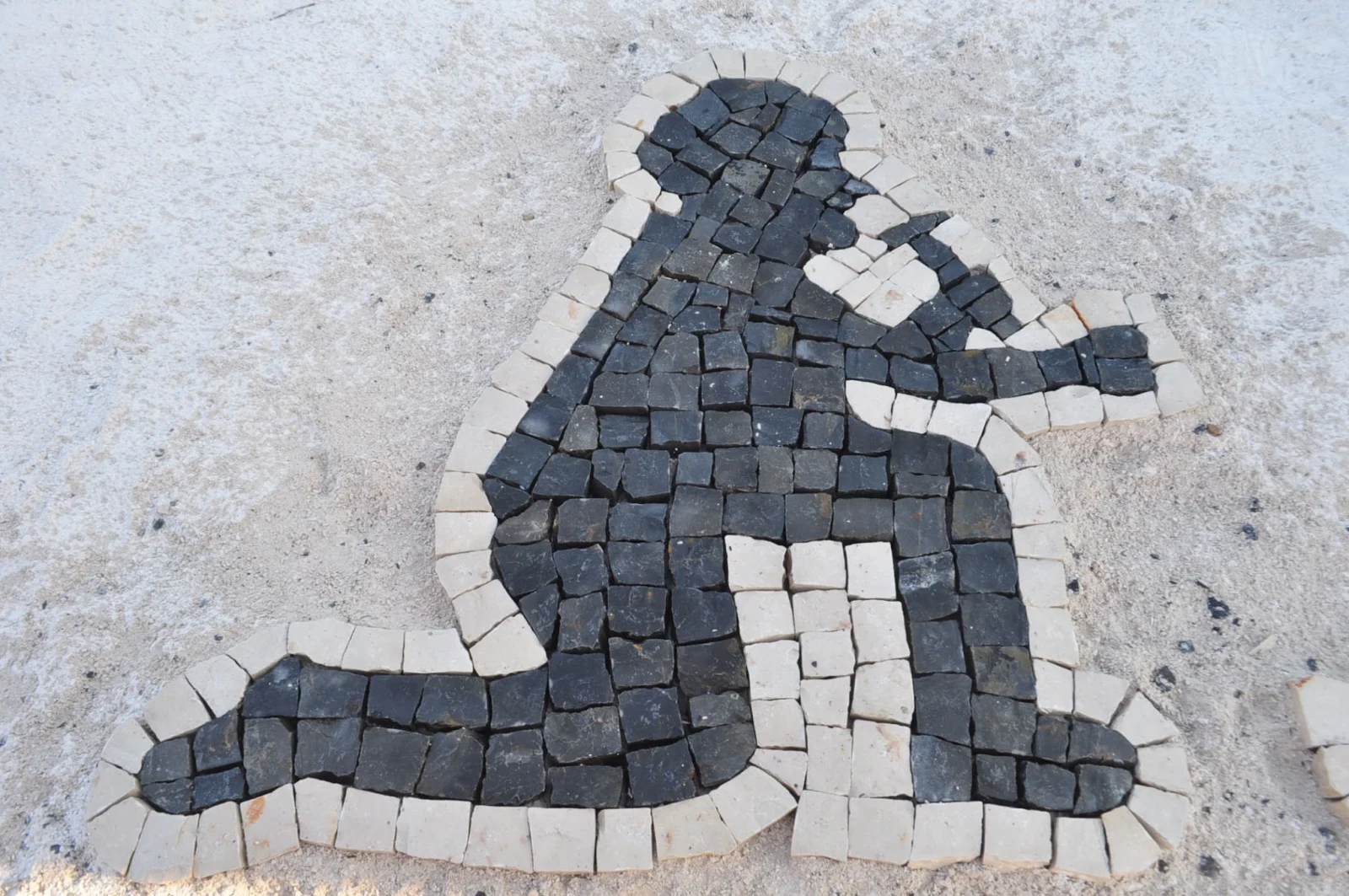
- Restauradores (Praça dos Restauradores). Here stands the monument to the paviours, Homenagem aos Calceteiros. One of the figures works right at ground level. His posture gives a sense of what laying a pattern across a whole square involves.
- Avenida da Liberdade. Wavy motifs return along the wide side promenades. Here the pattern stretches along the boulevard and reveals itself gradually as you walk.
Portuguese pavement route on Visit Lisboa
For the 40th anniversary of Lisbon’s schools for paviours and gardeners, the Municipal Archive has opened a free exhibition, Lisboa da calçada e do jardim. It runs until 6 March 2027 at the archive’s photographic branch. It brings together photographs, videos and drawings showing how the city’s pavements and gardens have changed. The exhibition at the Municipal Archive