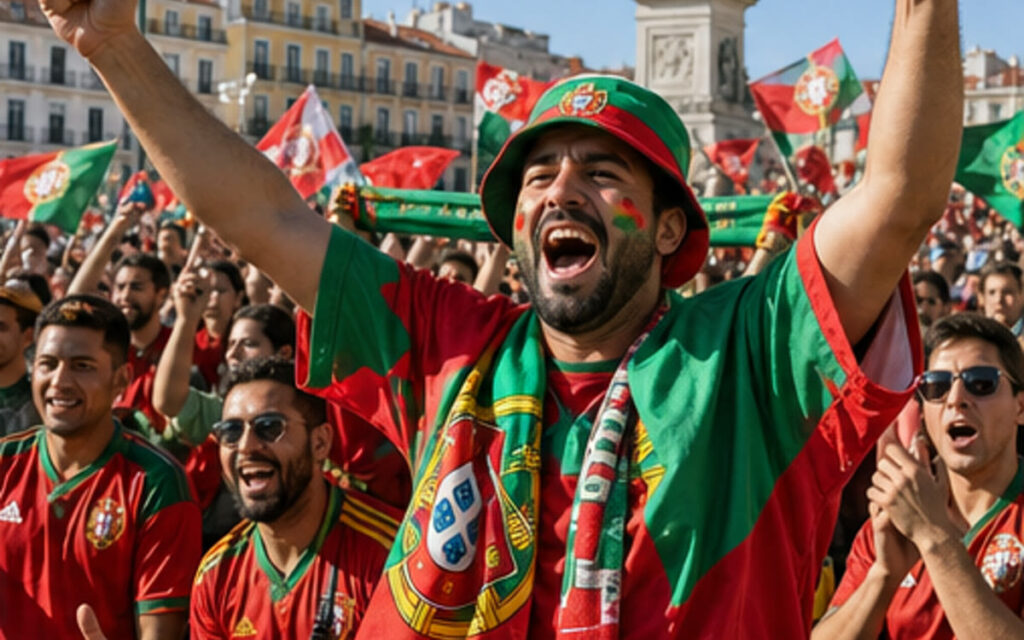
A few days ago, Portugal’s national football team was knocked out of the World Cup bracket, losing to Spain in the round of 16. For 41-year-old Cristiano Ronaldo, this marked a dramatic end to his international career: he never got his hands on a World Cup trophy, even though he’s still, of course, considered one of the greatest footballers of all time. Along with Ronaldo, thousands of Portuguese fans wept, for whom this match felt like a personal tragedy. Journalist and lecturer on Portuguese history Alena Khazinurova explains why football matters so much to the Portuguese.
Football was brought to Portugal (as to many other countries) by the English in the second half of the 19th century. At the time, many Portuguese studied in England, while British engineers and entrepreneurs worked in Portugal. In 1888, Portuguese aristocrat and sports enthusiast Guilherme Pinto Basto — now considered the father of Portuguese football — organized the first exhibition match before the royal court in Cascais.
The first official football match took place on March 2, 1894, in Porto, between teams representing Porto and Lisbon. The Lisbon team won 1:0, and the trophy — made of pure silver — was presented to them personally by King Carlos I.
Over time, football became more than a sport for the Portuguese — it became something closer to a religion under António de Salazar. Like any dictator, he needed ideas that would unite society and distract from real problems. Three such pillars emerged: fado, Fátima, and football (the "three Fs").
The authorities skillfully used the national team’s victories in their campaigns, stoking patriotism and national pride. The entire propaganda machine was built around this: newspapers, radio, and television gave extensive coverage to the team’s successes in state media, shaping the image of a strong, successful nation.
That said, modern historians point out that, paradoxically, Salazar himself wasn’t a football fan and never officially supported or encouraged the game.
Moreover, during his rule it was actually illegal in Portugal to be a professional footballer — the authorities tried to keep any kind of organized community under tight control.
Legally, all players were considered ordinary employees — clerks, mechanics, laborers — who played football in their spare time outside their main jobs. In practice, clubs tried to work around this restriction by paying players bonuses "in envelopes."
After the dictatorship fell, football’s popularity only grew. The biggest star was forward Eusébio da Silva Ferreira, ranked among the ten greatest footballers of the 20th century. He was followed by a "golden generation" of Portuguese players (Luís Figo, Rui Costa, Fernando Couto), who won the U-20 World Cup two years running. Naturalized Brazilian-born Pepe also became a local football legend.
By the end of the 20th century, small Portugal — a country that had already lost its colonial empire and wasn’t among Western Europe’s economic leaders — didn’t have many opportunities left to loudly announce itself to the world. Football success on the international stage filled that gap, becoming perhaps the country’s leading source of national pride.
Cristiano Ronaldo played an enormous role here — a boy from a poor family in Madeira who became the first Portuguese footballer to reach that level of global superstardom.
For a country with a population of around 10 million, that alone was a source of enormous pride.
Portugal’s football phenomenon lies in the fact that local clubs don’t have the money to buy ready-made world stars. So instead, they bet on developing their own players from early childhood — and as we can see, that bet has paid off remarkably well. Sporting, Benfica, and Porto start training kids seriously from age 6–7, so that by the time they’re 20, they’ve become footballers of world-class caliber.
The Ronaldo era came to an end before our eyes: he played his last World Cup match on July 7 in the United States. But as history shows, in Portuguese football, one star is invariably followed by the next. Fans’ attention is now fixed on the national team’s younger players: Vitinha, Nuno Mendes, João Neves, Diogo Costa. Remember these names — we’ll probably be hearing more of them.