
Housing is getting more expensive at an incredible pace — given Portuguese salaries, locals can no longer afford to live in their own country, especially in the capital. The reason is obvious: it seems the country builds almost nothing — at least per resident, Portugal delivers half as much housing as France and the US. Here's how the industry reached its current state and what the government is doing to bring it back to life.
In the first quarter of 2026, housing in Portugal rose in price by 17.8% year over year — Eurostat recorded the fastest price growth in the EU, more than triple the union's average. This has been going on for over a year: since spring 2025, the annual increase has held in the 17–19% range. One of the main reasons is that construction failed to keep up with demand for years. Banco de Portugal calculated that over the past decade the delivery of new housing lagged behind the growth in the number of households by roughly 300,000 apartments and homes.
In the early 2000s the country was delivering more than 100,000 homes and apartments a year, then the industry collapsed, and by 2015 the volume had shrunk to 7,100. Now construction is recovering: in 2025 around 27,300 units were completed, and 42,100 permits were issued — the most since 2011. The state is streamlining approvals, cutting taxes for some projects, converting land for development, and expanding the public housing program, but current delivery still falls short of even half the 2007 level.
Demand ran ahead
Tourists and foreign buyers are most often blamed for the rise in housing prices. Banco de Portugal has a different explanation: the main source of additional demand is population growth. Over the past decade the country gained more households than new housing was built; the accumulated gap came to about 300,000 homes and apartments.
And that's a modest estimate: the bank compared housing built only against the needs of permanent residents. Some apartments are bought by foreigners living abroad, investors targeting short-term rentals, and second-home owners — this housing never reaches local families, so the real shortage is even higher.
In 2025 the annual gap, by the central bank's estimate, largely closed: immigration slowed and construction grew. Only the current flows evened out: enough new housing is being built for new arrivals within a single calendar year, but the overall shortfall accumulated over ten years hasn't gone anywhere.
Too little — how little?
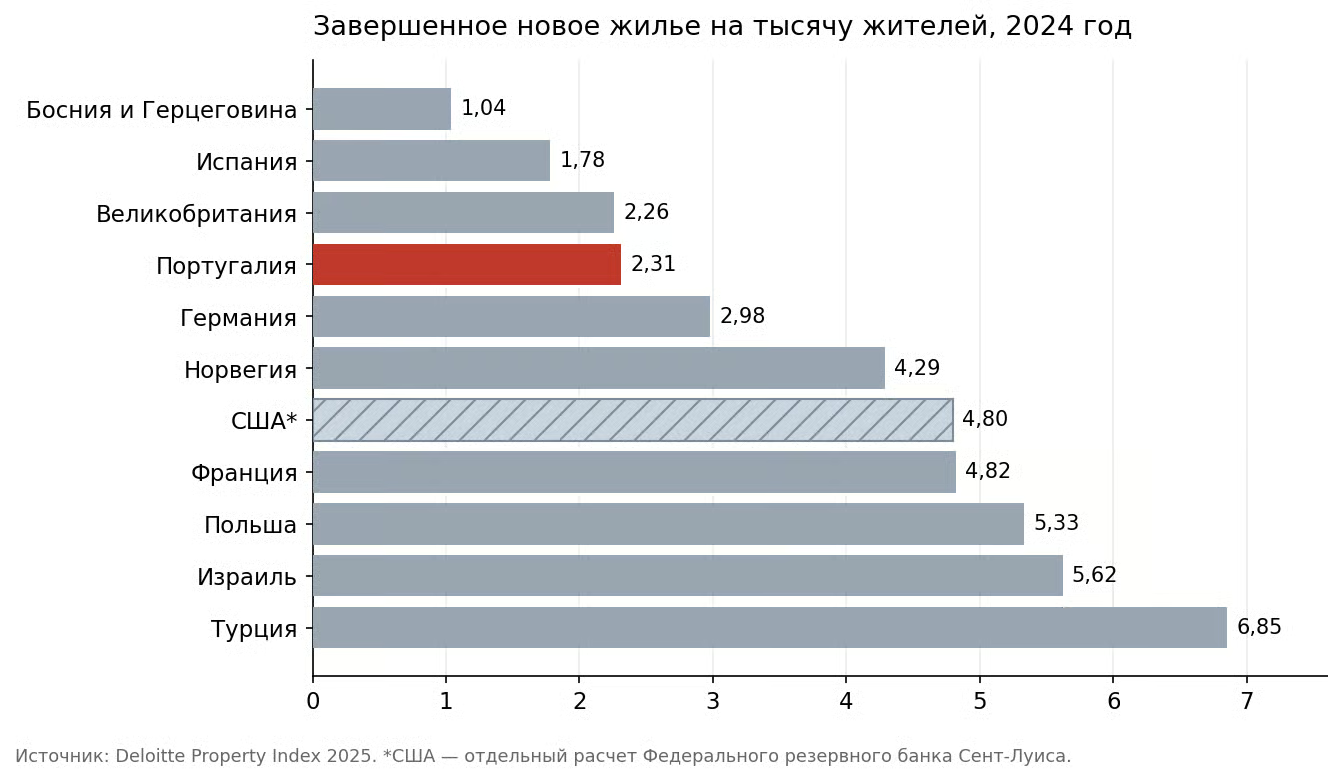
By Deloitte's calculations, in 2024 Portugal delivered 2.31 new homes or apartments per thousand residents — more than Spain with 1.78 and the UK with 2.26, but less than Germany with 2.98 and half as much as France, where the figure reached 4.82. Even in war-torn Israel, according to the same report, there were 5.62 new builds per thousand residents. Portugal can't be called the world's worst, but it lags roughly twofold behind the countries that are actively replenishing their housing stock.
From boom to bust
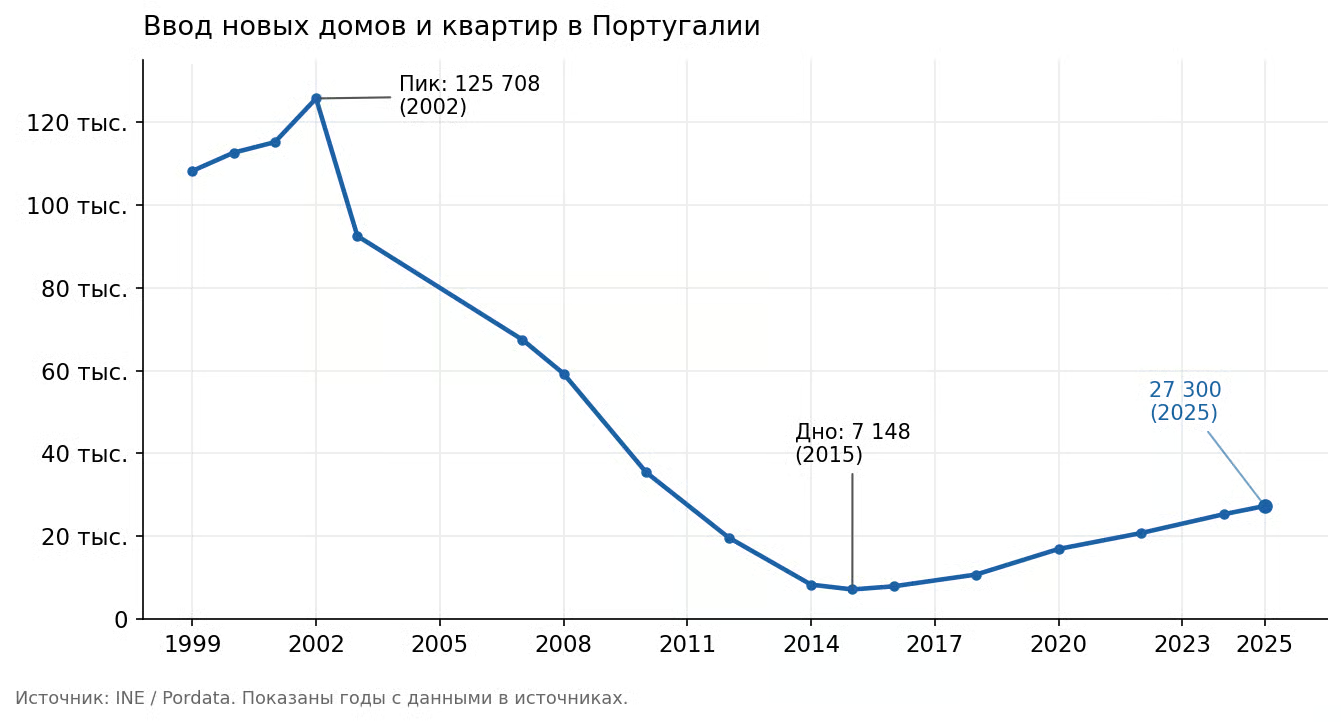
The current level looks modest above all against the country's own past. In 2002 Portugal completed a record 125,700 homes and apartments — the result of a credit boom that the OECD describes as a consequence of cheapening loans and rising incomes.
The boom ended before the global crisis: as early as 2003 delivery fell by a quarter, and by 2007 it had dropped to 67,500 — households had piled up high debts and the economy slowed. Then the industry was hit by the global financial crisis and Portugal's own debt crisis. By 2014 delivery had shrunk to 8,300 units, and the bottom came in 2015: 7,148 homes and apartments, 94% below the peak.
Along with orders, the industry lost its production base — the real capital stock of the construction sector fell by about 30% from 2010 to 2017 and even in 2023 remained 20% below the 2010 level.
The bottom is behind us
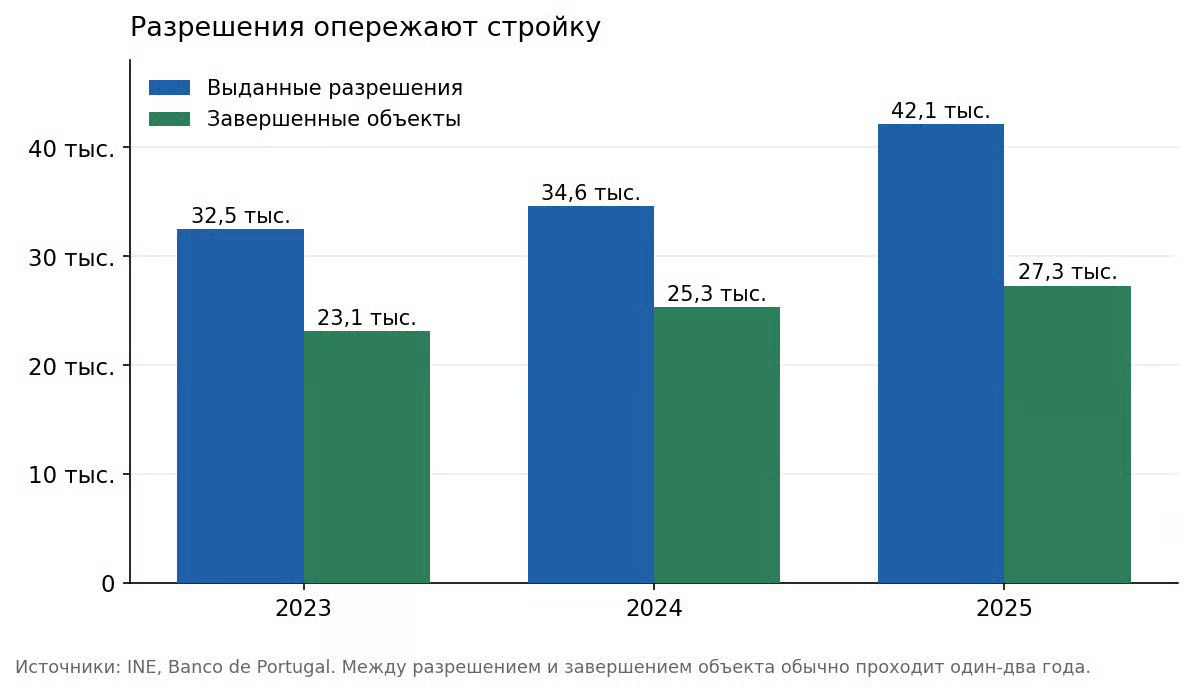
Since 2015 delivery has grown without interruption: 16,900 units in 2020, 25,300 in 2024, around 27,300 in 2025. Building permits, which give a sense of construction in the coming years, are growing even faster: over 2025 municipalities issued them for 42,100 new homes and apartments — more than in any year after 2010.
By Banco de Portugal's estimate, these permits should turn into additional supply within a one-to-two-year horizon, though on their own they won't close the accumulated deficit. The entire increase can't be credited to recent reforms: the rebound began long before the current government packages, and their effect is yet to be measured.
Why so slow
Several barriers at once stand in the way of a fast recovery. Construction companies are short of people: about a quarter of firms name a labor shortage as the main obstacle, and it was closed largely through immigration — the share of foreign workers in the sector grew from 10% in 2019 to 32% in 2025. The industry itself is fragmented: 98% of companies are micro and small businesses, which find it harder to raise productivity and weather downturns. Costs have risen 36% since 2019: first materials grew more expensive, then labor, which added an average of 7.6% a year in 2022–2025.
A separate scourge is procedures. In 2023, obtaining a building permit in Lisbon took an average of 545 days, and in Porto 453, with each municipality having its own requirements and fees. Individual projects got stuck in approvals for three years or longer. Everything was arranged sequentially: a project passed in turn through municipal services, the fire department, and utility networks, and in the historic center also heritage protection. Any authority could send the documents back for revision, and the cycle would start over.
The queues also come down to people. A licensable application has to be reviewed by a relevant specialist at city hall — an architect checks the project against the master plan and building rules, and without their sign-off there's no permit. And it's getting harder for municipalities to retain such staff: the private sector pays more, and competitions for urban planning departments often go unfilled. There's a shortage of buildable land precisely where demand is highest, while vacant housing — about 12% of the stock per the 2021 census — is for the most part located away from sought-after places or in need of repair. The public sector isn't yet able to smooth out the shortage: social housing makes up about 2% of the stock versus roughly 7% on average across the OECD.
What the state is doing
The authorities' response is made up of four strands: procedures, land, taxes, and public construction. In January 2024 they adopted a reform of urban licensing: some permits were replaced with notifications, a tacit-consent mechanism was introduced, and the separate permit for using a finished building was abolished. In practice the reform went with difficulty: city halls were cautious, and banks and notaries treated a "tacit" permit without the usual stamped paper with distrust — without it, it's hard to arrange a mortgage and close a deal. In May 2026 the government approved a new version of the rules — the main part of which takes effect in August.
The land reform of late 2024 allowed municipalities to convert rural land for residential development on the condition that at least 70% of the above-ground built area goes to public or moderately priced housing. The tax package of May 2026 temporarily cut VAT to 6% for construction and renovation projects meeting a number of conditions. The public housing program was expanded to 59,000 units by 2030 with €4.2 billion in funding; by May 2026 more than 20,000 homes and apartments had been handed over to families.
The OECD considers the direction correct but proposes going further: harmonizing requirements and timelines across municipalities, helping smaller ones pool planning specialists, and shifting part of the tax burden from transactions to ownership. A separate block of recommendations concerns vacant housing: defining such properties more broadly and financing their repair — without which around 350,000 vacant homes won't return to the market.
From permits to finished homes
Portugal has indeed bounced off the bottom: construction has grown for the tenth year running, permits are at a multi-year high, and the measures adopted target real bottlenecks. At the same time, current delivery is about 40% of the 2007 level, the accumulated deficit is measured in the hundreds of thousands of units, and a significant part of the reforms only took effect in 2026.
The main test lies ahead: over the next year or two the record permits need to turn into completed homes — and affordable ones, precisely where demand is concentrated: in Lisbon, Porto, on the coast, and on the islands. If that doesn't happen, there'll be no talking of a steady and rapid exit from the housing crisis.