
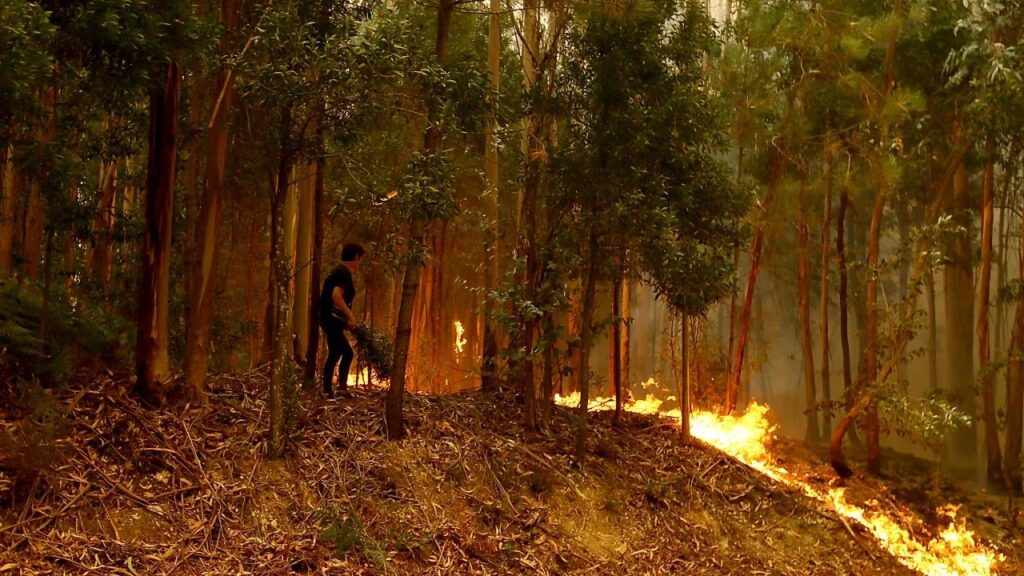
Portugal is going through a difficult period of wildfires. According to the Copernicus Earth observation program, Portugal has come in second in the EU for the size of burned territory relative to the country's area — about 0.3%. Only neighboring Spain is worse off, with around 0.4% burned. Here's what's known about the fires in Portugal and Europe as a whole — and what to expect going forward.
Fires in Portugal
Even if your home stands far from the forest, a fire can still reach you — through the air. Smoke from the blazes in northern Portugal has been carried tens, if not hundreds, of kilometers in these weeks.
In early July, air-quality monitoring recorded spikes of harmful PM2.5 particles in the districts of Braga, Aveiro, and Viseu — that is, in the air breathed by the residents of entire regions. Such smoke aggravates asthma, respiratory illnesses, and cardiovascular disease. According to Copernicus, air pollution from wildfires causes thousands of premature deaths in the EU every year.
People are now being evacuated from their homes, sometimes without time to gather their belongings; some are losing their animals, homes, and harvests. Portugal's Interior Minister Luís Neves described the situation with the phrase "powder keg": dry ground after record heat ignites from the slightest spark.
That's precisely why all the districts of northern and central Portugal, as well as the Algarve, were placed at the highest level of fire danger.
What's burning in Portugal
One of the season's largest blazes was the fire in the Vouzela area in the central part of the country. The fire broke out on Thursday and by Sunday had swept through about 13,000 hectares. More than 1,200 firefighters battled it, supported by nearly 400 vehicles and 15 aircraft. Spain and Italy sent help, dispatching firefighters and aircraft. By Monday, according to emergency services, about 80% of the blaze had been brought under control, though dangerous spots remained.
The north of the country also came under threat. In the second half of Saturday, a fire flared up in the Melgaço area, on the Portuguese bank of the Minho. Portuguese firefighting services recorded the blaze around noon on Saturday and reported roughly eight hours later that it had been brought under control.
Things went differently in Valpaços (Vila Real district), where the front remained active for six days. Wind and steep terrain complicated the deployed crews' work for hours. According to civil protection, the fire in northern Valpaços, fought by around 800 firefighters, left five people injured. Spreading into the Bragança district, the fire hit agriculture hard: 2,000 hectares of olive groves and vineyards were destroyed in the municipalities of Mirandela and Vinhais. Restoring them could take years. The government has already announced compensation — damage up to €10,000 is reimbursed in full, and for larger losses (up to €400,000) co-financing of at least 50% is provided.
Earlier still, on Monday, July 27, a major wildfire broke out in the municipality of Vila Verde. For several days about 200 people worked to bring the fire under control.
Fires in the border zone (raia) often jump across the border, so cooperation between Portugal and Spain on this matter is routine.
Is there any way to help?
Aid for those affected is already organized, and anyone can join in. For example, there's the Portugal Ajuda platform — it directly connects those affected with volunteers. Through it you can offer or request shelter, food, clothing, medicine, transport, psychological support, and help with rebuilding homes or caring for animals. Those affected are also supported by the national Caritas network.
Physical donations are accepted at the fire stations nearest to the blazes and from local volunteer firefighters (bombeiros voluntários). What's needed most is still water and juices in individual packaging, as well as cookies in single-serving packs.
Importantly, not everything here depends on the elements: since the start of the year the national guard (GNR) has detained more than 150 people on suspicion of involvement in wildfires. That said, far from all of them are arsonist troublemakers. Many blazes arise from carelessness: a spark from machinery, garden waste burned at the wrong time, a cigarette tossed into dry grass. In heat, low humidity, and wind, that's enough for a major fire to flare up within minutes.
On track for the worst year on record
The European Union as a whole may now be heading for the worst fire season on record. According to the European Forest Fire Information System, about 1,200 fires were recorded in the EU in 2026 — more than double the average annual figure of 569.
Spain has been the hardest hit in the EU — over 200,000 hectares burned, about 0.4% of the country's territory. On Sunday the country's prime minister, Pedro Sánchez, said that more than 90,000 people had been forced to leave the areas around Madrid and Ávila. The fire in Ávila became the largest in Spain since fire records began in 1961 — it swept across an area of about 50,000 hectares. By Thursday, July 30, the authorities reported no "active blazes."
In the Madrid region alone, by preliminary estimates, at least a hundred homes were destroyed, and the head of the Madrid region, Isabel Díaz Ayuso, warned that the figure would grow.
France has had a hard time too, with about 260,000 people evacuated, and the southwestern department of Gironde hit the hardest. A megafire that destroyed about 240 homes in the southwest became the strongest in France since 1949.
By Thursday, July 30, active blazes persisted, but after rain the fire spread less aggressively. More than half of those evacuated were able to return home. There were no human casualties, but rescuers are searching for dead animals — in Lège a separate crew was even hastily created for this task. A fire near Brignoles on Wednesday night forced George Clooney and his family to leave their estate.
Earlier, in early July, fires had already raged across southern Europe. Back then the flames swept through nearly 20,000 hectares in Portugal, Spain, France, and Greece, and spectators were barred from a Tour de France stage in the Pyrenees. In the foothills of the French Pyrenees near the Spanish border, 700 firefighters battled an out-of-control blaze that swept 5,000 hectares and forced the evacuation of more than 10,000 people. The EU sent France four water-bombing planes from Cyprus and Sweden.
The EU warned that fire-favorable conditions had also set in across the center of the continent. The flames spread to Greece, Portugal, and Turkey. On the Greek island of Crete, 8,000 people were evacuated on Wednesday night, where two firefighters died, and another died near the port of Gythio in the Peloponnese. In Turkey, firefighters battled at least 115 active blazes, primarily in the provinces of Antalya and Muğla on the Turkish Riviera and along the Dardanelles coast. The authorities reported that 110 of them were fully under control. Major fires also destroyed forest, vineyards, and scrub on the Croatian island of Hvar and in Tale, Albania.
Is this all because of global warming?
Scientists link the heat waves and severe drought in Europe to climate change caused by human activity. The current fires were preceded by premature heat in May and heat in June that broke temperature records in western Europe, caused thousands of excess deaths, and left vast areas especially vulnerable to fire.
The scale of burned territory keeps growing. According to Copernicus, by July 29 the total area swept by fire in the EU had already reached 457,459 hectares — that's 31.8% more than on the same date a year earlier, and almost double the area of Luxembourg.
The fires' carbon footprint is growing too. By the estimate of the EFFIS system (Copernicus), the 2026 blazes have already released about 18 million tons of CO₂ into the atmosphere — for comparison, the average EU resident leaves a carbon footprint of roughly 5.55 tons over an entire year.
In the long term, scientists don't expect improvement. According to research, climate change will very likely increase both the length and the intensity of the fire season, and fire-prone areas will expand.
For Portugal — one of the continent's most fire-vulnerable countries, where over the past four decades an average of 100,000–115,000 hectares burned annually — the forecasts are especially alarming: under high-emission scenarios the number of wildfires could grow by roughly 21% by the end of the century.
For the Mediterranean as a whole, the area of burned land could increase by 40–100%, depending on the warming scenario. What's more, the lengthening of the fire season that climatologists predict for the whole of this century has, judging by the data, already arrived in Portugal: the peak of danger has shifted to late spring and early summer, and June is increasingly becoming a genuinely fire-prone month.