
There is a month when Portugal stops answering. It doesn’t slow down or work at half capacity—it simply stops answering. Emails vanish. Phones ring in empty offices. On the door of the workshop that promised to finish “next week” hangs a sign reading encerrado para férias—closed for holidays—often with no return date, because everyone is assumed to already know it. The lawyer handling your case will reply in September. So will the doctor you booked in spring. Your accountant is somewhere in the Algarve, probably, but no one can confirm it.
Some people put this down to national temperament, but that explanation is both wrong and useless. Portugal’s August shutdown has authors, dates, legal grounds and a history almost a century long.
Here’s what you actually can’t get done over the coming weeks, why the system is built this way, how Portuguese August differs from the Spanish or German version—and what still works.
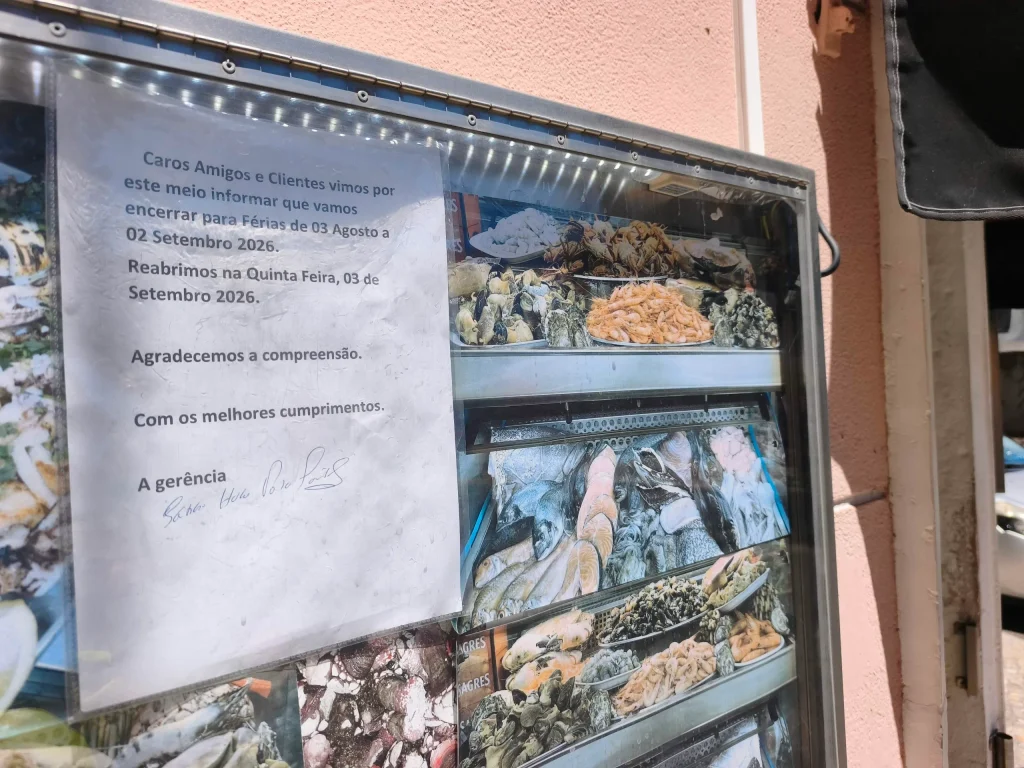
Dear friends and customers, We would like to inform you that we will be closed for holidays from August 3 to September 2, 2026. We will reopen on Thursday, September 3, 2026. Thank you for your understanding. Kind regards, Management.
What You Won’t Be Able to Do
Start with the bad news, since it’s usually the part people soften.
Move a court case forward. The summer judicial recess runs from mid-July through the end of August. Non-urgent hearings simply aren’t scheduled, and judges and lawyers go on holiday. A claim filed now effectively starts moving in September.
Close a property deal on time. The escritura—the final step of buying or selling real estate—runs through an entire chain of institutions and people: notary, bank, lawyer, tax office, sometimes the municipality. In August, it takes just one link taking holiday for the whole chain to fall apart. Notary offices close for two weeks at a stretch, and banks’ credit departments run on skeleton staff. If your contract has an August deadline, plan on moving it.
Get a municipal decision. A building permit, a licence, an approval from the câmara municipal (town hall)—urban planning departments run on minimum staff over summer. Your application will be received, but the decision comes in autumn.
See a doctor for anything non-urgent. Your family doctor is on holiday, a stand-in isn’t guaranteed, and a specialist appointment will most likely slip to autumn. What does keep running is emergency care and the SNS 24 helpline—the channels built for genuine emergencies.
Find a tradesperson. Plumbers, electricians, air-conditioning technicians are either on holiday in August or booked two weeks out. A leak in mid-August is its own particular Portuguese experience.
Settle anything that needs two signatures. Any deal, approval or negotiation that needs several people with authority to sign off is essentially impossible in August. One person is on holiday, the second just got back, the third leaves the day after tomorrow.
Speed anything up at AIMA. The immigration system isn’t fast in a normal month. In August, summer schedules and staff holidays pile on top of that.
Now the short piece of good news: hospitals and emergency care keep running, as do pharmacies, police, public transport, airports, supermarkets, bank branches at a basic level, and the entire tourism sector, for which August is peak season. Government portals—Portal das Finanças, Segurança Social Direta—stay open around the clock, but the person on the other side of the form is back in three weeks.
What closes first is the part of the economy where there’s no one to cover a shift. This is a common story in Portugal: the economy here largely runs on micro-businesses of three to five people, and when the owner goes on holiday, the whole business goes with them.
Where It Came From
“Was this a Salazar-era thing, or older?” turns out to have a surprisingly precise answer.
Paid leave first entered Portuguese law in the 1930s, inside the corporatist framework of the Estado Novo. In 1935, the government created the Fundação Nacional para a Alegria no Trabalho—the National Foundation for Joy in Labour, FNAT. The name sounds almost comic, but the organisation was entirely serious: it built summer camps for workers and their children, ran excursions, organised film screenings and gymnastics. Portuguese historians point directly to its models—Italy’s Dopolavoro and Germany’s Kraft durch Freude. The idea wasn’t so much to give people rest as to organise that rest in a way the state considered proper.
A formal right to paid leave was in place by the end of the 1930s. But unions point out that before 1974, this right, where it functioned at all, functioned at half strength: at best, a bit over a week off a year, and only after several years of unblemished service. Leave became a mass phenomenon only after the Carnation Revolution of 1974, when twenty-two working days plus a holiday allowance entered both the law and the average worker’s life.
Emigration then began shaping the picture. In the 1960s and 70s, entire generations from Portuguese villages left to work in factories across France, Switzerland, Luxembourg and Germany. European industry shut down for the holidays specifically in August—and a custom took hold that still holds today: in August, villages welcome their own back, and the entire calendar of village festivals is built around that return.
The third layer is institutional. Absent an agreement with the employee, the labour code allows the employer to schedule leave only within the warmer half of the year—the law effectively mandates a summer holiday. A neighbouring article lets an employer close the whole business, but not indefinitely: a simple closure is capped at fifteen consecutive days, and anything longer needs a separate legal basis—a collective agreement, a works-council ruling, or the nature of the business itself.
How This Differs From the Rest of Europe
“Isn’t all of Europe dead in August anyway—what’s special about Portugal?” is a fair objection, but only a partial one.
Start with the counter-example. Germany actively fights this kind of synchronisation. School holidays across the federal states run on a rolling schedule: some states break in late June, others in early August, and education ministers renegotiate the rotation every year—specifically so the whole country doesn’t grind to a halt at once.
In Sweden, the national pause falls in July. The logic is climatic: mid-July gives the best odds of real summer weather. Finland and Norway run on a similar calendar. For a Scandinavian, Portuguese August is already too late for a proper summer break.
The closest relatives are Italy, Spain and France. Even among them there are differences. France splits between people who holiday in July and people who holiday in August. In Italy, the peak compresses around Ferragosto in mid-month, but the big cities keep serving tourists and running on their own rhythm. Spain is the nearest relative, but built as a mirror image: there, the whole of August is a non-working period for judicial proceedings by direct statute of the law on judicial power, yet there is no labour-law restriction at all requiring leave to fall in the warmer half of the year—dates are set by collective agreement and mutual arrangement.
That produces a distinctive feeling you won’t find in Madrid or Milan: the country in August doesn’t so much empty out as regroup—just not where you’d think to look.
Does the Economy Actually Stop?
No need to overdramatise: the economy doesn’t shrink in August, it redistributes. Industry genuinely dips—collective factory and construction-site shutdowns are visible to the naked eye. Tourism, meanwhile, runs at full stretch, and for a country where services generate the lion’s share of added value, the holiday month turns out to be a reshuffling rather than a loss.
Economists who calculated the cost of days off concluded that the effect of public holidays and leave days on annual GDP is modest. And Portuguese productivity, which lags noticeably behind the European average, hasn’t grown over the years that leave entitlements were trimmed. In other words, August isn’t the source of the country’s economic troubles.
The other economic issue concerns the holidaymakers themselves. Every employee in Portugal has the right to paid leave—not necessarily the money to use it. According to recent Eurostat data, roughly one in three Portuguese residents can’t afford a week away from home. That’s noticeably worse than the EU average, though far from the worst figure on the continent. And a large share of the people who are “on holiday” in August are spending it at home, with relatives, or in the village their family once left.
What to Do About August
You’ve probably already read the universal advice—”get everything done in July”—back in June. It’s useless now, so here’s what actually helps.
Reassess your plans. Anything that needs a live person with authority—a signature, a negotiation, an approval—is realistically a second-half-of-September task. Trying to force it through in August costs nerves and usually doesn’t work anyway. What August is genuinely good for is the stuff you’ve been putting off: sorting paperwork, finishing anything that needs quiet and focus rather than someone else’s signature.
“Closed” rarely means “until September.” Fifteen consecutive days is the legal maximum for an ordinary holiday closure. If the sign on the door has no date, it’s worth just calling—the odds that the workshop reopens in a week or ten days are better than they feel in the moment of frustration.
Online channels work while offices don’t. Portal das Finanças, Segurança Social Direta and AIMA’s electronic submissions don’t take holidays. Even if the reply comes in September, filing now locks in the date—and in bureaucracy, the filing date often matters more than the speed of the reply.
Check the specific office, not just the agency. Summer schedules are published on individual Loja de Cidadão (citizen service office) pages—Aveiro, for example, or Coimbra—each with its own shortened hours and closed services. Check current addresses and hours for AIMA offices before you leave the house, not after.
Watch the bureaucratic deadlines. The suspension of procedural deadlines works in your favour too—a month and a half of summer doesn’t eat into your time to respond. But if your case falls into an urgent category, that grace period doesn’t apply to you: deadlines run as normal, and August is the easiest month to sleep through one. Separately: tax and reporting obligations don’t go anywhere, even if your accountant is in the Algarve.
Prepare for August on the practical, everyday level. Your family doctor may be on holiday with no guaranteed stand-in. Renew prescriptions for ongoing medication this week rather than at the end of the month. Find the duty pharmacy through INFARMED’s search tool or the service on gov.pt, and use the SNS 24 line for consultations. And line up two or three backup contacts for a plumber and an electrician now, before you need them.
Prices for domestic trips vary sharply. The coast is at peak prices and peak crowding right now. If your trip isn’t tied to a specific spot, look inland instead: while the coast is packed, the interior is having its best month of the year. Village festivals run one after another, and this is exactly the Portugal you can’t see during the other eleven months.
The main point. If you’ve emigrated from a country with a different rhythm, it’s worth understanding one thing: arguing with this is pointless, but planning around it is entirely doable. Treat the working year here as eleven months long. Do that, and August is far less likely to become a source of irritation.