
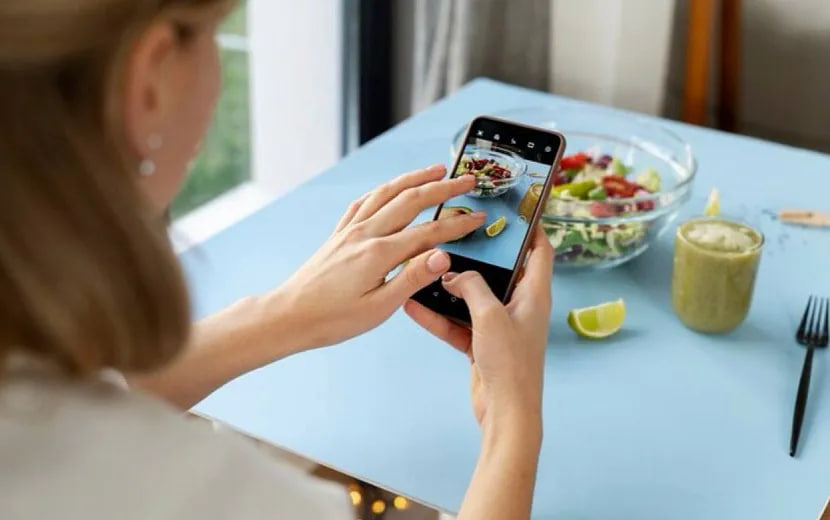
For a long time, full-scale influencer marketing was a tool reserved for large companies: you had to find bloggers, vet their audiences, negotiate terms, monitor the posts, collect the statistics, and figure out whether the campaign had worked. The Portuguese startup Rippla has turned that same process into a service for a small restaurant, bar, spa, or hotel: the business pays around €100 a month, sets the parameters of the audience it wants, and gets access to bloggers willing to work on a barter basis. Nika Borisov spoke to the startup’s founder, Maria Donskikh, for Xpat.Land about how she came up with the idea and the challenges she has faced along the way.
From L’Oréal and Nestlé to small business
Before moving to Portugal, Donskikh worked in marketing for international brands including Nestlé, Danone, and L’Oréal. After her forced emigration, she no longer wanted to continue a corporate career.
The idea for a new business came about almost by accident. While staying at a quinta in northern Portugal, Donskikh got to know its owner. When the owner learned about her guest’s marketing background, she asked for help attracting customers.
Simply becoming a consultant for one small hotel didn’t interest Donskikh, so she started thinking: could the marketing technologies and tools used by large corporations be made accessible to thousands of small companies?
The relationship between a business and a creator is based on barter. A restaurant can treat a blogger to dinner, a spa can offer a treatment, a hotel can provide a room.
In return, the influencer publishes pre-agreed content — for example, a Reel and a few Stories — and, if needed, leaves a review on Google, TripAdvisor, or Apple Maps. Everything else, as Donskikh envisioned it, is automated by Rippla. To get started, a business registers on the platform and specifies who it wants to attract: audience age, geography, and other parameters.
For the European market, the geography of the followers themselves is especially important. A Portuguese-speaking blogger with hundreds of thousands of followers won’t necessarily help a restaurant in Lisbon: most of their audience might be located in Brazil, for instance. That’s why Rippla analyzes not only the influencer but also their audience.
The startup doesn’t collect this data manually: there are specialized companies on the market that analyze accounts’ followers, posts, comments, views, and other metrics. Rippla buys the data from one such provider.
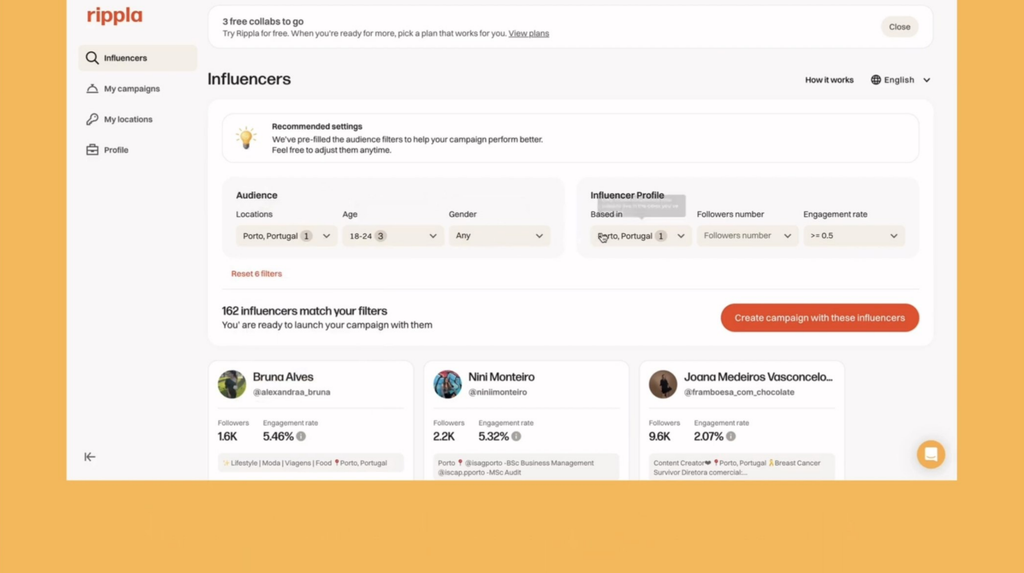
Once the audience is set up, the business creates an offer: for example, dinner for two in exchange for one Reel and three Stories. Only bloggers who match the specified parameters can see it. From those who respond, the restaurant picks the ones it likes. From there, Rippla monitors whether the agreements are fulfilled and collects the campaign results.
Ekaterina Plotnikova, owner and brand chef of the Borboleta restaurant in Porto, works with Rippla and speaks positively about the collaboration.
“Independent projects have always relied on word of mouth for PR, and it was only thanks to word of mouth that places became popular,” she says. “With them, I can write the brief myself, define the target audience, choose bloggers, research them, look at the results of their work — and most importantly, once I start working with bloggers, I can immediately feel the results, not just in the number of followers but in increased revenue.
It’s transparent to me: what the blogger has to do, what I’ll get, and how much it will cost me. And I’m not chasing anyone or asking when the content will be ready.”
The startup began in Portugal, and it is still registered there today. Now, however, it also has clients in Spain and the UAE, in roughly equal proportions.
Why would a blogger want a free dinner?
At the start, Donskikh had doubts about one of the key parts of her own model: she thought only very small bloggers would be willing to work for barter. Her fears turned out to be unfounded — the platform has influencers with 100,000 followers or more, which is already a substantial audience for the small Portuguese market.
The thing is, a blogger needs more than a free dinner: they constantly need new content. An unusual restaurant, a national cuisine, a beautiful hotel all become material for the next Reel. What works especially well is something the blogger’s audience hasn’t seen before. Donskikh recalls a Ukrainian restaurant to which Rippla sent Portuguese influencers with large followings — borscht, horilka, and appetizers unfamiliar to the local public easily caught the interest of both the bloggers and their followers.
The platform also has people who don’t consider themselves professional influencers at all: doctors, lawyers, schoolteachers, and university lecturers with sizable lifestyle blogs — in short, people for whom creating content isn’t their main job.
Why a restaurant pays €100
Today Rippla’s team consists of just five people, and the rest of the work is done by artificial intelligence, Donskikh says. “In my investor deck there’s a team slide. Half the slide is people: Masha, Anya, Dima, and so on. The other half is AI agents.”
The main constraint of Rippla’s model is built into its price: a restaurant pays around €100 a month to use the platform and can run many barter collaborations, while the influencers themselves receive no money. But out of that €100, the startup has to buy data, maintain servers, develop the product, do marketing, and pay its staff.
“Who can you hire for 100 euros?” Donskikh says. “None of my economics would add up if it weren’t for AI.”
AI agents help support users, check that promised content appears, remind influencers about posts, and collect results. According to Donskikh, the initial development of the platform cost about €300,000; if the same product were built today, it would cost less, since some of the code and internal processes can now be handed off to AI.
Ten thousand influencers
In just over a year, around a thousand restaurants have gone through Rippla, and more than 10,000 influencers have signed up on the platform. Hundreds of business clients of various types use the service on an ongoing basis — not only restaurants, but also spas, workshops, and hotels.
In Portugal, much of the growth among bloggers is already happening organically: users recommend the platform to one another. Rippla’s main markets today are Portugal, Spain, and the UAE, primarily Dubai and Abu Dhabi. The latter turned out to be important also because of seasonality: when Southern Europe is in high tourist season and restaurants need less additional advertising, Dubai is in its low season, and a few months later the situation reverses.
There are other differences too: according to Donskikh, influencers in Dubai are less reliable, so the automated system has to monitor more closely whether the promised content has appeared and send reminders about posting.
Can a blogger’s impact be measured?
Influencer marketing remains a hard channel to measure: a restaurant owner can’t always tell why the place is packed on a Friday — because of yesterday’s Reel, the good weather, or simply because the weekend has arrived.
Rippla uses several evaluation methods. The most direct is a promo code: for example, a specific blogger’s followers are offered a complimentary glass of wine, and the restaurant can see how many guests came after the post. Another metric is the total number of views of the content, which can be compared with the cost of equivalent reach through conventional media advertising.
But sometimes the result is visible without any sophisticated analytics. One of Rippla’s clients in Dubai wanted to attract a Turkish audience. The platform matched them with a Turkish journalist with the right followers. Her Reel got only about two thousand views — a result Donskikh initially considered a flop. But after the post went up, Turkish customers started coming to the restaurant: for a local business, two thousand of the right viewers proved more valuable than tens of thousands of random ones.
On money and scaling
Donskikh initially invested around €300,000 of her own money in Rippla. The startup then raised another €500,000 at a €5 million valuation, in a round that included two funds and six private investors. The company isn’t planning a new funding round for now — Donskikh expects to reach operational break-even by the end of the year. Rippla was also accepted into the Unicorn Factory Lisboa accelerator program, which gave it €10,000 — but most importantly, Donskikh says, it provided access to investors, potential clients, and the Portuguese media.
Hotels have become Rippla’s next stage. Until recently, there were only about a dozen of them on the platform: selling a new marketing tool to a hotel is harder than selling it to a small restaurant, but hotels have more purchasing power and, according to the team’s observations, stay with the platform longer.
In addition, a single hotel effectively combines several businesses at once: it has rooms, a restaurant, and often a spa, and each of these needs different influencers. For a Sunday brunch, the restaurant might need a blogger with a Lisbon audience, while for selling rooms, the same hotel would be more interested in someone whose followers live in London and might be willing to fly to Portugal for the weekend. For Portuguese hotels, Donskikh says, a British audience is one of the most frequent requests.
Artificial intelligence has sharply reduced the cost of developing and maintaining a product. But at the same time, a new problem has emerged.
“In the age of AI, the hardest thing is getting through to your customer. Products are now churned out overnight, but only those who truly understand the customer’s pain and can tell their story about it very loudly will survive,” Donskikh says.