
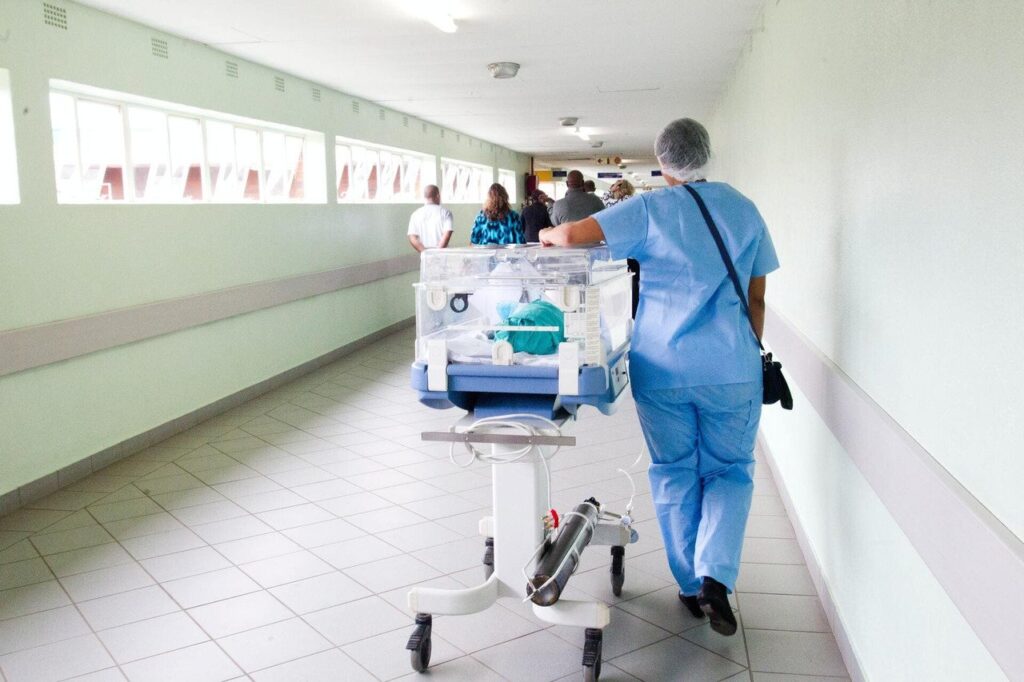
Portugal's public health service (SNS) has officially admitted that it cannot clear the queues for consultations and operations — there aren't enough doctors and nurses. About 1.6 million residents of the country don't have an assigned family doctor. By OECD (Organisation for Economic Co-operation and Development) standards, the system is short roughly 10,000 doctors and 33,000 nurses. Portugal has been through a similar crisis before, and once already found a solution. Here's what it was.
How it worked in the 2000s
In the late 1990s and early 2000s, a wave of immigration from the former USSR poured into Portugal: Ukrainians, Moldovans, Russians, Belarusians. Among the arrivals were hundreds of certified medical professionals, and almost all of them worked outside their field. The newspaper Público at the time described a cardiologist painting walls on a construction site, a neurologist working as a housekeeper, and a general practitioner working as a locksmith.
Back then the Calouste Gulbenkian Foundation, together with the Jesuit Refugee Service and the Ministry of Health, launched a program to recognize the qualifications of immigrant doctors: paid Portuguese courses (both general and medical), stipends during the preparation period, reimbursement for document translations and Medical Association fees, subsidized hospital internships, and personal support all the way through to employment. The exams, meanwhile, were not waived for anyone. As a result of the two programs, 174 immigrant doctors joined the SNS, among them 45 Ukrainians; together with a similar project for nurses, the system gained more than two hundred specialists.
The program was studied as an exemplary case of integration at Heidelberg University, and the Ukrainian foreign minister made a special visit to the foundation to thank it for helping émigrés.
The rules were simplified, but the number of doctors didn't grow
Formally, today it's easier than ever for a foreign doctor to enter the Portuguese system. Since October 2023 there has been an exceptional regime for recognizing foreign medical diplomas for hiring into the SNS — it has been extended to December 31, 2026, and diplomas already recognized in another EU country are accepted automatically. The result is visible in the statistics: 4,808 foreign doctors work in the country, a third of them Brazilians, who are about to overtake the Spanish as the largest foreign group in the profession.
And yet the hole isn't closing. There's a shortage of about 800 family doctors, and emergency departments periodically close. The causes are internal: a young specialist's salary has fallen over ten years from 6.2 times the minimum wage to four, more than 4,000 doctors have left the country over the past five years, and private clinics are actively poaching staff.
Ukrainian doctors who arrived after February 2022 go through the standard procedure: recognition of the diploma at a medical faculty with theoretical and practical exams, then a medical communication exam at the Medical Association. The support infrastructure that existed in the 2000s no longer exists, and on top of the university language exam in Portuguese there's also the Association's communication test.
Can the old experience be revived, and what would it give
Returning to the 2000s model isn't technically difficult: it requires no changes to the law, only funding for the support system. The Gulbenkian Foundation itself launched a new Integration Initiative in 2026, with grants for projects on language training and employment for immigrants — meaning the framework for bringing back the doctors' program essentially already exists.
The effect would, on the one hand, be fast and targeted: by the estimate of the head of the Medical Association, from specialists already living in the country alone, the SNS could gain at least 50 doctors at once who don't require six years of study and specialization. For a system where maternity wards are closing, that's not a small thing.
On the other hand, there should be no illusions: a shortage of ten thousand doctors can't be closed by integration programs. As long as public medicine loses out to private and foreign options on salaries and conditions, any influx — Brazilian or Ukrainian — won't cover everything.
But the experience of the 2000s proves the main point: the country knows how to turn painters back into cardiologists. It just doesn't want to, for now.