On 30 September Portugal launches its seasonal vaccination campaign against flu and COVID-19 for autumn and winter 2026–2027. The rules have changed noticeably this year. Free flu vaccination now covers children up to the age of four. Seasonal COVID-19 vaccination, on the other hand, now focuses on people over 70 and risk groups. Where you get vaccinated depends on your age and on what makes you eligible for a free jab: some people can book at a pharmacy, others need to go through the SNS (Serviço Nacional de Saúde), Portugal’s National Health Service. Here is who can get vaccinated for free and where to go.
How seasonal vaccination works
Portugal has a National Vaccination Programme — the Programa Nacional de Vacinação. It covers routine vaccines and runs all year round. Seasonal vaccination against flu and COVID-19 is separate. Every autumn the DGS, the Directorate-General of Health, decides which groups are covered for the new season.
The 2026–2027 campaign starts on 30 September. Under the current DGS rules, flu vaccination runs until 31 March. This date may change depending on how the epidemic develops.
The main changes this year concern children and COVID-19: free flu vaccination has been extended to younger children, and the age threshold for the seasonal COVID-19 jab has been raised.
Who gets a free flu jab
Free flu vaccination is offered to everyone aged 60 and over, to pregnant women, and to children from six months up to and including four years old. The new rule this season is free vaccination for children aged two to four. If a child is between six and 23 months old and is being vaccinated against flu for the first time, the DGS recommends two doses.
The jab is free for children from age five and adults up to 59 with a condition that raises the risk of severe flu. The DGS lists these conditions in its rules for the campaign.
There are special groups too — for example, some residents of long-term care facilities and professionals who provide direct medical care. Their criteria are set out in the same document.
Who can get the seasonal COVID-19 vaccine
The biggest change this season is that the age threshold has gone up from 60 to 70. So a 65-year-old with no risk factors can get a free flu jab, but age alone is no longer enough to qualify for seasonal COVID-19 vaccination.
Under 70, the vaccine remains available to people with conditions or circumstances that put them in a higher-risk group. The programme covers residents of long-term care and residential facilities — above all ERPI (residential homes for older people), similar institutions and the RNCCI, the National Network for Integrated Continuing Care. The DGS keeps a separate provision for people living in these more vulnerable settings. Separate rules apply to some healthcare workers.
Where to get vaccinated
If you are in one of the free groups, you can get vaccinated through the SNS. For some adults there is a simpler option: a participating pharmacy.
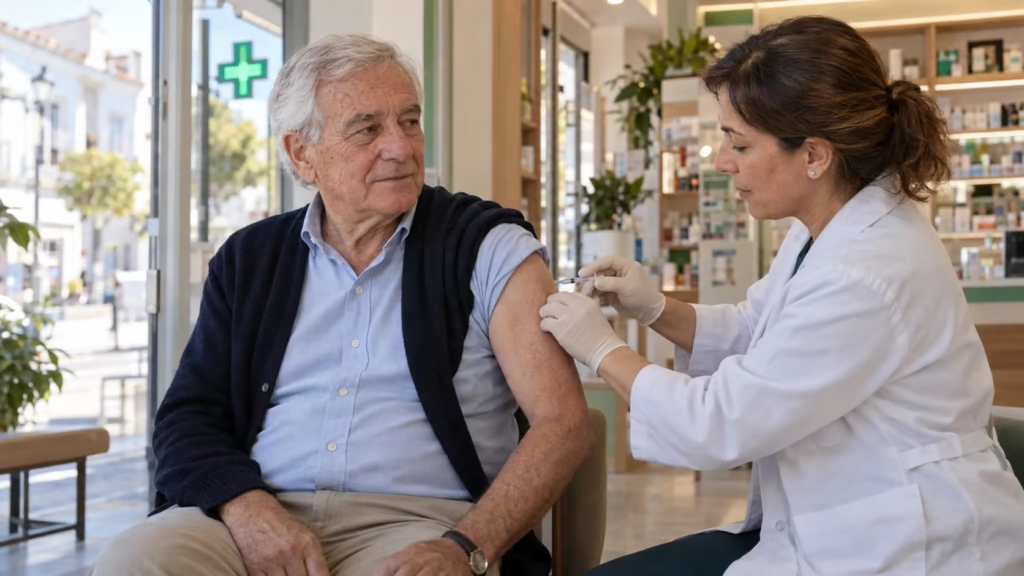
You can get a free flu or COVID-19 jab at a participating pharmacy if you meet the pharmacy criteria for age or health. For flu, that means people aged 60 to 84 and adults aged 18 to 59 with a risk-group condition; for COVID-19, people aged 70 to 84 and adults aged 18 to 69 with a risk-group condition.
People aged 85 and over are vaccinated free of charge through the SNS; the limit of 84 applies only to pharmacies. Children and pregnant women go through the SNS too, unless they have a separate reason to qualify at a pharmacy.
The list of participating pharmacies and online booking are on the Farmácias Portuguesas website. The pharmacy checks your eligibility for free vaccination based on your age or medical information.
If you are not in a free group
You can still get a flu jab. If you are under 60 and do not belong to any of the free groups, a doctor can write you a prescription for the vaccine, which you can then buy at a pharmacy. You pay for it yourself, but the SNS reimburses 37% of the price.
COVID-19 is different: healthy people under 70 with no risk factors are not part of the 2026–2027 seasonal programme. If you think you need the vaccine for medical reasons, talk to a doctor and check whether you fall into one of the clinical groups set out in the DGS rules.
If you don’t have a family doctor
Not having an assigned family doctor does not in itself stop you from getting a seasonal jab. If you meet the pharmacy criteria, you can book directly at a participating pharmacy. If you need to go through the SNS, contact your local health centre (centro de saúde) or ULS (Local Health Unit).
How to register with the SNS, get a número de utente (SNS user number) and manage without a family doctor is covered in our guide to seeing a doctor in Portugal.
Also: protecting babies against RSV
Since 16 September another seasonal programme has been running: protection for children against respiratory syncytial virus, or RSV. It uses not a vaccine but nirsevimab, a ready-made monoclonal antibody. A vaccine prompts the body to produce its own antibodies; nirsevimab supplies them directly, giving passive protection.
Nirsevimab is given free of charge to all children born between 1 April 2026 and 31 March 2027. Another eligible group is high-risk children entering their second RSV season who have not yet turned two by 30 September 2026.
Babies born from 16 September onwards receive nirsevimab in the maternity ward. Those born between 1 April and 15 September receive it through primary care. Premature babies and children in risk groups may receive it through primary care or in hospital. Nirsevimab is not sold in ordinary pharmacies.