
How to See a Doctor in Portugal: SNS, Private Clinics, Insurance and a Family Doctor
There are two main routes to a doctor in Portugal: the state system, the SNS, and private clinics. You can use both at once. A utente number is what opens the state route; private insurance works under a separate contract of its own.
In the SNS the path starts at a centro de saúde — the local primary care centre. That is where a patient is registered, assigned a médico de família, a family doctor, where one is available, and referred for tests and to specialists when needed.
With a private clinic you usually book directly and pay yourself or through insurance. That route is often faster for a routine appointment, but the cover is limited by your contract and it does not replace being registered with the SNS. Below we look at the strengths and the limits of both, and then at what to do when you have a utente number but no family doctor.
How to Choose Between the SNS and a Private Clinic
The SNS is the better fit for continuous care: routine monitoring, vaccination, antenatal care, managing a chronic condition and treatment on a state referral. Its weak point is waiting: access depends on how urgent your case is and on which specialists have capacity. A private clinic will usually let you pick your doctor and your slot sooner, but you pay yourself or use insurance, which may cover only part of the bill.
For an acute problem that is not life-threatening, the state route is best started with a call to SNS 24: they will assess the symptoms and tell you where to go. If life is at risk, call 112 straight away. Private insurance may include urgent care, but which clinic and on what terms depends on the contract.
Plenty of people run both routes at once — private medicine for a quick routine consultation, the SNS for long-term monitoring, state programmes and the treatment insurance does not cover.
How Private Insurance Works
A seguro de saúde — health insurance — does not buy unlimited access to every private doctor. The policyholder pays a regular premium, and the company pays for services only within the cover and the limits chosen. Portugal’s insurance regulator, the ASF, distinguishes two mechanisms: direct payment to the clinic, and reimbursement of the patient.
Under the first, you go to a clinic in the insurer’s network and pay only your share — the copagamento. Under the second you settle the bill in full and then claim the reembolso, the share your contract provides for. One policy can combine both.
Before you book, check the clinic network, whether the specific service is covered, the copagamento or the franquia — the amount the patient pays — the annual limits, the exclusions, and the período de carência, the waiting period after buying a policy during which some services are not yet available. Some procedures need the insurer’s approval in advance.
Don’t confuse a seguro de saúde with a plano de saúde. Insurance pays or reimburses under contract; a health plan usually just gives you discounts at partner providers and does not count as an insurance contract. The ASF explains the difference between insurance and a health plan separately.
Why Register With the SNS If You Have Insurance
Insurance can carry exclusions, waiting periods and payout ceilings; pre-existing conditions are often not covered at all, or accepted only on special terms. Registering with the SNS keeps an independent route open to primary care, vaccination, a state hospital and emergency treatment — including at the moments when a private contract does not apply or its limit has run out.
The utente number is the first element of that route, but not the only one. For primary care you also need to check your entry in the state register, your enrolment at a centro de saúde and your family doctor status.
What a Utente Number Actually Is
The Número Nacional de Utente, or NNU, is a permanent identifying number in the Registo Nacional de Utentes, the national patient register. A foreigner is usually assigned one at their first contact with a state medical facility — a hospital, say, or a centro de saúde. Which means the number can appear before you are enrolled at a clinic.
It ties one person’s medical records together: prescriptions, results, vaccinations and visits within the SNS. With it you can log in to your SNS 24 account and check your contact details and, if you already have one, your primary care registration.
But the number on its own is no guarantee that the SNS will pick up the cost. For a foreign resident, the record has to carry an identity document, a NIF, a full address in Portugal and a valid document proving the right to reside. If any of that is missing, the profile can end up as registo em curso — registration in progress. After roughly six months an unfinished record becomes a registo incompleto.
That does not cut anyone off from medical care: the law extends the SNS to foreigners with unresolved immigration status too. But the type of record determines who is responsible for the cost and whether you can register for primary care. With a registo incompleto, general enrolment at a centro de saúde is no longer available; vaccination, care for children, antenatal care and reproductive health are specifically protected. The ERS, Portugal’s health regulator, sets out the difference between access to care and responsibility for its cost in detail.
So the first job for a foreign resident with a utente number is to check the state of their RNU record. To enrol in primary care the record has to have the status registo atualizado; if data is missing, it has to be updated at a state medical facility.
Why You Have a Number but No Centro de Saúde
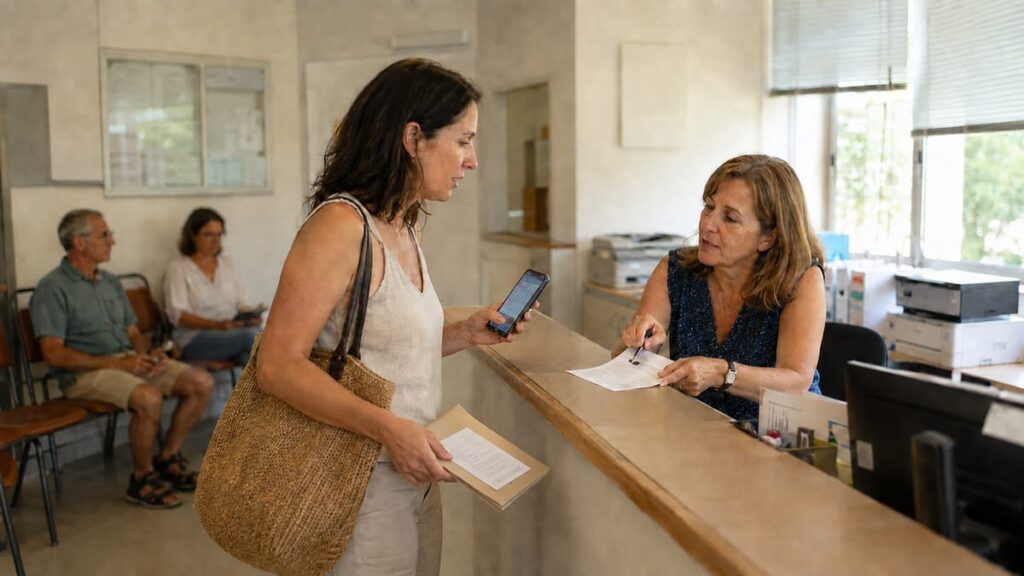
Registration in the RNU and enrolment in primary care are two separate procedures. To enrol, you go to the centre’s reception desk and apply for primary care registration — inscrição nos cuidados de saúde primários.
The simplest place to start is the centre for the area where you live. Take your utente number, your identity document, your NIF, your residence document and proof of address. The official registration page states it plainly: a foreigner can register at a centro de saúde only once their RNU record has the status registo atualizado.
And enrolment does not mean a family doctor will be assigned straight away — the doctor who follows you over time and refers you to specialists when needed. It only makes you a candidate for a family health team. From there it depends on capacity at your Unidade Local de Saúde (ULS), the territorial grouping of state primary care centres and hospitals. Families with a pregnancy, small children, several diagnoses or chronic conditions get priority.
A lack of capacity should not cancel the registration itself. If all you are told at the desk is “there are no doctors”, ask about two separate things: whether you are registered at that facility, and whether you are on the waiting list for a family team. The ERS states explicitly that a patient without a médico de família keeps the right to primary care.
No Family Doctor. Who Will See You?
For patients with no doctor of their own there is the consulta de reforço, or consulta de recurso — an appointment with whichever doctor is available. You can request one at the reception desk, by phone, or through the SNS 24 portal. The official booking page says separately that not having a family doctor is no obstacle to a consulta de reforço, as long as you are registered at a centro de saúde.
Different centres organise care for patients without a family doctor differently. An appointment with an available doctor may be called a *consulta aberta*, a *consulta de recurso* or a *consulta de reforço*, and extra appointment hours *atendimento complementar*. The formats differ a little, but the thing worth knowing is one: you can get care without a doctor assigned to you. Some centres open bookings for the next few days, some hand out slots in the morning, some ask you to call SNS 24 first. Which is why searching online for a universal “open surgery” timetable gets you nowhere — the rules have to come from your own centre.
At an appointment like this the doctor can assess your condition, prescribe treatment and, where there are clinical grounds, issue a further referral. Not having a permanent family doctor does not close off tests or a hospital specialist consultation, but it does make care less continuous: each time, someone new may be working through your history.
If You Need a Doctor Right Now
For an acute problem that is not life-threatening, the SNS recommends calling 808 24 24 24 first. The SNS 24 line runs around the clock. A medical professional assesses the symptoms and picks the route: care at home, a centro de saúde, a telemedicine consultation, an urgência or the emergency service.
After that phone assessment SNS 24 can send you to a centro de saúde itself and pass the details of your call on to them. You will be seen by whichever specialist is available — it does not have to be your family doctor. If the centre you were sent to cannot fit you in, it has to offer a suitable alternative; if that does not happen, you can go back to SNS 24.
From 2026, a request about an acute illness in primary care has to get a response within twenty-four hours. For a routine problem that a patient raises themselves, the deadline is roughly three working weeks. The date of the request has to be entered into the system. The facility is obliged to organise a response within the set period.
Calling before you head to an urgência is recommended, but it is not a condition. Even if SNS 24 did not pick up, you keep the right to seek care.
If someone loses consciousness, shows signs of a stroke, has severe breathlessness, chest pain, heavy bleeding, a serious injury or any other risk to life, call 112 immediately.
Can You Go to a Different Centro de Saúde?
Yes, if the problem is acute or cannot wait. A patient registered at one centro de saúde can make a one-off visit to another without transferring. In the rules this is called a contacto esporádico. You will be seen according to urgency and the resources available.
If you live or work outside the municipality you are permanently enrolled in, you can arrange a temporary registration at the local centre for up to a year. Your previous enrolment is suspended for that period and then restored automatically. The mechanism is described in the state guide to healthcare for migrants.
If you move, you can also ask for a full transfer to another clinic. It is not compulsory, but a centre near your new address is usually more convenient for routine appointments, monitoring and home visits. The request to change centro de saúde is submitted at the facility you want to move to.
What to Do If You Have a Utente Number but No Doctor
Check your SNS 24 account. See whether your primary care facility is listed there, and update your phone number and email.
Check your RNU status. If you have a number but no enrolment, ask the centro de saúde to confirm that the record has the status registo atualizado and holds enough data.
Separate the registration from the doctor. Ask them first to register you at the facility, then to confirm that you are on the waiting list for a family team.
Ask for a consulta de reforço. If the problem is routine, try the SNS 24 portal, the phone or your centre’s reception desk. Having no médico de família does not in itself cancel an appointment.
For an acute condition, call SNS 24. The line can carry out a medical assessment, offer a telemedicine consultation or direct you to a suitable facility. If life is at risk, call 112.
If you are refused an appointment, ask for the refusal or the request to be recorded in the system, and for a written explanation.
If care still is not forthcoming, go to the patient liaison office, the Gabinete do Cidadão, at your ULS. A complaint can be left in the Livro de Reclamações or sent straight to the ERS.
If you have tried to see a doctor without a médico de família and your centro de saúde offered you a different route, write to us at welcome@xpat.land. Practice still varies noticeably between centres, and we will keep collecting the ways that work.