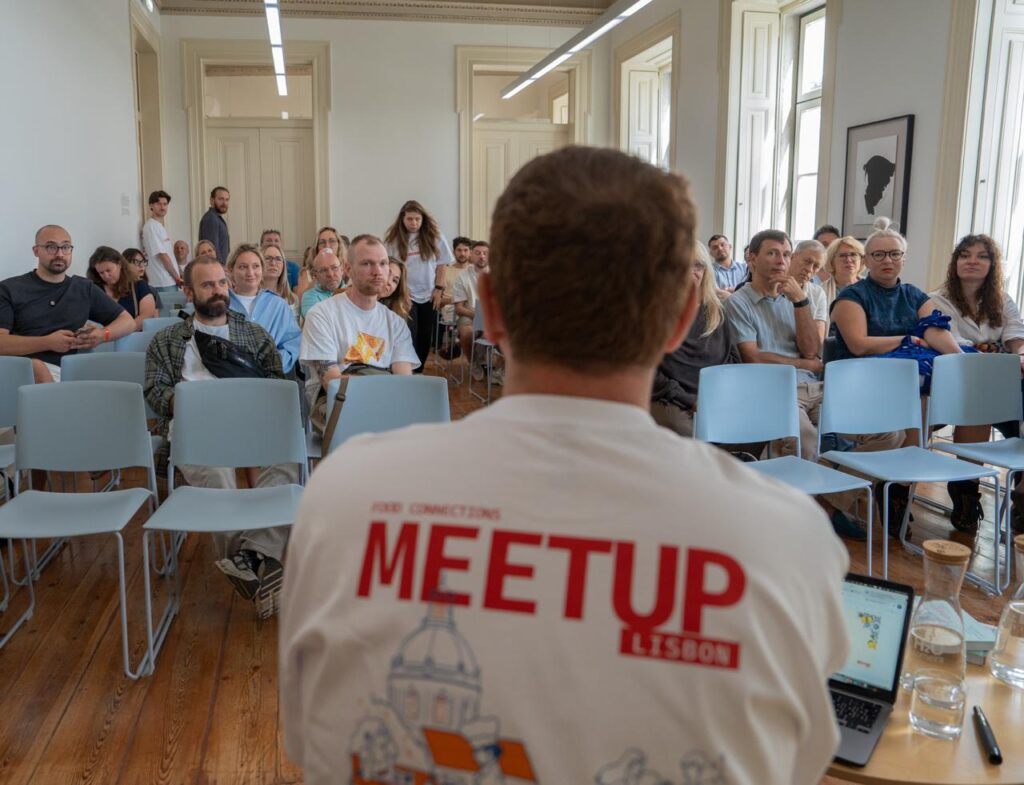
On October 2, Portugal’s Russian-speaking restaurant crowd gathered at Brotéria, a Jesuit cultural center in central Lisbon, where Food Connections held its annual meetup in the country for the first time. It was the community’s third in-person gathering, after Barcelona and Belgrade. There were nearly two dozen speakers and almost no stories along the lines of “we just believed in the product and it all worked out”: all day, participants counted money, deadlines, rent, average checks and the cost of their own mistakes. Restaurateur Nika Borisov was there and wrote for Xpat.Land about how the meetup went.
Food Connections was created by food producer Alena Ermakova, its founder, together with her team, as an international Russian-speaking community for people in the restaurant and food business. The idea is fairly simple: when you find yourself in a new country, you don’t have to reinvent everything alone. You can get to know people who have already opened a restaurant, found suppliers, survived a renovation, figured out the taxes or made the mistakes before you did. Most of the interaction happens online, and once a year the community meets in person: in Spain in 2024, in Serbia in 2025, and now in Portugal.
And there really is plenty to count. Portugal’s restaurant market keeps attracting new players, even though doing business is clearly getting harder. Between January and May 2026, 6,446 businesses opened in the sector and 9,279 closed. Food costs are rising, wages in the sector have grown by 23% in three years, competition has intensified, and the rapid growth in the number of foreigners, who in recent years supplied a ready-made audience, has slowed sharply.
Even so, there seem to be no fewer people who want to open a restaurant or a coffee shop.
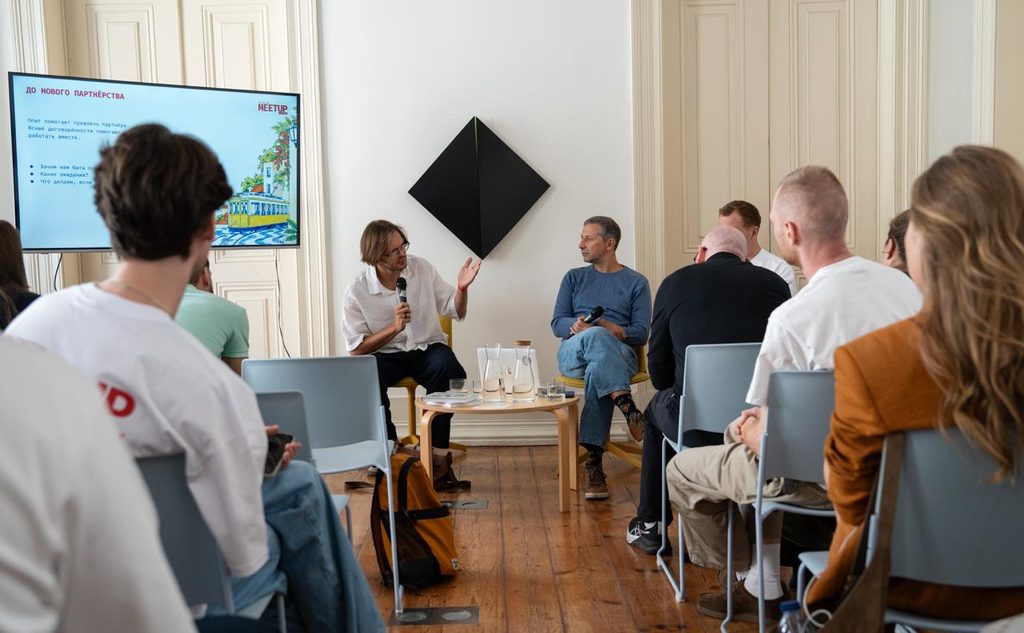
Xpat.Land Editor-in-Chief Ilya Zhegulev (right) and restaurateur Nikita Volkov at Food Connections in Lisbon. Photo: Ivan Podoynitsyn
One of the first speakers was Let’s Pastrami founder Maxim Letunovsky, a chef and restaurateur. He opened the first Let’s Pastrami in Portugal in Lisbon in January 2024. Before moving to Portugal he had a fairly prominent restaurant career in Moscow: he started out on Ivan Shishkin’s team, was sous-chef at Delicatessen, then became head chef at Yunost, and later chef and operations director at Shortlist Bar.
Letunovsky talked about how a single café can grow into a full-fledged company. Maxim and his partners invested €240,000 in the first location in central Lisbon, while two new launches and an expansion of production cost just €46,000, of which €15,000 went to rental deposits. The new locations already account for more than half of sales. Maxim’s conclusion was this: “The number of locations is a measure of growth. Running without my constant involvement is the measure of a company.” But the business still has room to grow, he admitted.
Alexander Rozhkov of Unity Coffee Roasters brought a different kind of arithmetic. The search for a suitable space took six to seven months and more than 50 viewings. Then came the renovation, on two sites at once. One was supposed to be finished in May and was finished in August. The other was due to open in June, and the opening slipped to October. The dates were moved six times, and about €20,000 went simply on rent for premises that were closed. For anyone who has ever renovated a property in Portugal, Rozhkov’s advice sounded especially convincing: take the contractor’s deadline and multiply it by 2.5 straight away.
Katya Rodionova spoke not about opening a business but about exiting one successfully. In her words, business has brought her relief twice: when she opened her projects and when she finally sold them. The tiny wine bar Rato Holy Wine went for €25,000, and Bowls Bar for €165,000.
From numbers, the conversation moved on to food. Borboleta chef Katya Plotnikova explained how she gets fairly conservative Portuguese guests used to unfamiliar combinations. The chicken liver story was especially memorable: many Portuguese remember it from childhood as dry, so they would never order it of their own accord. In that case the restaurant’s job is not just to cook a different dish, but to make a person reconsider their own memory of it. The Portuguese, of course, are under no obligation to automatically love everything we like. You have to get to know the local guest and sometimes spend quite a long time finding common ground. Xpat.Land, incidentally, has already spoken with Katya separately; you can read that interview here.
There was another good example: Katsu, an Asian bistro near Pink Street. It has just 30 seats and about 4,000 guests a month. By the team’s estimate, roughly 80% of its guests are Portuguese, even in tourist season. To reach them, the team worked with Portuguese creators and media. Instagram and Facebook were used for the local audience, and Google to bring in tourists.
The marketing block turned out to be one of the most practical of the day. Bistro Alba rebuilt its Google Maps listing around real search queries such as “brunch, coffee and matcha” and brought in more of its target audience as a result. Liberty launched its own loyalty program: more than 1,500 people have signed up since March, and at one of its locations roughly one in five payments is now made with a loyalty card. At Borboleta, paid marketing started at around €200 a month, and after active work with its own channels, the press and influencers, its Instagram grew from 3,400 to more than 12,000 followers. They were helped by Rippla.com, a service run by one of the meetup’s speakers, Maria Donskikh, which connects influencers and restaurateurs on a barter basis. Xpat.Land has written about it as well.
One of the most interesting cases came from Egor Medvedev of Kitchens.pt, who showed how he uses AI in his business in practice. Kitchens.pt has six independent kitchen units and more than 380 items on its combined menu. The company uses three of the units itself and rents out the other three. The project was originally conceived as a dark kitchen, but it later added a dining room and a terrace for guests. In the end it dropped its own couriers and handed delivery over to Glovo.
The work for AI lies in the back office. A daily sales report arrives in WhatsApp automatically. If a dish runs out, a kitchen employee can say so in a voice message on Telegram, and an AI agent recognizes the message and marks the item as unavailable. Invoices are recognized automatically and go into the register without manual entry. Menus and prices are synchronized between the accounting system and the website.
According to Medvedev, an agent has to be trained for each specific task like a new employee, but only once. The key decisions, he says, remain with people.
At the end, participants were given an open mic: you could talk about your project, look for a partner or simply introduce yourself. And that produced the best example of real-time marketing. At one point a young man stood up and announced that he had nothing to do with the restaurant business at all. He was an osteopath, and he treats backs. After his turn, a whole line of people formed to get his contact details. Which, if you think about it, makes perfect sense. Some people in the restaurant industry spend all day on their feet, and others sit at a computer for hours. Both end up with sore backs.
So the participants spent several hours discussing Google and Meta, bloggers and collaborations, CRM systems and ways to find their target audience, and then an osteopath came along and showed in one minute how it’s done. It’s hard to imagine a better ending for a restaurant meetup.