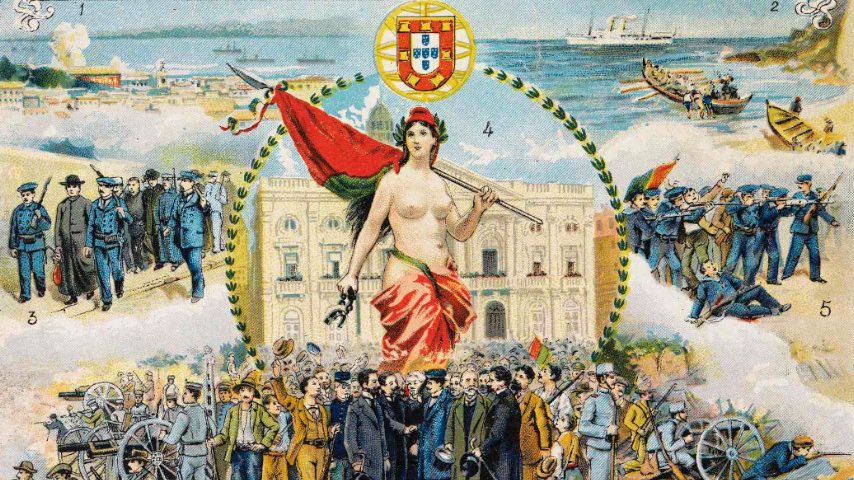
Today, Portugal celebrates the anniversary of the proclamation of the republic. We previously covered how it happened in our walking tour of the revolution’s key sites. But what came before and after? Where did the “Pedrists” and “Miguelists” come from, how did a queen fend off assassins with a bouquet, where did the last king flee, and what do his descendants live on today?
The King on Remote
Liberal ideas began to gain momentum in Portugal in 1820, influenced by ideas spreading across Europe and by the political and economic crisis the country had fallen into after the Napoleonic Wars. Liberals wanted to curb the king’s power and establish a constitutional monarchy.
By then, King João VI had already been “relocated” to Brazil by Napoleon 13 years earlier, even though Napoleon himself had long since fallen. João VI tried to rule Portugal from across the Atlantic, sending decrees by ship (two months between signing a decree and its publication was not exactly the fastest form of communication, but there was no alternative). In practice, the British wielded considerable influence over Portugal at the time.
Portuguese liberals were not exactly thrilled with this arrangement, and in 1820 they launched a revolution in Porto, forcing the king to return. That led to the adoption of Portugal’s first Constitution in 1822.
Pedrists vs. Miguelists
After João’s death in 1826, his sons Pedro and Miguel embarked on a long and rather complicated struggle over power. As the elder brother, Pedro IV inherited the Portuguese throne, but he was also Emperor Pedro I of Brazil (a rather impressive case of royal multitasking). Realizing that he could not hold on to two crowns at once, he struck a deal with his brother and came up with an elaborate plan. He abdicated the Portuguese throne in favor of his seven-year-old daughter Maria, arranged her engagement to his brother Miguel (yes, her own uncle; yes, at the age of seven), and agreed that Miguel would rule Portugal as regent until Maria turned 18.
In return, Miguel promised to respect the Constitutional Charter and not overstep his authority. He did not keep his promise. Two years later, he proclaimed himself king and restored absolute monarchy in Portugal.
In 1832, Pedro, who by then had also abdicated the Brazilian throne, returned to Portugal to deal with his brother. A civil war followed, dividing the country between the “Pedrists,” supporters of constitutional monarchy, and the “Miguelists,” who wanted to restore absolute rule (pedristas and miguelistas — I’m not making this up!). In 1834, the “Pedrists” won, and the crown went back to Maria II.
Gunfire in Commerce Square
But the liberals’ victory did not bring peace to Portugal. Coups and uprisings continued to flare up until 1851. Several decades of relative stability followed, but by the end of the 19th century the crisis was heating up again. Discontent with the monarchy was growing, while the republican movement was gaining strength.
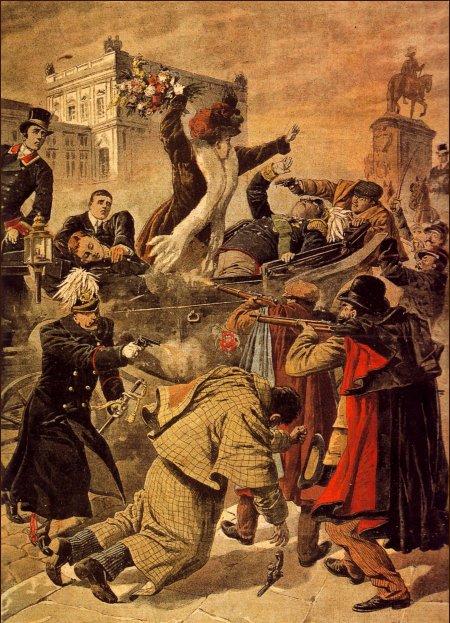
The political chaos eventually ended in gunfire. On February 1, 1908, King Carlos I — the great-grandson of the same Pedro IV who had led the “Pedrist” cause — and his eldest son Luís Filipe were shot dead in an open carriage as it crossed Lisbon’s Praça do Comércio. Their younger son Manuel survived thanks to his mother, Queen Amélia. According to eyewitness accounts, she fought off the attackers with a bouquet of flowers, shouting, “Scoundrels!” That was how 18-year-old Manuel II became Portugal’s last king.
But he was destined to rule for just two years. On October 4, 1910, he was at the Necessidades Palace when rebels began firing at it directly from ships on the Tagus. The king had to flee first to Mafra and then, on October 5, when the Republic was proclaimed in Portugal, he made his way to Ericeira. It was the last piece of Portuguese soil Manuel would ever set foot on. There was no bloody reckoning, however: the deposed monarch safely sailed to England, where he lived for the rest of his life.
The Prince Without a Crown
Manuel II had no children of his own, but his brother Pedro did — Miguel I. Miguel’s great-grandson, 81-year-old Duarte Pio de Bragança, now lives in Sintra and is considered the head of the royal house and the main claimant to the throne, should Portugal ever restore its monarchy.
Interestingly, Duarte Pio is also the great-great-great-grandson of Pedro IV through the Brazilian line. As we remember, Pedro IV was also Brazilian Emperor Pedro I. His great-great-granddaughter Maria Francisca is Duarte Pio’s mother. In other words, the two rival branches of Portugal’s royal family ultimately converged in Duarte.
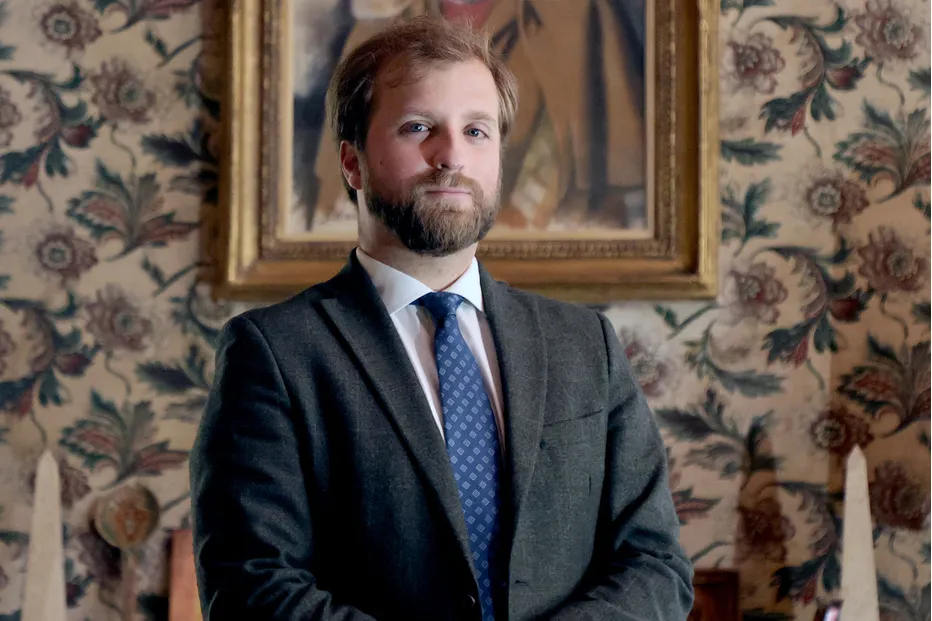
Photo: Dom Afonso de Santa Maria de Bragança
The royal descendants, unsurprisingly, are not exactly struggling financially today. Duarte himself is mostly involved in public and charitable activities and heads Fundação D. Manuel II, a foundation that supports cultural and social projects across Portuguese-speaking countries. The Braganza family owns several properties in Lisbon’s central Chiado district, as well as a real estate company that rents them out. There are also assets in Brazil, likewise inherited over the generations.
Duarte has three children, one of whom is 30-year-old Crown Prince Afonso. He is also Prince of Beira and Duke of Barcelos. Afonso occasionally turns up at social events in Lisbon, including charity balls. And, according to the Portuguese media, he is currently single and not seeing anyone. Ladies, take note!