
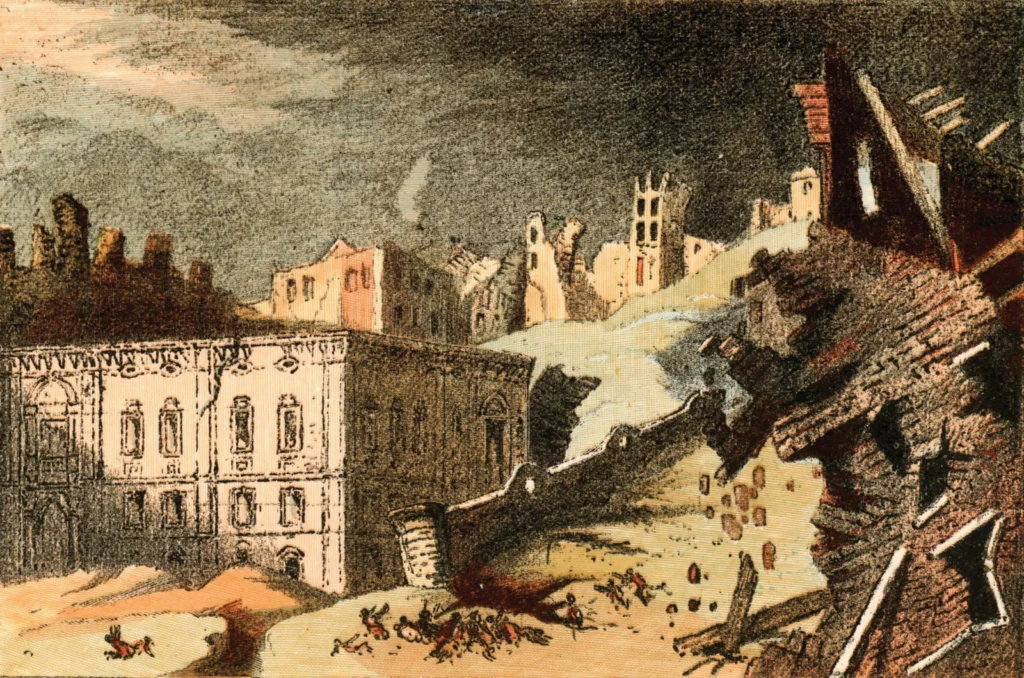
On 1 November 1755, 290 km off the coast of Portugal, a sudden shift of the Earth’s crust at the boundary of two tectonic plates in the Atlantic triggered a powerful earthquake and tsunami. Its effects were felt across Europe and parts of Africa, but Lisbon suffered most: the city was almost entirely destroyed. Today the earthquake’s magnitude is estimated at 8.7–9, but at the time neither the Richter scale nor Charles Richter himself existed, and any disaster was attributed to the wrath of God. Yet the scale of the destruction and the sheer number of ordinary people killed raised questions in the minds of the period’s thinkers and led them to doubt the idea of divine providence. For Xpat.Land, journalist and researcher of Portuguese history Alena Khazinurova explains how the Lisbon earthquake changed not only Portugal but the whole world.
Also read Xpat.Land’s pieces on the earthquake, featuring eyewitness accounts and on the country’s current preparedness for seismic activity.
A disaster on an unprecedented scale
What makes the Lisbon earthquake unique is its scale: the world faced a natural disaster of a magnitude never seen before. Of course, there had been cataclysms before, including in Portugal in 1531, but they were recorded only in scattered archival documents, were not widely studied and remained more like local legends. Until then, if an earthquake struck, say, Japan, someone in England might never even hear of it: there was no internet or radio, and periodical press barely existed.
In 1755, firstly, the tremors were felt all over Europe. A three-metre tsunami hit the south coast of England; in Dutch ports, waves tore moored ships from their piers; Seville, Málaga and Cádiz in Spain also suffered damage and flooding. On lakes in Norway and Sweden, so-called seiches were observed, with water rising and falling for no apparent reason, and the healing spring in the spa town of Teplice in what is now the Czech Republic suddenly gushed out a huge volume of water. The north coast of Africa was also badly hit.
Secondly, the disaster became a global event thanks to the growth of newspapers, which carried the news to many countries. Many of them exaggerated the scale of the tragedy: some put the death toll as high as a million. We still don’t know the exact number of victims, but historians estimate it at between 10,000 and 90,000.
Even the Saint Petersburg Gazette reported that “a terrible earthquake struck the Spanish coast and the whole Kingdom of Portugal,” as a result of which “more than half of the Portuguese capital, Lisbon, collapsed, crushing some 100,000 people within a few minutes.”
The wrath of God
The key fact that fundamentally changed how the tragedy was perceived is that the first tremors hit Lisbon at 9:40 am on 1 November, All Saints’ Day, one of the most important Catholic holidays of the time. The city’s residents were at mass in church when chunks of wall literally began falling on their heads. Buildings collapsed, and the streets filled with rubble and dust. People ran out of buildings in panic, searching for loved ones and trying to dig themselves out from the debris.
Those who ran to the river hoping to escape by ship were swept away by a huge tsunami wave. Lisbon was then one of the largest cities in Europe, though far more compact than today: its inhabited area was limited to the Alfama and Mouraria quarters, the low-lying Baixa up to Rossio Square, and the Chiado, Bairro Alto and waterfront Cais do Sodré districts. On 1 November 1755, up to 80% of buildings were destroyed or left uninhabitable. Whatever the tremors and the water spared was consumed by fire by evening: stoves and church candles set buildings ablaze, and there was simply no one to put the fires out. Survivors could hardly describe what was happening except in apocalyptic terms.
People asked: why would God punish people in the middle of prayer? And what had Lisbon in particular done wrong? After all, Portugal was then one of the most devout and conservative Catholic countries in Europe. It was this contrast between the country’s piety and the cruelty of the disaster that sparked a profound intellectual crisis in the Age of Enlightenment.
Adding a piquant twist was the rumour that the port’s brothel district (today’s Pink Street) suffered far less damage. To the survivors, it looked like absurd cruelty: the pious died in churches, while the sinners survived.
“Lisbon lies in ruins, and in Paris they dance”
“What crime, what fault had these children committed,
crushed and bloodied on their mothers’ breasts?
Did Lisbon, which is no more, have more vices
than London and Paris, steeped in pleasure?
Lisbon lies in ruins, and in Paris they dance.”
So wrote the French philosopher Voltaire.
In 1756 he published his Poem on the Lisbon Disaster, in which he reflected on the suffering of innocent people and questioned the idea of the world as the creation of a just and merciful God. In 1759 came the novel Candide, or Optimism, in which the aftermath of the earthquake became part of a satire on philosophical optimism, alongside criticism of religious fanaticism, clerical hypocrisy, the cruelty of war and social inequality. In these works he asks many rhetorical questions that boil down to one: how could a just God allow such a catastrophe? And is everything really “for the best in the best of all possible worlds”?
The Church could not give people answers to these questions, which undermined its authority. The reaction to Candide was harsh: the book was placed on the Index of Forbidden Books, which could not be read on pain of excommunication. Despite this, it became one of the first international bestsellers: it was translated into many languages and printed clandestinely.
Voltaire’s emotional questions sparked serious debate both among the philosophers and thinkers of the time and among ordinary readers. The English preacher John Wesley, for example, disagreed with him. In 1755 he published a pamphlet, Serious Thoughts Occasioned by the Late Earthquake at Lisbon, in which he interpreted the disaster as a manifestation of divine judgement and urged people to examine their own lives before it was too late.
Man is not the ultimate purpose of all God’s actions
The earthquake also made a strong impression on Immanuel Kant.
On the one hand, he tried to investigate the physical causes of the tremors, suggesting that earthquakes were caused by underground chemical processes. In his view, combustible mixtures of substances could ignite in vast underground cavities, causing explosions and collapses.
On the other hand, he did not shy away from more philosophical questions, such as how the existence of natural evil could be reconciled with the idea of divine wisdom.
Kant wrote that humans cannot know God’s designs and are mistaken in seeing themselves as the ultimate purpose of all His actions: “Man is in ignorance when he tries to guess the intentions by which God is guided in governing the world.” In the philosopher’s view, it was naive to believe that everything that happens in nature is intended for humans: to reward them, punish them or teach them a lesson.
And what happened in Portugal?
The reconstruction of Lisbon was led by King José I’s chief minister, Sebastião José de Carvalho e Melo, better known today as the Marquis of Pombal. He enjoyed the king’s full trust and could push many decisions through at the level of the state.
Pombal insisted that the disaster should be treated as a natural event, and he effectively became one of the founders of seismology by sending a questionnaire across the country to gather information about the earthquake’s warning signs and effects.
He also openly opposed sermons that declared the event God’s punishment for sin, and urged people not to spread panic or be distracted from rebuilding the city. To prevent the spread of disease, he ordered the dead to be buried in mass graves without funeral rites or thrown into the Tagus, which was a serious breach of the Church’s rules at the time.
Pombal’s conflict with the Church, however, was not limited to differing views on the cause of the disaster. In 1759 he secured the expulsion of the Jesuits, one of the most influential Catholic orders, from Portugal and the confiscation of their property for the Crown. In the following years, the government also restricted the Church’s ability to acquire new land and inherit property, and allowed some Church holdings to be sold. The education system was overhauled too: instead of Jesuit schools, Pombal ordered the creation of a network of state schools, and in 1772 he reformed the University of Coimbra, expanding the teaching of natural sciences and mathematics. Many of these decisions, incidentally, drew heavy criticism.
The Lisbon earthquake did not lead to a mass rejection of religion in Europe: for many ordinary people, it was rather a reason to pray harder so that such “divine punishment” would not happen again.
But the disaster made very tangible a question that had previously been discussed only in the abstract: why do the innocent suffer if the world is governed by a just and merciful God? No single answer emerged, but after 1755 the debate about evil, faith and the order of the world became one of the sharpest intellectual conflicts of the Enlightenment.