
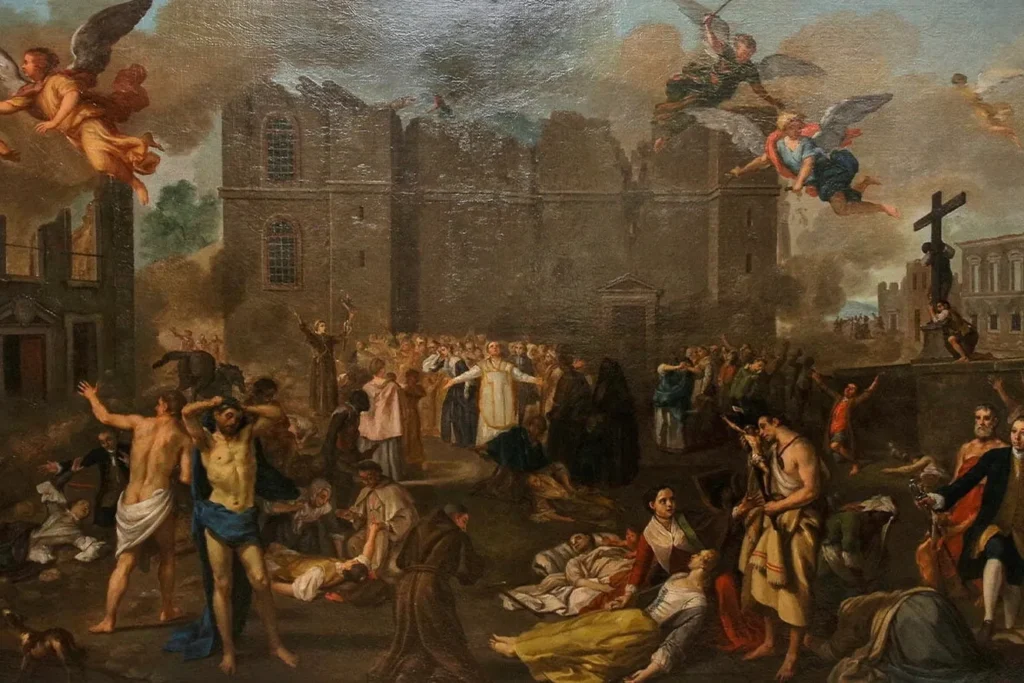
The most devastating earthquake in Portugal’s history, which triggered a tsunami and a fire, came as a shock not only to locals but also to the foreigners living there. Lisbon was one of Europe’s largest ports, home to English merchants, clergymen and traders from other countries — the expats of their day, you might say. Survivors described in horror collapsing houses, a wave rising like a mountain and crowds begging for mercy. Xpat.Land correspondent Alena Khazinurova has gathered the most vivid of these accounts.
Richard Goddard
Anglican pastor from Swindon, England
“No Words can express the Horror of my Situation at that Instant, involved in almost total Darkness, surrounded with a City falling into Ruins, and Crowds of People screaming, and calling out for Mercy, while from the violent and convulsive Motions of the Earth, we expected every Moment to be swallowed up.
Such a Situation I apprehend is not easily to be imagined by those who have not felt it, nor to be described by those who have.”
Charles Davy
English Anglican clergyman and writer
“It was on the morning of this fatal day, between the hours of nine and ten, that I was set down in my apartment, just finishing a letter, when the papers and table I was writing on began to tremble with a gentle motion, which rather surprised me, as I could not perceive a breath of wind stirring. Whilst I was reflecting with myself what this could be owing to, […] the whole house began to shake from the very foundation, […] as I found it was owing to a strange frightful kind of noise under ground, resembling the hollow distant rumbling of thunder. […]
but in a moment I was roused from my dream, being instantly stunned with a most horrid crash, as if every edifice in the city had tumbled down at once.
The house I was in shook with such violence, that the upper stories immediately fell; and though my apartment (which was the first floor) did not then share the same fate, yet everything was thrown out of its place in such a manner that it was with no small difficulty I kept my feet, and expected nothing less than to be soon crushed to death, as the walls continued rocking to and fro in the frightfulest manner, opening in several places; large stones falling down on every side from the cracks, and the ends of most of the rafters starting out from the roof. To add to this terrifying scene, the sky in a moment became so gloomy that I could now distinguish no particular object; […] however, it is certain I found myself almost choked for near ten minutes.
I hastened out of the house and through the narrow streets, where the buildings either were down or were continually falling, and climbed over the ruins of St. Paul’s Church to get to the river’s side, where I thought I might find safety.”
“You may judge of the force of this shock, when I inform you it was so violent that I could scarce keep on my knees; but it was attended with some circumstances still more dreadful than the former. On a sudden I heard a general outcry, ‘The sea is coming in, we shall be all lost.’ Upon this, turning my eyes towards the river, which in that place is nearly four miles broad, I could perceive it heaving and swelling in the most unaccountable manner, as no wind was stirring.
In an instant there appeared, at some small distance, a large body of water, rising as it were like a mountain.
It came on foaming and roaring, and rushed towards the shore with such impetuosity, that we all immediately ran for our lives as fast as possible; many were actually swept away, and the rest above their waist in water at a good distance from the banks. For my own part I had the narrowest escape, and should certainly have been lost, had I not grasped a large beam that lay on the ground, till the water returned to its channel, which it did almost at the same instant, with equal rapidity. I observed the ships tumbling and tossing about as in a violent storm; some had broken their cables, and were carried to the other side of the Tagus; others were whirled around with incredible swiftness; several large boats were turned keel upwards; and all this without any wind, which seemed the more astonishing. It was at the time of which I am now speaking, that the fine new quay, built entirely of rough marble, at an immense expense, was entirely swallowed up, with all the people on it, who had fled thither for safety, and had reason to think themselves out of danger in such a place: at the same time, a great number of boats and small vessels, anchored near it (all likewise full of people, who had retired thither for the same purpose), were all swallowed up, as in a whirlpool, and nevermore appeared.”
Thomas Chase
British merchant born and raised in Portugal in an expatriate family
“About three quarters after nine o’clock in the morning, on Saturday, the day that made me twenty-six years of age, and in the very house where I was born, on the 1st of November, 1755, I was alone in my bed-chamber, four stories from the ground, opening a bureau; when a shaking or trembling of the ground, which I knew immediately to be an earthquake, obliged me to run to the door.
Before I could reach it, the floor began to heave and toss in a most frightful manner; and in an instant the walls, with a horrid crash, split into cracks of a foot wide. The noise and the motion together were so violent, that I could scarcely keep my feet; and in trying to run down, I was obliged to put my arm out of a window, and support myself by the wall. Every stone in the wall separating each from the other, and grinding, as did all the walls of the other houses, one against another, with a variety of different motions, made the most dreadful juncing noise that ears ever heard. […]
I had resolved to throw myself upon the floor, but suppose I did not; for immediately I felt myself falling, […] I found myself lying with my face and breast covered with rubbish, and my legs buried deep in it. […] I then scrambled out of the rubbish, and found myself unhurt, except for some bruises and a cut on my head.
As I looked round, the scene of desolation was beyond description: the great church of St. Nicholas had tumbled into a heap of ruins; the streets were choked with massive stones and beams; and the air was filled with a thick, suffocating cloud of dust and the smell of sulfur.”
A German merchant living in Lisbon
From a letter to his parents
“On the 1st of November, I was tempted by the beauty of the morning to take a stroll, so I left my office and went to the top of St. George’s Hill. That might have been my salvation, as the plateau there is wide and free of buildings. Suddenly, the shaking started. I didn’t quite understand what was happening, but by the third shake, and as I hung onto a pole for dear life, I knew that I would be lucky to survive.
When the ground stopped shaking, and as I walked down from the hill, I understood the extent of the damage. No words can express the horror. Dust and smoke from the fires surrounded me, and I could barely breathe. Darkness was around me, and I found myself surrounded by a city falling into ruin, with crowds of people screaming and calling out for mercy.
This city will never be able to recover!”