

We recently published a guide to free Portuguese courses for foreigners, and today Xpat.Land correspondent Yuliana Prus shares her personal experience of getting onto one of these programmes. For about a year she submitted online applications and made the rounds of schools in Lisbon without success, and this summer she finally started classes. Looking back, she realised she could have got onto a course faster, so in this column Yuliana explains how to avoid wasting time and energy on what can at times be a tricky process.
Mistake one: I put all my eggs in one basket
I first tried to sign up for a free language course in July last year. I submitted an online application for a course due to start in September, and my name was put on a waiting list. Weeks went by, but I was never invited to classes. I didn’t get a rejection either: September simply came, and I never heard anything back.
My first mistake was choosing just one course. I later applied to several more places, but by then it was too late: almost everywhere, the autumn groups were already full.
Be careful! Over the past five years, demand for language courses for foreigners in Portugal has more than doubled, and fake language schools have appeared on the back of it. Immigrants pay scammers thousands of euros for state-recognised diplomas, only to receive forgeries. Public language courses are held at state schools, IEFP training centres and Qualifica network centres. Xpat.Land has already written about how to check whether a specific course is genuine.
Mistake two: I was too naive
I emailed the nearest state schools and Qualifica training centres. Half of my emails went unanswered; a few places turned me down, and others put me on a waiting list again. One place invited me to submit my documents in person.
The in-person appointment took more than two hours: first I had to queue, then I was asked to fill in a form, my documents were scanned, and I was even given a certificate confirming that my application had been accepted. At the end, they promised to email me further instructions.
The instructions never came. I contacted the school myself and found out that there wasn’t a place for me on the course after all, and I’d have to wait for the next intake. Once again I’d lost time, because I naively assumed that if they’d invited me to come in person with my documents, I was definitely in and could stop looking for other options.
After that, I applied even more actively. Where I’d previously ruled out schools that were awkward to get to, I now signed up everywhere within Lisbon. A couple more schools invited me to in-person appointments. Each time it was roughly the same: at least an hour in the queue, filling in a form and… welcome to the waiting list.
The required documents varied slightly from school to school, but they usually asked for a NIF, a residence permit or NIPC, and a NISS (until I had one, I brought the letter refusing my NISS application).
Mistake three: I ignored online courses
Language courses vary: some last a couple of months but require four to six hours of study a day, while others are more relaxed and last six months. Classes can be in person, online or blended. Some schools ask for a small registration fee (€20–30), others charge nothing at all and will even pay you, providing an allowance for meals and travel.
I really wanted an in-person course, and that backfired on me. I can’t count how many applications I submitted, but over the course of a year I received only two invitation emails. I had to turn down both, because I was away and couldn’t get back in time. Missing the first classes wasn’t an option: it meant automatic expulsion.
Mistake four: I didn’t turn to local communities
Sometimes you can find out about a language course on social media and in expat chats. For example, a colleague of mine at the editorial office signed up after seeing an announcement in the Armenians in Portugal chat. There were students from many countries on the course; the organisers had simply sent invitations to various local communities. The key thing is to make sure it really is a free public course.
Mistake five: I was waiting for the right moment
At first I thought all courses started either in September or in January. That’s not actually true: I came across courses starting in November and in February too.
At some point I decided to check the Citeforma website (a project run under the IEFP) once a week to see whether any new intakes had opened. That’s exactly how I got onto the A1–A2 course I’m taking now. Incidentally, it started in July.
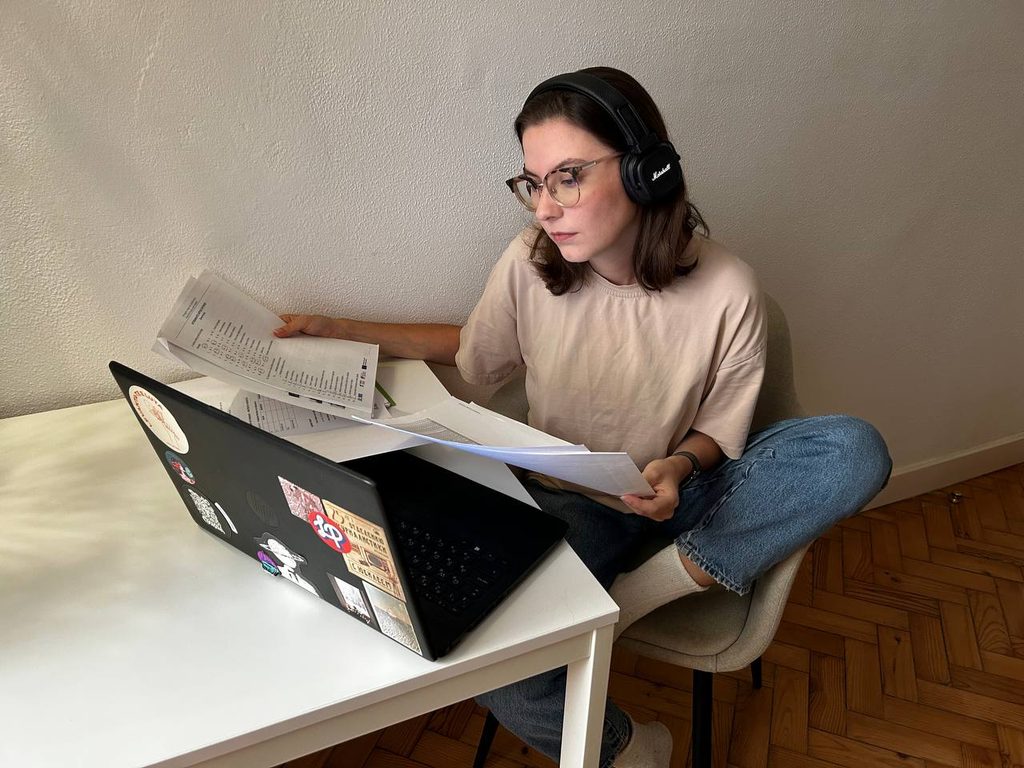
My course lasts just three months. It’s designed for complete beginners, but the programme is fairly intensive. In the second week we already had an internal exam: we had to listen to an audio recording and answer questions about it, do grammar exercises and complete a written task.
I didn’t have to buy any textbooks: all materials were handed out as printouts or sent electronically. The teacher spoke to students in both English and Portuguese.
The course is partly online and partly in person, with most lessons online. We attended in person for the first week and a half; after that, we only had to come in on exam days. Under our programme, there’s an exam at the end of each topic, roughly every two weeks.
Lessons take place four times a week, four hours a day, from 2pm to 6pm. Most often we study Monday to Thursday, but not always: some weeks a class might fall on a Friday, with, say, Tuesday off. There was a two-week break in the middle of the course. In short, the schedule shifts, so you need to keep an eye on it and plan around it.
Since I’ve had invitations to other courses and have something to compare it with, I can say this schedule is pretty good. Our classes always start at the same time, whereas on other courses the timetable was more chaotic: for example, one day classes could run from 9am to 6pm, and another day only from 4pm to 6pm.
I don’t pay anything for the course; on the contrary, I receive €6 for every day of classes.
I finish at the end of October and hope to get my certificate, then sign up for a B1–B2 course.