
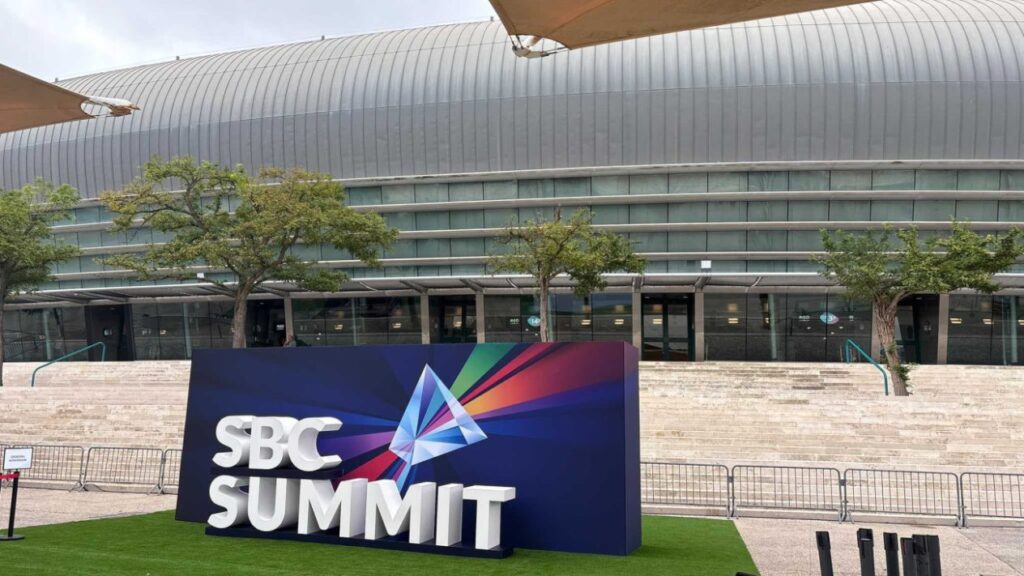
From September 29 to October 1, Lisbon hosted SBC Summit, one of the world’s largest conferences for the sports betting and online casino industry and the second most important event in Portugal after Web Summit. The organizers report 40,000 attendees from more than 150 countries, around 800 companies and 600 speakers. Davier Sevire attended as our undercover correspondent, representing a company that builds AI tools for customer communication. On her return, she shared her impressions of how the online gambling industry’s biggest gathering really works.
Blackjack without the blackjack
The first time, I struggled to figure out where to look. The vast halls of FIL (Lisbon’s largest exhibition center, in Parque das Nações), stages, meeting rooms, people stopping to talk in the middle of the aisles. Small companies make do with a couple of tables and a screen; big brands build two-story stands with bars and sofas. Music plays in one corner, and somewhere a party is already underway in the middle of the afternoon. Just walking the whole floor takes several hours.
What do you actually sell at a gambling expo, besides the games? Almost everything a modern online business needs, it turns out. Casinos and bookmakers sit at the center, but most of the floor belongs to those who serve them: platform developers, payment providers, marketing agencies, specialists in analytics, security and AI. Nearly all of it could just as easily be sold to a bank or an online store. At SBC, it is all organized around a single act: someone decides to place a bet.
Everything revolves around gambling, yet there seem to be no drugs, no blackjack and no hookers. Take the company names off the stands, and the summit could easily pass for an ordinary tech conference. It is also a very small world. People keep running into former colleagues and familiar faces from past conferences; they change companies but stay in the industry.
Why Portugal
SBC moved here from Barcelona in 2024, and the reasons were mostly practical. The event had outgrown its venue, and ICE, the industry’s main rival show, was relocating from London to Barcelona. Lisbon offered more than 100,000 square meters at FIL and MEO Arena and over 25,000 hotel rooms, direct flights from almost everywhere, a warm late September and the experience of Web Summit, which taught the city to host tens of thousands of guests at once. The authorities welcomed the summit: ministers and the mayor turn up to open it every year.
SBC is now the country’s second-largest recurring business event after Web Summit, and per visitor its economic impact is about the same: roughly €4,000.
Portugal is no stranger to the industry either. Online betting has been regulated here since June 2015, and a decade on, the licensing rules are well established. According to SRIJ (the state gambling regulator), licensed online operators earned €1.2 billion in gross gaming revenue in 2025, meaning stakes minus winnings paid out, and in the first quarter of 2026 revenue grew another 13.7%. Add land-based casinos and the state lotteries run by Jogos Santa Casa, and the gambling sector takes in about €2.7 billion a year from players. That is less than 1% of GDP. But the state collects more than €1.2 billion of it in taxes and levies, and the losses work out to about €240 a year for every resident of the country.
In Porto, Blip, the tech hub of Flutter (owner of Betfair and FanDuel), employs around a thousand people who write code for the group’s brands worldwide, including in Brazil. Many more work for the industry remotely: employed by companies in Malta, Cyprus or the UK while living in Lisbon, Porto or on the coast. For them, SBC is a rare case of a major conference coming to their doorstep.
The other half of the picture
Responsible gambling was one of the conference themes, and in Portugal it is anything but abstract. Self-exclusions, where a person voluntarily asks the regulator to bar them from gambling, reached 380,500 by the end of March 2026, up 23% from a year earlier. That is almost 8% of all registered accounts. And the bigger the market grows, the more pressing the question of where business growth ends and responsibility to its customers begins.
Two days at SBC did not make me think better of gambling. Its revenue ultimately comes from people’s losses, and no amount of stands with sofas changes that. But I also saw the other side. A whole ecosystem of thousands of companies has grown around betting, and it needs developers, marketers, payments specialists, support staff and communications people. Many of them are expats.
In Portugal, with its modest salaries, bureaucracy and a job market where many doors stay closed without Portuguese, finding good work as a newcomer is hard. An international industry where English is the working language and other languages are often an asset barely notices those barriers. For many of the people I spoke to at SBC, gambling became the way to stay in the country and work in their field. In a sense, I am one of them: I never looked for a job in a casino, yet for those two days, this was the industry that gave me work.