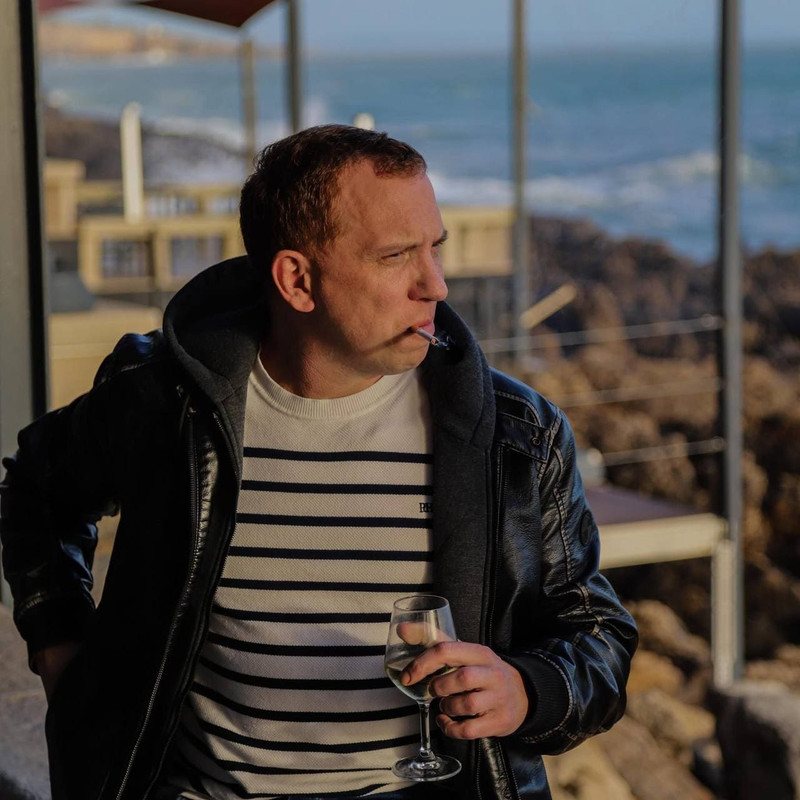
Nika Borisov moved to Lisbon three and a half years ago, and back then, as co-owner of the club "Mart" and the "Kvartira 44" restaurants, it seemed to him that the hardest part would be learning the language. But it turned out fairly quickly that the real education begins when you try to build something in a new place.
"Over these years I've tried to study the restaurant market, real estate, and public spaces, to talk with entrepreneurs, architects, property owners, and contractors. The deeper I dug, the more clearly I understood: the rules here are their own. And no one is in any hurry to explain them to you.
The very first conversations with colleagues who had arrived before me shattered all my romantic notions about opening a restaurant. A full-fledged restaurant in Lisbon is a pleasure not for the faint of heart: huge sums for trespasse (the transfer of lease rights), high costs for renovation and equipment, high taxes, fierce competition. Meanwhile, brunch cafés were multiplying practically every month, and the market already seemed oversaturated."
Especially for Xpat.Land, the entrepreneur shared two years of experience building a business in Portugal and told us what to watch out for and what difficulties lie in wait, in this friendly and hospitable country, for someone who wants to build a business.
The idea that seemed simple
About six months after the move, once the apartments had been found, the residence permit documents submitted, and the kids enrolled in school, my friends and I began thinking about what to do in the new country. To start, we decided merely to bring over an acoustic concert by a friend of ours — not a stadium tour, but an intimate performance for 150–200 people, for friends and a small audience. What could possibly go wrong, you'd think. It turned out: a great deal. Finding a suitable venue in Lisbon proved harder than finding the artist himself.
We were open to all sorts of places, but everything that came to mind had some serious drawback. For example: a casino was too big and completely wrong in atmosphere. University lecture halls have no bar, and the general mood felt more like an exam than a concert. Some places had no sound, some had nothing at all, and renting equipment, lighting, and a bar turned the event into a guaranteed loss.
The venues that more or less fit were booked months in advance or proudly ignored our emails.
That's exactly when the idea was born to create our own transformable space: by day a cozy brunch café, by evening a concert venue, an exhibition hall, a place for lectures, festivals, corporate events, and private celebrations.
To me this idea didn't seem like a gamble: for fourteen years in Moscow I'd run a similar project, "Mart," at the Moscow Museum of Modern Art (MMOMA). I had a rough idea of how a space like this could work. All that was left was the small matter of finding it in Lisbon.
The hangar
We almost signed on the first option — a huge hangar in Marvila. We were already preparing the layout and acoustics, designing the restaurant, discussing the interior, and had assembled a pool of investors. Only a few days remained until signing, and we felt like we were on the home stretch.
On a Friday I went there with a well-known architect — looking respectable, portfolio under my arm. Within ten seconds the walls started shaking as if the building had decided to dance. It turned out that just behind the wall, an equally respectable rave was being prepared.
Neither the realtor nor the owner had, for some reason, seen fit to share this detail in advance — knowing full well that we were about to sign a ten-year lease and pour hundreds of thousands of euros into the project. When I asked for the contacts of the owner of the neighboring hangar, I was politely informed: contacts only after signing the lease and paying the first three months.
We found the contacts ourselves, of course — Lisbon is a small city. The conversation confirmed our worst fears: combining intimate concerts and a cultural program with a rave next door was impossible, both physically and conceptually.
We backed out and lost a few months — a small price for not opening a cultural center to the accompaniment of bass thumping through the wall.
The dream space
The second find looked like a gift from fate: a ten-minute walk from Avenida da Liberdade. An atrium with seven-meter ceilings, a balcony, and a glass roof — one of those places you later describe to guests with bated breath. The high rent was a little frightening — but there was no grueling trespasse. We got back to work: design plan, concept, documents, license.
And then it turned out that the person renting it to us was himself a subtenant, with no right to sublet the space. We'd already managed to haul out the trash, commission a design plan, and even obtain a license — and once again we were back to square one, this time with a license for an empty spot.
No one is in a hurry here. But there's an important nuance
After stories like these, I stopped being surprised by anything. I often hear the phrase that in Portugal no one is in any hurry. I'll gladly sign off on that — with one correction: no one hurries except those who need to get your money. There, all of a sudden, appears an agility that an Olympic sprinter would envy.
Hence my main advice to everyone planning to open a business, do renovations, or buy property here: don't let yourself be rushed. Realtors will push you, property owners will hurry you, contractors will insist that tomorrow will be too late. But almost always it's precisely the haste that ends up costing more than anything else.
I'll never forget the ventilation contractor. He walked into the space, cast a proprietary glance around it for about ten seconds, and pronounced: sixty thousand euros. He didn't bother listening to the technical brief — apparently it was all clear to him anyway.
The market here is so uneven that the same job can cost wildly different amounts depending on who got out of bed on the wrong side that day. During my renovation I had two quotes on my desk at once for installing air conditioning, to the same brief: 6,900 euros and 22,000. A difference of more than threefold. And I'm sure that's not the record.
Over these years I've learned: in Portugal you can't go by the first offer. You need a second, a third, and sometimes a fifth — because you, and only you, pay for the consequences of someone else's mistake.
Recently an acquaintance signed off on a home renovation. Everything looked perfect, including the underfloor heating sensors — which, as it later turned out, were connected purely for show. There was no actual underfloor heating beneath the tiles. Another acquaintance had a similar story, only with buying an office by proxy for a "golden visa": on paper the area was 480 square meters, in reality about 308.
Hope dies last
Stories like these happen not only in Portugal. But it was here that I finally learned one thing for good.
Portugal is a very comfortable country to live in: it's pleasant to stroll, raise children, drink coffee on a terrace, and gaze at the ocean while pretending deadlines don't exist. But if you've decided to invest, build, or open a business, it's best to leave emotion and trustfulness at home. Check documents, double-check quotes, verify areas, ask uncomfortable questions, and always gather several independent opinions.
Trust is a wonderful quality. But it's verification that most often saves tens, and sometimes hundreds of thousands of euros. And, not least, your nerves.
And yet, despite all these stories, I don't regret a single attempt. If you try nothing and give up after the first hangar, nothing will come of anything at all. So, taught by bitter experience, I'm already turning a couple of new projects over in my head. Maybe it's an occupational deformation. But it seems the best answer to Lisbon and its surprises is to never stop trying.