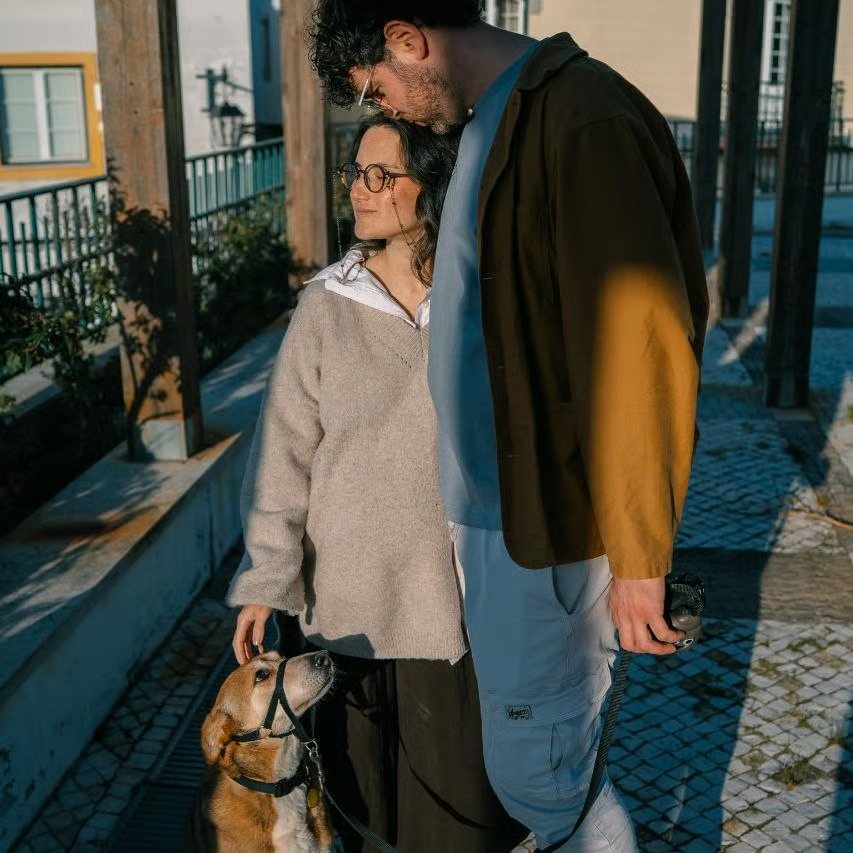
Buying a house in Portugal without a local employment contract — and without being an ideal borrower in the bank's eyes — is no easy task. Zhenya, a heroine of Xpat.Land who moved to Portugal from Israel in late 2023, told us how she made it happen with her partner Kfir: from renting a house that became a gathering spot for a whole crowd of expats, to getting their own mortgage. She also shared the unconventional solutions they had to come up with along the way — from a contract with a deferred deposit to opening her own company just to get the "right" proof of income.
At some point my common-law husband found a job at an office in Pinhal Novo, and we started looking for a place to live in that area. We fell in love with Palmela at first sight.
We found a wonderful three-story house there that became a magnet for expats — people who had relocated from Israel, the US, Ukraine, and Russia. We loved throwing evenings on that rooftop, playing guitar and watching the sunset with friends. The rent wasn't very expensive — 1,600 euros a month, which for a three-story house half an hour from Lisbon is just fantastic.
A year after we moved into the house, we found out the owner had put it up for sale. We didn't want to leave — we'd already put down roots in Palmela — so we didn't even consider other options and immediately agreed with the owner to buy it. The house fully met our requirements, and the price he offered us was far better than any other option in the area. We didn't spend long discussing it as a family; there were almost no doubts.
How I became a "convenient borrower"
The house cost 350,000 euros. The down payment — 90,000 — came from the sale of my apartment in St. Petersburg. We agreed with the owner that we'd pay this deposit and then wait eight months.
It wasn't a standard CPCV. Usually that kind of contract means that if the bank doesn't approve the mortgage, the deposit isn't returned to the buyer. In our case, our lawyer drew up a different contract: if the bank refused, the deposit would be returned within eight months.
Without a down payment like that, we most likely wouldn't have been given a mortgage at all. We didn't look like ideal borrowers to the bank: our age was no longer the most attractive, and our income wasn't especially high.
For a bank to see you as a suitable borrower, the best thing is to work for a Portuguese company. But I worked for an American startup that paid me as a freelance sole proprietor. The bank needed a Portuguese company. So I created a Portuguese company and hired myself. After that, I needed to build up six months of tenure at that company. We also set aside roughly another two months for dealing with the banks.
My income alone wouldn't have been enough: I have two children, and banks look at the ratio of the payment to the family's income. The monthly mortgage payment usually shouldn't exceed 30–40% of combined income. We met that criterion by the barest margin.
Banks and brokers
At the time I wasn't yet 35, so formally I qualified for the subsidized mortgage program for young people. My common-law husband Kfir, however, turned 36 just six days after we signed the purchase agreement. We made it literally at the last moment — which is exactly why we didn't pay IMT or stamp duty on the purchase.
We worked with two mortgage brokers and at the same time applied to several banks on our own. In the end, the best terms came from a bank we approached ourselves — and, importantly, it was the one that requested the smallest package of documents. The other banks wanted, in order to consider an application, income for the past three years, credit histories, six months of bank statements, information on all active accounts and securities, a CV, and all the documents for the house.
A separate story was the architectural plan of the house. Neither the owner nor the municipality had such a document, and without it the bank couldn't carry out the property valuation. The plan had to be commissioned separately, but in the end the owner took on that expense. We also bought some of the furniture and appliances from him separately.
Now it's all ours
When we were renting the house, the rent was 1,600 euros a month. Now the mortgage payment is around 1,000 euros plus insurance — that's roughly another 100 euros. Factoring in all the mandatory insurance, the difference works out to about 500 euros a month in the mortgage's favor.
But it's not only about money. A sense of security appeared. It became easier to plan for the future — schools for the kids, trips, vacations — without the constant worry that we might have to move out at any moment. It's more comfortable to have a child, plant a garden on the terrace, and host as many guests as we like for as long as we like.
We started investing in our home: planning renovations, choosing things more carefully, knowing we're here for the long haul. Our relationships with the neighbors and the municipality grew stronger. A sense of community formed around us.
By the time we signed the preliminary contract, we'd lived in Portugal for a year. By the time of the purchase itself — two years. Portugal is a pleasant country with a stable democracy and a low level of antisemitism; that mattered to me, and it's why we chose it.
And the experience of buying a house turned out to be very positive. If I had to go through it all again, I wouldn't change a thing. Everything came together perfectly.
Advice for anyone who wants to buy a house in Portugal
Get hired by a local company, bring your own clients into it, and become a regular salaried employee. Don't be afraid to reshape a contract to fit your situation: the standard terms aren't the only option. And talk to owners as human beings — get to know their situation.
The success of our deal came first and foremost from the fact that we built a relationship of trust with the owner: we sometimes played padel, we visited each other's homes. It was precisely understanding his needs and his situation that let us offer terms that were as convenient as possible for both him and us — terms that would never have fit into a standard contract.