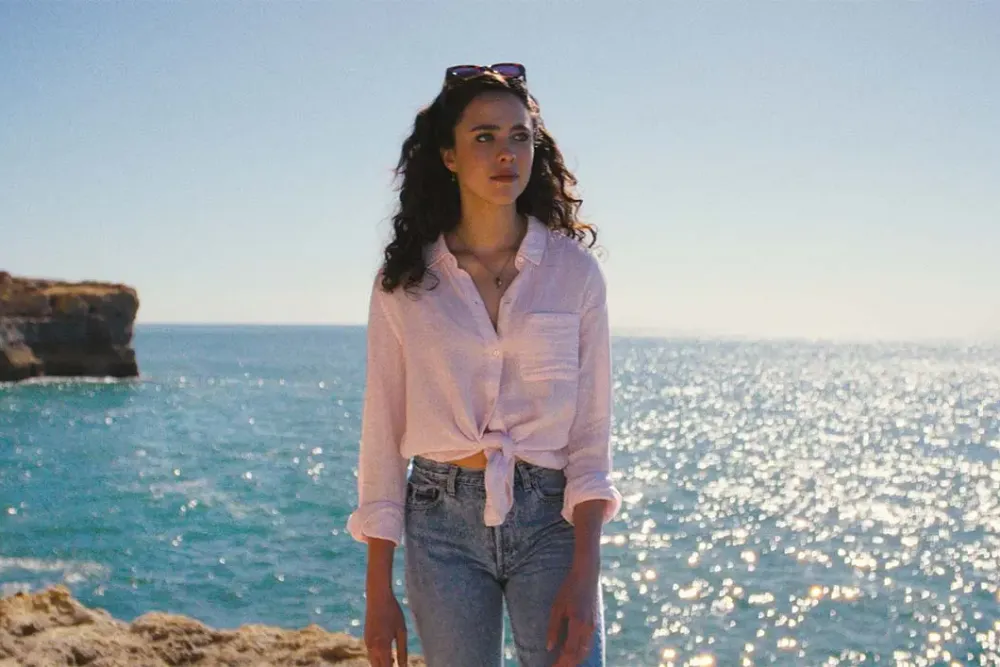
This week sees the release of Love of Your Life, directed by Rachel Morrison and starring Margaret Qualley (The Substance, Once Upon a Time in Hollywood), shot in Lisbon in summer 2025. It’s a romantic comedy about Maya, a 26-year-old nurse who leaves the US for Portugal after her husband’s death and tries to build a new life. Recognisable streets of Lisbon’s historic centre keep flashing by on screen, along with those famous yellow trams.
Foreign directors have filmed in Portugal before, but producers started coming here en masse after 2018, when the government began reimbursing part of the cost of shooting in the country (a so-called cash rebate). Demand was so high that in 2022, when Fast X was being shot here, the programme’s annual budget (€12 million) ran out by May: 43 projects had applied. According to an assessment commissioned by the government, by 2023 the programme had supported 168 films and series, with €238 million invested in production, more than half of it from abroad. In those years Portugal was also chosen by major international productions, such as the final season of the Spanish hit Money Heist. In 2026 the scheme was relaunched as SCRI.PT, with its budget raised to €350 million over four years.
Alena Khazinurova has picked ten of the best-known films and series shot in Portugal for Xpat.Land and explains exactly where they were filmed.
1. On Her Majesty’s Secret Service (1969, directed by Peter R. Hunt)
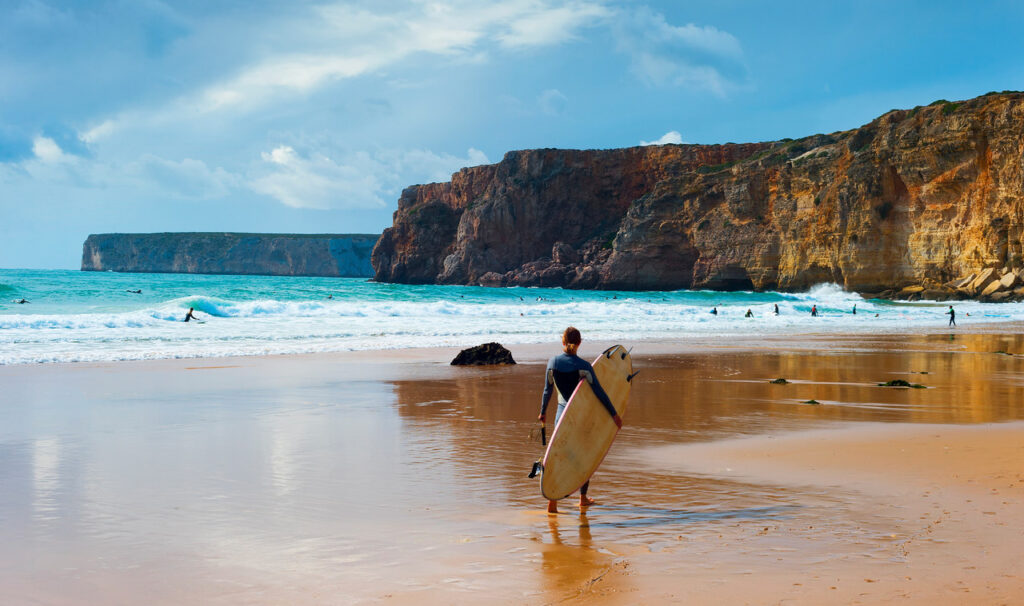
The sixth Bond film and the only one in which agent 007 was played by George Lazenby. It holds a special place in the Bond story: this is where he meets Tracy, the only woman he ever marries. Their first encounter takes place on Guincho beach near Cascais, where Bond pulls Tracy out of the waves. Guincho is still known as one of the wildest and windiest beaches on the Lisbon coast: surfers and kitesurfers flock here, and the hills of Sintra rise beyond the dunes.
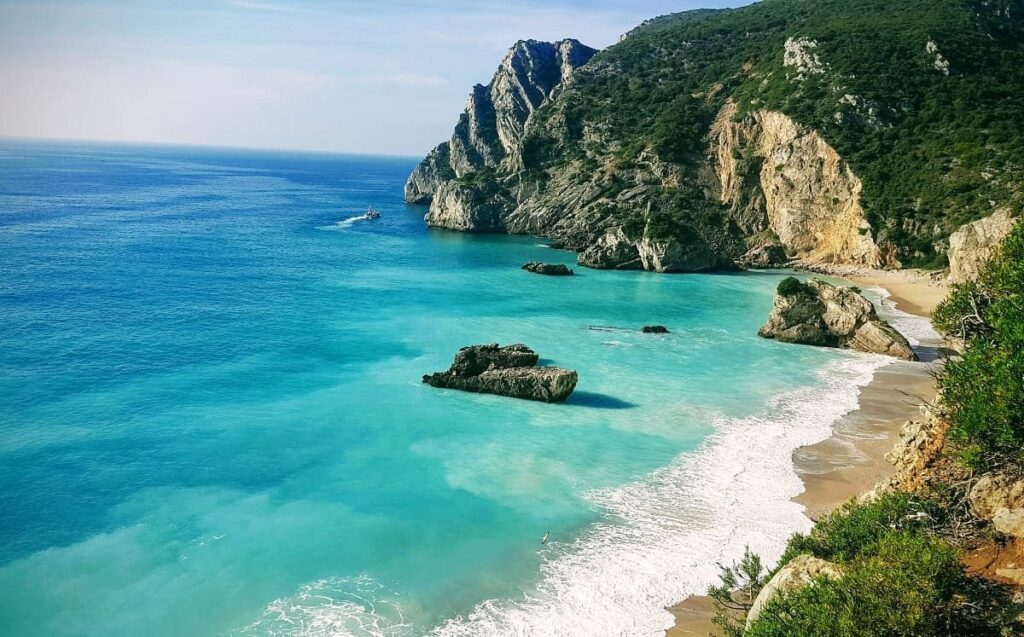
The film also features the 25 de Abril Bridge (at the time of filming it was still called the Salazar Bridge) and the Hotel Palácio in Estoril, where Bond and Tracy stay in the story. During the Second World War, Estoril was the main resort of neutral Portugal; spies from both sides stayed at this hotel, and its guests included Ian Fleming, the future author of the Bond novels. The estate of Tracy’s father was filmed at Herdade do Zambujal in Palmela. The final scene was shot on one of Portugal’s most scenic roads, in the Arrábida Natural Park, where limestone hills drop straight into the turquoise Atlantic between Setúbal and Sesimbra.
2. The Boys from Brazil (1978, directed by Franklin J. Schaffner)
A British-American thriller based on Ira Levin’s novel of the same name. The film became widely known for its blend of political conspiracy, science fiction and psychological drama, as well as for its strong cast: Gregory Peck (To Kill a Mockingbird, Roman Holiday) plays Nazi criminal Josef Mengele, hiding in South America, and Laurence Olivier (Hamlet, Pride and Prejudice) plays a Nazi hunter. The film received three Oscar nominations, including one singling out Olivier for Best Actor.
Portugal stands in for Paraguay and Brazil in this film. In Lisbon, scenes were shot at the Hotel Tivoli on Avenida da Liberdade (turned into the South American Hotel Flamingo), at the Santa Clara market in Alfama, next to which the Feira da Ladra flea market runs on Tuesdays and Saturdays, and at the Palacete Mendonça, an early-20th-century neoclassical mansion now owned by the Ismaili Imamat.
3. The House of the Spirits (1993, directed by Bille August)
A historical drama by Danish director Bille August, based on the novel of the same name by Isabel Allende, writer and niece of former Chilean president Salvador Allende. The film follows several generations of a Chilean family, weaving together love, family conflict, political upheaval and the supernatural. It probably has the starriest cast of any production shot in Portugal: Meryl Streep, Antonio Banderas, Jeremy Irons (Reversal of Fortune, Die Hard with a Vengeance), Glenn Close (Fatal Attraction, Dangerous Liaisons, 101 Dalmatians), Winona Ryder (Edward Scissorhands, Little Women) and others. Even the soundtrack is star-studded: it was composed by Hans Zimmer.
Here Portugal plays Chile. Filming took place at Cabo Espichel near Sesimbra, a deserted plateau above sheer cliffs with an 18th-century pilgrimage church, and at the Queluz Palace, known as the Portuguese Versailles. In Lisbon, scenes were shot in the Jesuit church of São Roque in Bairro Alto, home to one of the richest Baroque chapels in Europe. The film also shows the grand staircase of the Palácio de São Bento, the Portuguese parliament building and a former Benedictine monastery. Some of the large-scale sets were built in the Alentejo.
4. Queen Margot (La Reine Margot, 1994, directed by Patrice Chéreau)
A historical drama about the French Wars of Religion and the tragic fate of Princess Marguerite de Valois, based on Alexandre Dumas’s novel of the same name. The lead role is played by Isabelle Adjani (Possession). The film won the Jury Prize at Cannes and became one of the best-known French costume dramas of the 1990s.
The role of the 16th-century Louvre in Paris, then the residence of the French kings, was played by the National Palace of Mafra, 40 km from Lisbon. King João V built this palace-monastery in the 18th century with Brazilian gold, and it is one of the largest Baroque buildings in Europe. It has hundreds of rooms, countless corridors, a basilica with several organs and a famous library whose books are guarded from insects at night by bats. Since 2019 the complex has been a UNESCO World Heritage Site.
5. Lisbon Story (1994, directed by Wim Wenders)
A feature film by German director Wim Wenders, made as a declaration of love to Lisbon, and perhaps the definitive film about the city by a foreigner. Wenders conceived it for the year Lisbon was European Capital of Culture. In the story, a sound engineer arrives in the Portuguese capital to help a director finish a film about the city and wanders through Alfama with a microphone, recording the sounds of its staircases, courtyards and trams. Alfama is Lisbon’s oldest district: it was barely damaged in the 1755 earthquake and has kept its medieval tangle of streets. The music, and a cameo on screen, come from the band Madredeus, who became famous far beyond Portugal after the film.
6. The Ninth Gate (1999, directed by Roman Polanski)
A supernatural thriller starring Johnny Depp. In the story, a rare-book dealer is hired to authenticate a book that, according to legend, can summon the Devil. His search takes him to Europe, where dangerous people are hunting for the book.
It would be hard to find a better place for such a plot than Sintra, a UNESCO World Heritage town of Masonic estates, romantic palaces and misty forests. Scenes were shot at the late-19th-century neo-Gothic Biester Palace, decorated with Templar symbols and occult signs, which suited the film’s atmosphere perfectly. Some shots were also filmed at the Hotel Central opposite the National Palace of Sintra and in the town’s central streets.
7. Night Train to Lisbon (2013, directed by Bille August)
A philosophical drama with elements of mystery and romance, based on the bestseller by Swiss writer Pascal Mercier. The cast includes Jeremy Irons, Charlotte Rampling (The Night Porter, Melancholia, Dune), Bruno Ganz (Wings of Desire, Downfall) and Christopher Lee (The Lord of the Rings, Dracula). In the story, a Swiss teacher finds a book by a Portuguese doctor and travels to Lisbon to find out who its author was. Gradually he learns about the doctor’s role in the resistance to Salazar’s dictatorship, a tragic love affair and difficult moral choices.
This is a rare foreign film in which Lisbon is not a backdrop but part of the plot. The hero arrives at Santa Apolónia, the city’s oldest railway station, where trains from Spain and the north of the country still arrive. Plenty of recognisable places appear on screen, right up to the Miradouro de São Pedro de Alcântara viewpoint at the top of the Glória funicular, which looks out over São Jorge Castle and the whole of Baixa.
8. Glória (2021, directed by Tiago Guedes)
A spy thriller about the confrontation between American and Soviet intelligence services on Portuguese soil in the late 1960s, and the first Portuguese series on Netflix. In the story, a young engineer with ties to the Portuguese regime takes a job at the American radio station RARET in the small village of Glória do Ribatejo, but is recruited by the KGB.
During the Cold War, the RARET station really did operate in Glória do Ribatejo, broadcasting Radio Free Europe to the Soviet bloc. So the setting is quite real, though the story of the Soviet spy is fiction. The series was filmed in Lisbon and in the Ribatejo region, a flat stretch of land along the Tagus north-east of the capital, known for its stud farms, bullfighting and rice fields.
9. Fast X (2023, directed by Louis Leterrier)
One of the largest foreign productions in the country’s history, with a crew of 600–700 people working in Portugal. Alongside Vin Diesel and Jason Momoa (Aquaman, Dune), the film features Portuguese actors Daniela Melchior (The Suicide Squad, Guardians of the Galaxy Vol. 3) and Joaquim de Almeida (Desperado, Fast Five).
The characters arrive in Portugal by boat at Cais do Ginjal in Almada, a strip of abandoned warehouses on the south bank of the Tagus with a great view of Lisbon. Cars race from the Boca do Vento panoramic lift, which links Almada’s old centre with the riverbank, to Quinta da Arealva. The tunnel chase was filmed on the A24 motorway near Vila Real, on the approach to the Douro wine valley. Filming also took place in Viseu.
The shoot had an unpleasant aftermath: Portuguese authorities dragged out the bureaucratic procedures for the cash rebate owed to local production companies for more than a year, which badly damaged their reputation in the eyes of Universal. The money was eventually paid, but the scandal forced Portugal to completely overhaul its system of public film funding.
10. Turn of the Tide (Rabo de Peixe, 2023–2026, directed by Patrícia Sequeira and Augusto Fraga)
A Portuguese crime drama series with thriller elements about friends from the island of São Miguel whose lives change after a large haul of cocaine washes up on the shore. It is Portugal’s biggest Netflix hit and the platform’s second Portuguese series after Glória: its first season made the global top 10 of most-watched non-English-language series.
Filming took place in the Azores, primarily in the fishing village of Rabo de Peixe in the municipality of Ribeira Grande. The island’s signature landscapes also appear on screen: the Sete Cidades lakes in the crater of an extinct volcano, the islet off Vila Franca do Campo with a round bay inside its crater, and the Furnas valley with its hot springs, where locals cook cozido stew in the ground. After the series’ success, Ribeira Grande’s town hall launched a tourist route around the filming locations.
Interestingly, the series is based on real events: in 2001 a smugglers’ sailing boat carrying half a tonne of cocaine sank off the Azores.