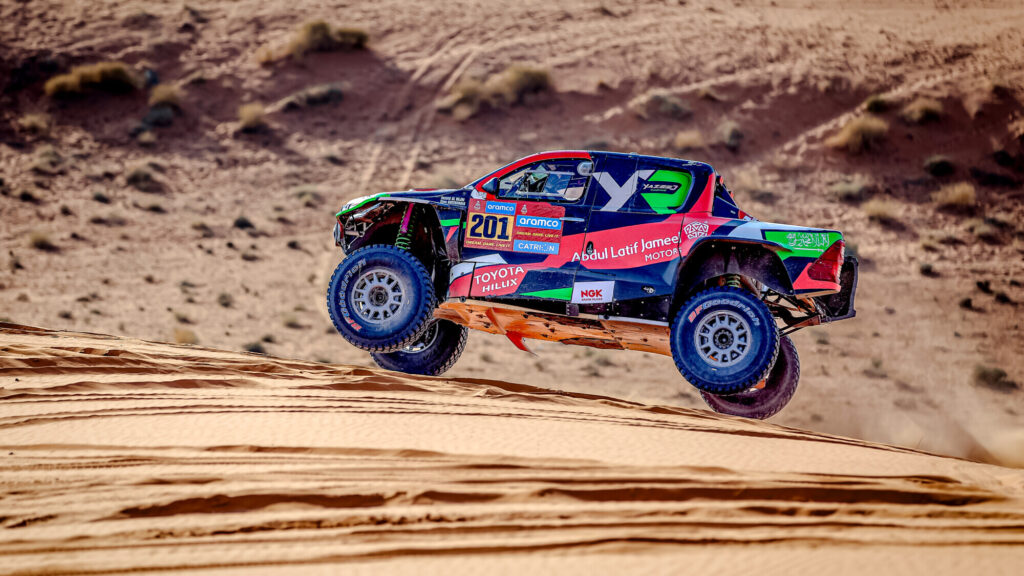
The Dakar Rally, the world’s most famous off-road race, will start in Portugal in January 2027. The race organiser, the French company ASO (Amaury Sport Organisation, which also runs the Tour de France), announced on 30 October that the 49th edition will run from 9 to 23 January on a route from Loulé and Faro to Marrakech. The dates still have to be approved by the FIA World Motor Sport Council. Crews will cover 7,824 km, 4,341 km of them on special stages (the timed sections). The Algarve will host the prologue and the first special stage, after which the caravan will cross the Mediterranean to Morocco. The remaining 11 stages and the rest day in Agadir will take place there.
Just a month ago, the race was planned for Saudi Arabia from 1 to 15 January. The kingdom had hosted the Dakar since 2020, but ASO and the Saudi company SMC dropped the plan, citing “recent events in the region.” Portuguese media link the decision to the escalating conflict between Yemen’s Houthis and Saudi Arabia. The organisers had about two months to put together a new route. Race director David Castera insisted that the rush would not make the Dakar any easier. In his words, starting in Portugal is a chance to take the rally back to its roots, to the journey from Europe to Africa. The 50th-anniversary Dakar in 2028 is due to return to Saudi Arabia.
A race that began when a man got lost
The Dakar’s story began in 1977. French motorcycle racer Thierry Sabine was competing in the Abidjan–Nice rally when he got lost in the Sahara and spent several days alone in the desert. Once he made it out, he decided the experience was worth turning into a competition. In December 1978, the first Paris–Dakar rally set off from Paris: the route crossed the Mediterranean and the Sahara and finished in the Senegalese capital. The race grew quickly, and by the mid-1980s hundreds of crews were lining up at the start. Factory teams from Porsche, Peugeot and Mitsubishi competed side by side with amateurs who drove into the desert in their own cars and on their own motorbikes. It was this mix of world-class motorsport and something close to a tourist adventure that made the Dakar famous.
The rally soon became a society event too. In 1982, the crew of Mark Thatcher, son of British Prime Minister Margaret Thatcher, went missing in the desert for several days, and the search for him became international news. Four years later the race suffered its worst tragedy: during the 1986 rally, a helicopter was caught in a sandstorm in Mali and crashed. Thierry Sabine, the popular French singer Daniel Balavoine and three other people were killed. Sabine’s father took over the organisation of the race, and the rights later passed to ASO.
Danger has always been part of the Dakar’s reputation, and not only for the drivers. According to figures compiled from public sources, more than 70 people have died over the rally’s history. More than half of them were not competitors: they were journalists, mechanics, spectators and local residents, including children hit by vehicles in African villages. For years critics accused the organisers of barely taking these deaths into account. Even so, the race kept attracting the best drivers. The record belongs to Frenchman Stéphane Peterhansel, with 14 wins: six on a motorbike and eight in a car.
In the mid-2000s, the Dakar twice started in Lisbon, in 2006 and 2007. In January 2008, competitors gathered in the Portuguese capital once again, but on 4 January, the day before the start, ASO cancelled the race for the first time in its history. Shortly before, four French tourists had been killed in Mauritania, through which half of the route was due to pass. The attack was blamed on a group linked to al-Qaeda, and the French government advised against holding stages in the country. A year later, the Dakar, keeping its name, moved to South America, where it was held for ten years in Argentina, Chile, Peru, Bolivia and Paraguay. One by one, the host countries pulled out, and in 2019 the race took place in Peru alone. In 2020 the rally moved to Saudi Arabia, which made it part of its programme to develop sport and tourism. Today the Dakar opens the World Rally-Raid Championship season, and since 2021 it has also included the Dakar Classic, a competition for historic vehicles. The January race will be the first in Africa since 2007 and the first in 20 years to start in Europe.
What spectators will see
People come to the Dakar from all over the world, and not just for the sport. For motorsport fans, seeing it live is roughly what a football fan feels about getting to a World Cup final. Yet the atmosphere is far more down-to-earth than in Formula 1. World-class drivers work in a shared service area alongside mechanics and amateurs, and you usually don’t need tickets for scrutineering, the start or the route. Many people turn the race into a road trip: they travel in groups in their own 4x4s, follow the caravan and spend a week immersed in the rally. For the past seven years, Europeans had to fly to Saudi Arabia for this, so the start in the Algarve is likely to draw big crowds. It’s best to book accommodation around Faro early, although André Gomes, head of the Algarve Tourism Board, points out that January is traditionally the low season for the region.
Bear in mind that a rally-raid works differently from circuit racing. There are no grandstands, and each vehicle flashes past in a few seconds. On the other hand, there are several hundred competitors — motorbikes, quads, buggies, 4x4s and multi-tonne trucks — and the stream goes on for hours. Following the race standings is easier in the app; going in person is about the machines and the atmosphere.
The Portuguese leg will begin on 6 January. Over three days, administrative checks and scrutineering will take place at the Algarve Stadium (Estádio Algarve) between Loulé and Faro, which will serve as the race’s operations hub. This is probably where first-timers and families with children will have the most fun: you can see the vehicles up close and talk to the teams. The organisers haven’t yet published spectator access conditions. On 9 January, the competitors will take on the Loulé–Faro prologue, a short timed section that sets the starting order, which the whole field completes in a single day. The next day, the first stage of around 300 km gets underway, after which the caravan will head to the port and cross overnight to Nador in Morocco. Spectator zones along the route haven’t been announced yet; look for them on the Dakar website closer to the start.
If you’re after the classic Dakar picture of dunes and desert, you’ll have to go to Morocco. But the stages there run through remote areas: you’ll need a 4×4, a local guide and time to spare, and viewing points are announced late. The easiest option is to fly to Agadir on 17 January, the rest day, when the entire race camp (the bivouac) stays put, or to Marrakech for the finish on 23 January. Wherever you watch, remember that spectators at rallies get injured more often than people think, almost always because they’re standing in the wrong place. Watch from the permitted zones, keep well away from the outside of bends and jumps, and follow the marshals’ instructions.
Those staying at home can watch too. The Dakar is usually broadcast by around 70 TV channels in 200 countries; in Europe, it’s on Eurosport. Daily highlights are posted on the race’s official YouTube and Facebook channels, and results are published in the Dakar app. Which broadcaster will show the race in Portugal will be announced closer to the start. It’s too late to enter as a competitor: crews apply many months in advance, and the 2027 field was put together when the route was still in Saudi Arabia. You may be able to help with the organisation through the Automóvel Club de Portugal (ACP), which supports ASO in the country. Look for volunteer calls on its website.