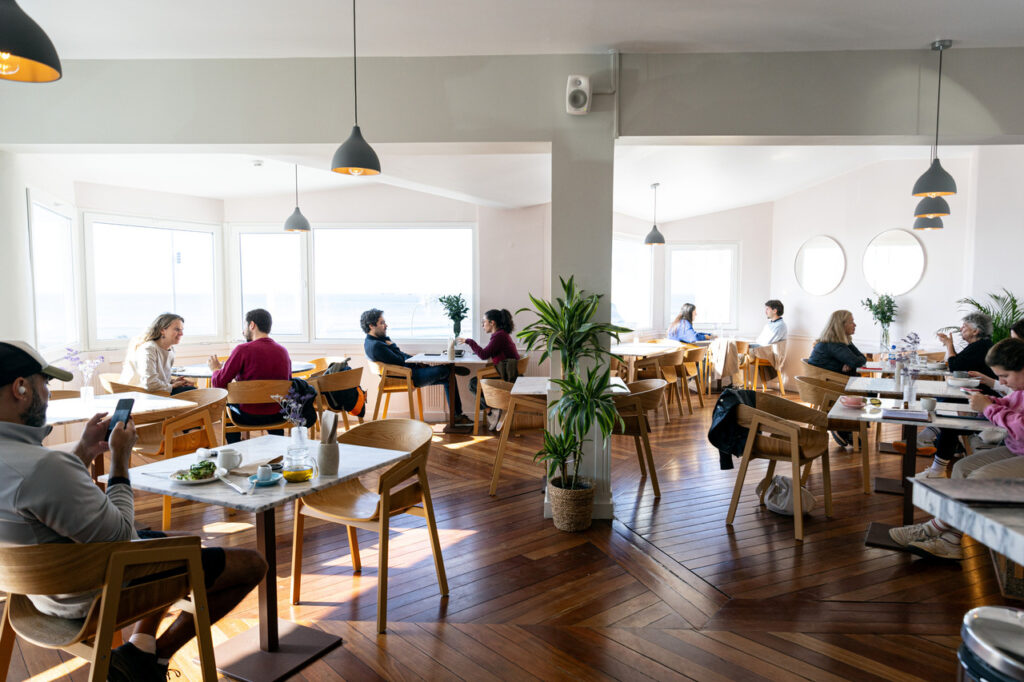
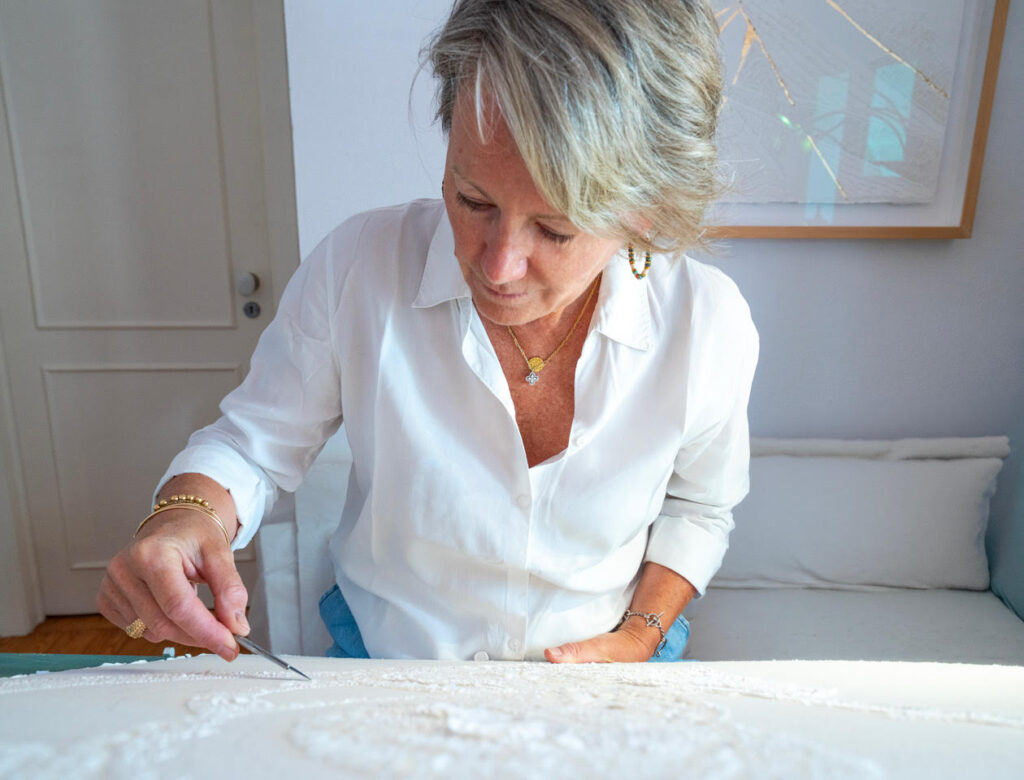
In late October, the group exhibition Golden Hour opened at the Palace of the Dukes of Cadaval in Évora. Among the participants is French artist Séverine de la Chapelle, who was personally invited by Diana de Cadaval; her work is on view until January 6. About ten years ago, Séverine moved to Portugal after 11 years in Asia: she first lived in Estoril by the ocean and now works in a Lisbon studio overlooking São Jorge Castle. Here she found her material — thick cotton paper that she turns into sculptural reliefs with nothing but a blade and no paint. The pandemic became a turning point: her work got noticed, and today it is shown in Geneva, Paris, Singapore and New York, with a charity auction in Brussels coming up. Xpat.Land correspondent Anna Sadova visited the artist in her studio and talked to her about her “Japanese soul,” imposter syndrome, and what Portugal’s ocean and the forests of Sintra give her.
The Birth of a Technique
Séverine de la Chapelle’s artistic journey began long before her paper reliefs, though it took a very different shape at first. After studying fine arts in France, she initially worked with oil painting, where color and pigments set the mood on the canvas.
Over time, she realized that the loud colors were hiding the essence of what she wanted to say. Séverine longed for something completely different: quietness, purity, and simplicity. The turning point came in Singapore. There, she saw an artwork made by cutting paper — something right between sculpture and drawing. It struck a deep chord inside her. She found a Japanese master and began studying the technique.
“My teacher always told me: ‘Séverine, you have a Japanese soul.’ Later, when I started learning this technique, I thought she might be right, because I truly feel like I live between two worlds. Zen philosophy, the Ensō circle (editor’s note: a Japanese Zen circle drawn in one continuous brushstroke), and calligraphy feel very close to my soul and my art. I love simplicity that has hard technical work behind it. Depending on your mood, every gesture and every simple line will turn out differently,” she says.
After moving to Portugal, Séverine began testing new materials. She soon realized that the ideal surface for her work was French 100% cotton paper weighing 640 g/m² — thick, sturdy, and with an elegant, matte off-white texture.
“I love its thickness. This brand (Arches — ed.) has three different finishes: very rough, medium — which is the one I use — and smooth satin with almost no grain. I really like its finish; it feels imperfect and alive,” the artist explains.
Instead of brushes, a sharp blade became her main tool. With it, she cuts and lifts the layers of paper, creating a dynamic 3D surface without using any paint:
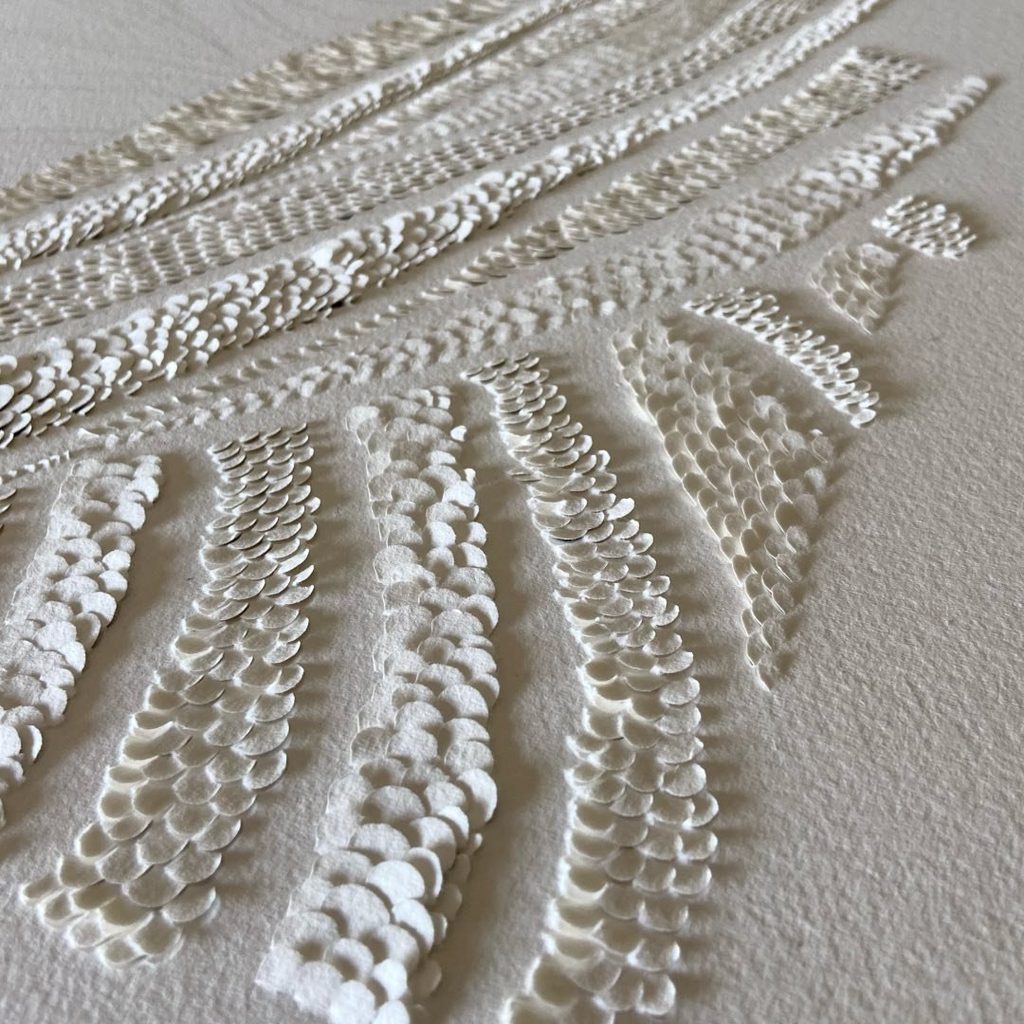
“I love the repetitive movement — it is like a meditation. You feel the tension in the paper, and then the relief rises, just like a breath. I don’t plan the cuts in advance. I decide where the light and shadows will go, but the actual sculpting process isn’t planned out. It all happens in a natural flow.”
The Philosophy of Gesture
Séverine’s creative process is deeply rooted in Eastern aesthetics. Like calligraphy or meditation, her work requires total focus, where every cut must be precise. She finds deep meaning in Eastern discipline and the quiet mental preparation needed before making a single gesture: before touching a blank sheet, an artist must clear the mind.
“Asian culture had a huge influence on me — especially the quiet and the Zen spirit. It is a mix of simplicity and hidden strength: a single gesture or circle, but made with power, deep roots, and the refined elegance of Japanese art,” she explains.
For Séverine, repeating the cuts is not mechanical work, but a form of reflection and a dialogue between tension and release. The off-white color is central: it stands for purity, peace, and light. The contrast between black and white, light and shadow, reflects the Yin and Yang concept — opposites coming together into harmony.
Only rarely does Séverine add gold leaf or experiment with silk thread. Her goal is always to keep the piece light and poetic without turning it into cold geometry.
A Quiet Space and the Pull of Nature
To create, Séverine needs complete solitude, something she describes as staying inside her own “protective cocoon.” Working with paper takes patience: spending quiet hours alone with a white sheet helps her stay centered and listen to her intuition.
She works in her home studio overlooking São Jorge Castle. The studio mirrors her art: clean, simple, and organized. Blades are neatly sorted into boxes, and canvases are stacked in the corner.
“I like to work while listening to audiobooks. When one side of my brain is listening to the story in my headphones, the other is completely free to move spontaneously. That’s how I find my flow,” she shares.
Nature is her greatest source of energy. When the family moved to Portugal about ten years ago, they first settled in Estoril by the Atlantic Ocean, which fit her lifestyle perfectly. Walks along the water, the sound of the waves, and the ancient forests of Sintra give her fresh perspective and inspiration.
Even now, living in Lisbon with its narrow streets and stone walls built to block the strong sun, Séverine tries to stay open to the elements. Looking back, key moments in her life seemed decided long ago: while still in France, she named her two dogs Shanghai and Vasco — quietly foreshadowing her moves first to Asia, and then to Portugal. She feels many things in her life happened this way.
“I believe we follow a script that is already written, though not without effort on our part. For example, when I was struggling to find a new style, I asked inside for a sign to bring me back to art. That is how I ended up at that life-changing exhibition, which inspired everything you see today,” Séverine explains.
Imposter Syndrome, the Art Market, and Global Recognition
The pandemic was a major turning point in her career. She used those weeks of lockdown to create continuously in her studio. When people started noticing her work on social media and pieces began finding buyers, Séverine struggled with imposter syndrome. Setting prices for her art felt very hard.
Friends in the art world stepped in and helped her build her first real price list. Soon, her work was being shown in Geneva, Paris, Singapore, and New York.
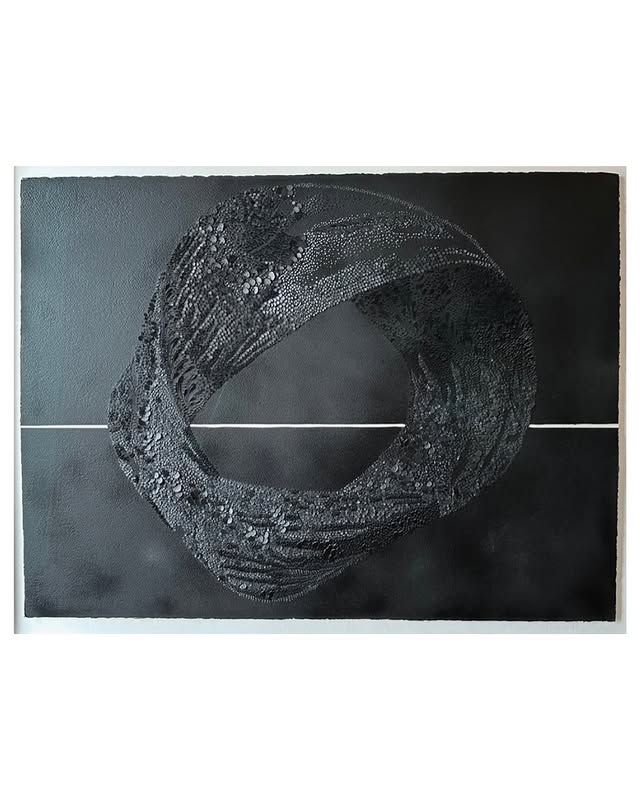
“When people first see this kind of art made without oil or acrylic, they are genuinely surprised. At first they like it, but they also have mixed feelings — they don’t quite know how to take it in. It requires training your eye. Quite often, someone sees a piece, thinks about it, and comes back a year later ready to buy it,” Séverine says.
Although earning money makes her proud, she values recognition from her family, her viewers, and her buyers far more.
“I love watching my family’s reaction: now that my work is really gaining popularity on the market, my husband and children look at my path with admiration. It’s also amazing to hear collectors talk about my work. They often describe the feelings behind it far more eloquently than I could myself,” the artist says.
Future Projects and a Message of Peace
Séverine’s career has now reached a new level. Her work is currently on view in the group exhibition “Golden Hour” at the Palace of the Dukes of Cadaval in Évora, where she was personally invited by Diana de Cadaval. The exhibition runs from October 31 to January 6.
At the same time, a charity auction and exhibition called “Empreinte” (Imprint) is being organized in Brussels, where one of her large-scale works will hang alongside pieces by leading European artists. The starting price for Séverine’s piece at the auction is currently €3,400.
For her, commercial success matters far less than creative freedom and honest connection: using fragile paper to share a sense of calm, light, and inner peace.
“I handle both the art and the business myself. I thought about hiring an art agent, but I prefer moving at my own pace and following my intuition. If someone tries to push me in a direction where I can’t express what I feel, it doesn’t work for me. I can’t stand being boxed in, and I protect my freedom above all else. I believe that through my work, I share a message of peace that people need so deeply today.”