
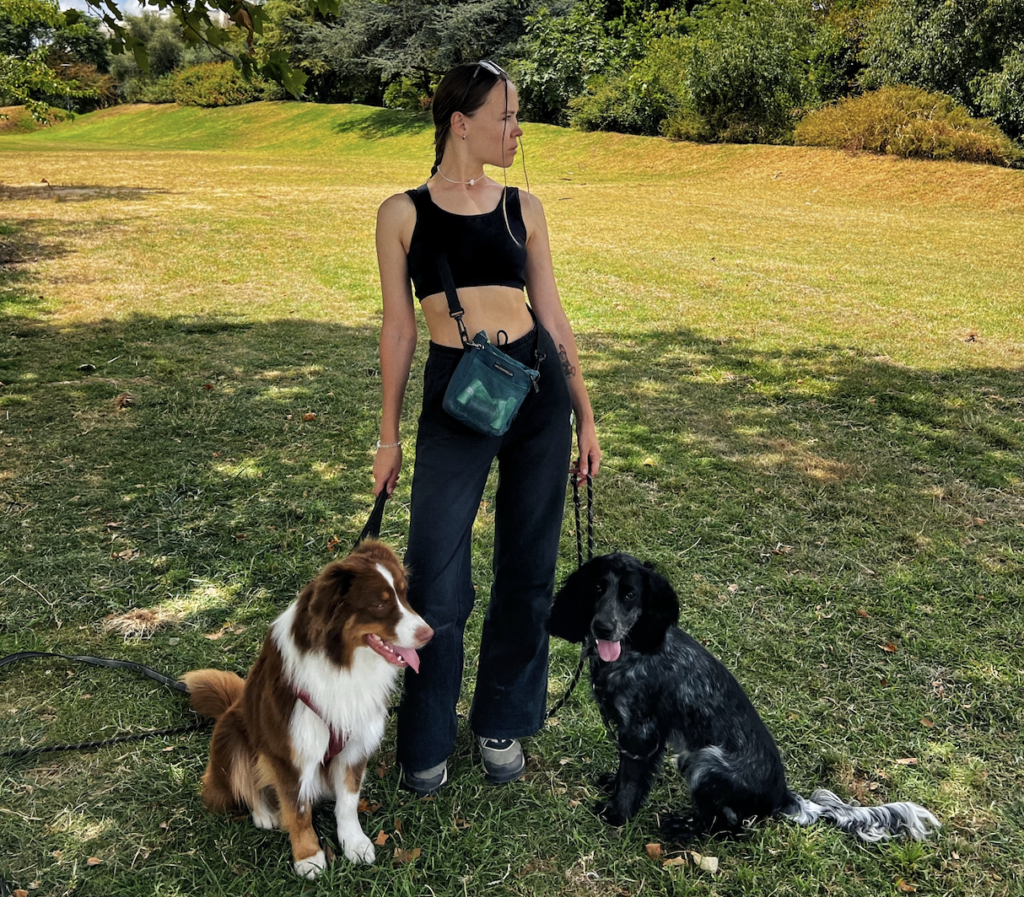
In emigration, many people have to “reinvent” themselves and look for new — sometimes unexpected — ways to earn a living. Yulia Mosova moved to Lisbon from Izhevsk. She worked in IT but decided to leave a stable position to take up pet-sitting — paid care for animals. Usually owners turn to such services when they’re going away somewhere. These days, Yulia’s Instagram proudly reads “Lisbon’s best dog nanny.” Her bookings are full six months out. On top of that, she regularly trains future pet-sitters. What she earns from caring for pets is enough to fully support herself. And recently, with the money she saved up from boarding animals, Yulia bought… a convertible! Xpat.Land spoke with her about how to build a successful business out of a love for animals. We’re publishing Yulia’s monologue.
Two and a half years ago my dog Tyapa died, and I took it very hard. A month after her death, I saw a message in one of the emigrant chats asking someone to board a corgi for three weeks. I responded to it back then without expecting anything in particular.
I was very nervous. I had absolutely no idea how it was all supposed to work. We discussed the details with the dog’s owners for a long time and met several times beforehand. They looked at my apartment, where their corgi would be living, and asked where we’d go for walks. I got to know Charlie and learned in detail from the owners about his quirks, his character, his daily routine, and everything, everything, everything.
He was still a puppy, just a few months old. He needed a lot of attention and play, and I also had to make sure he slept well. In short, I had to keep an eye on everything.
While we were out walking, I discovered through trial and error that whenever I sang, he’d start running for some reason. I filmed it on video and posted it on Instagram: it was my first clip about pet-sitting, and it took off immediately — it got more than 400 thousand views.
Charlie really helped me get through the death of my dog back then.
All the love, care, and attention I had so much of inside me, I gave to Charlie at that time. A new world opened up: it turned out I could do more than just suffer and wallow in my pain — I could take all that love I’d given to my Tyapa and give it to another dog.
I was ready to do it even for free, because it filled me up so much.
That’s why I was simply stunned when, three weeks later, the owners came back and paid me 500 euros. We had discussed that amount once at the very beginning, but then we never made a big deal of it, and I honestly hadn’t even been thinking about the money. When they sent me the payment, my mind was just blown. What? For doing something I love, something I get a thrill out of, something that gives me so much love — I get paid on top of it? Wow!
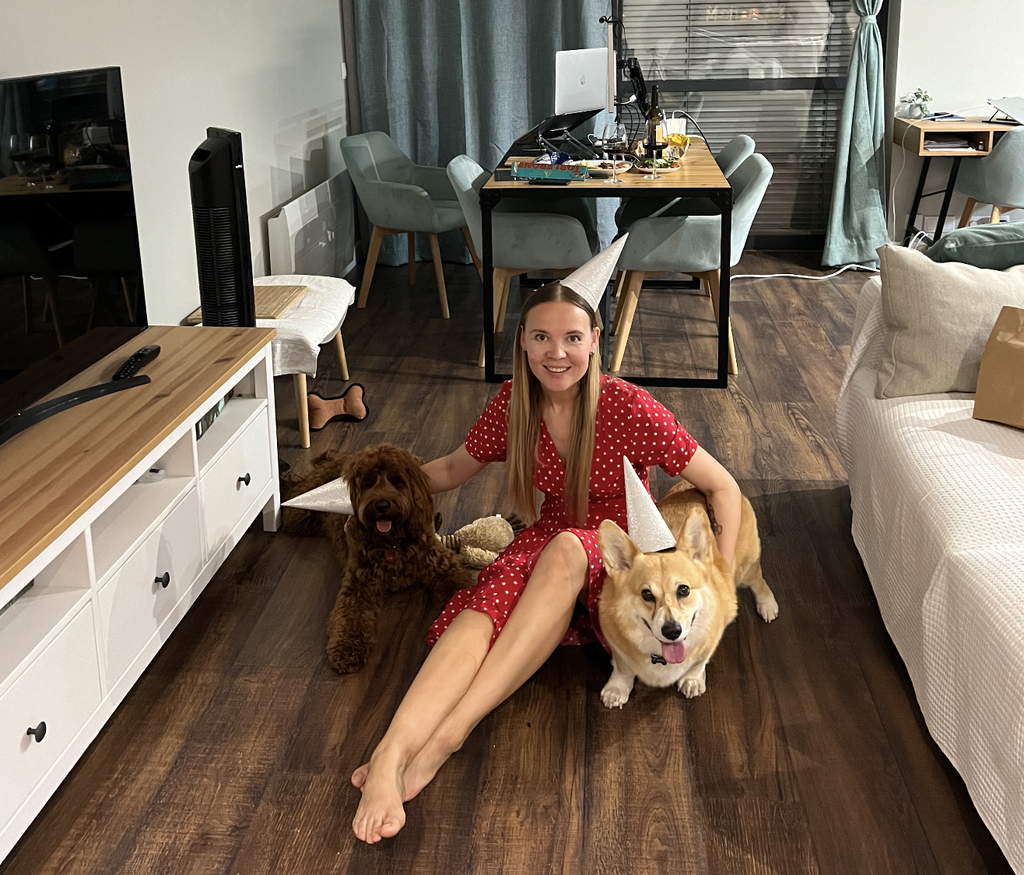
Around the same time, I was let go from the IT company where I’d worked as a project manager, and I decided to take the risk and make pet-sitting my job. After that it’s all a blur: I started responding to more and more of these ads, I put together a presentation about myself, I read up on breeds and temperaments, I outfitted my apartment — I bought non-slip mats, ramps, shampoos, towels, toys, long leashes, and so on. Once I got a car, I set up a spot in it for the dogs where they can feel comfortable and safe. After Charlie, I kept filming fun videos with dogs, and they took off too — and brought me a new audience. Twice, videos like that got more than a million views.
I did my job well, and people wanted to entrust their pets specifically to me. At first I posted ads for my services in the Lisbon animal-boarding chat, then regular clients appeared, they wrote reviews, word of mouth kicked in, and there were more and more bookings. I started to understand dog behavior more deeply, went to study to become a dog trainer, and became one of the most sought-after dog nannies in Lisbon.
“I created a profession for myself”
Before I went into IT, I worked for 12 years at a construction firm in Izhevsk. I came in as a realtor, then was an office manager, and gradually rose to deputy director. I had a staff of 100 people, I oversaw the work of 10 departments, held meetings, put together reports, was responsible for the company’s growth, and hired and fired people. In short, I did absolutely everything.
I came into IT shortly before moving to Portugal. It was a position with similar functions: I handled communication with clients, including huge state holding companies, and oversaw the work of analysts and programmers. I really liked it — there was stability, a clear-cut profession, experience. I knew I was good at it and roughly how much I could earn. So losing that job was pretty scary.
But now I understand that pet-sitting turned out to be a far better fit for me. Here I feel like I’m in my element, I grow and develop very quickly, I do what I love, I learn more and more about animals. And in two years I’ve found fulfillment and started earning more than I did in IT.
I really love the feeling that I created a profession for myself and gradually turned what was once just a love for animals into a full-fledged business.
Pet-sitting is only one of my areas of work. I also offer a service of hour-long, high-quality dog walks on a daily basis, for when owners don’t have the time for it. There’s a cat-care service for when owners are away. I come to feed them, clean up after them, and play with them so they’re not lonely. You can book pet transport through me if an animal needs to be taken somewhere. And there’s also a special dog-training support service — I work with the dog as a trainer and write up detailed recommendations for the owners.
A separate area is training people in the pet-sitting profession. When I got more bookings than I could physically take on, I realized I needed a partner I could confidently recommend. At first it was just one woman, to whom I passed on all my knowledge, but now I already have 13 partners in Lisbon and more than 60 people around the world who have completed my training. I wrote an online course for dog nannies who want to approach this profession thoughtfully and understand animals. I didn’t copy anything from anyone — I organized my own experience and the knowledge I gained while studying to be a dog trainer into my own training system.
Recently I launched a bot that connects Russian-speaking dog nannies and pet owners all over the world. And I also run a blog about pet-sitting with 17 thousand subscribers, where I promote a thoughtful approach to the profession. And I still have plenty of ideas and drive!
Just being a pet-sitter doesn’t satisfy me — I want to be the best and to scale up. This mindset is a reminder of my previous jobs in management positions.
“People get a premium-level service”
At the very beginning, of course, I earned quite small amounts. I was just starting out and saw it more as extra income. It came to up to 500 euros a month. Now I earn on average 2,000–2,500 euros a month. The most I’ve ever made in a month is 3,500 euros.
On average in Lisbon, sitters charge roughly 20–35 euros a day. I started at 20 euros too, but now boarding with me costs 50–60 euros a day. That’s one of the highest rates for boarding in Lisbon.
If people come to me, they get a premium-level service: this is my main job, so the animal gets constant individual attention, walks, and care, and my home is organized around them.

I take in animals with all sorts of behavioral or health issues, and the owner regularly gets photos and updates on how the animal is doing. And — most importantly — I don’t go for quantity; quality matters more to me, so I never look after more than two animals at once.
Every dog has its own daily routine that it’s used to at home, and I always keep to it. There are some I need to be out walking with by 6 a.m. And there are others that get up when I get up. There can be 3–4 walks a day, each lasting about an hour. But some dogs don’t need that many, while others, on the contrary, need more. I always discuss this with the owners in advance and adjust accordingly.
I always add some developmental exercises or socialization tasks to every walk. I manage all of this thanks to the knowledge I gained while studying to be a dog trainer. And it’s not charged separately in any way — it’s my passion. I always clear all of it with the owners, of course.
Every dog has its own feeding schedule; sometimes there are special diets or medications. I keep track of all that too. During the day we always sleep several times. So the dog doesn’t get overexcited, it needs rest, and that’s part of my job too. I keep track of the time, watch the animal’s condition, and provide the conditions for it to rest well.
Plus, every day the owners get lots of photos and videos from me, so they know how their pet is spending its time. I know how important that is to them.
“I never hide incidents from the owners”
It’s important to understand that pet-sitting is by no means “easy” money and not just the joy of being around animals, but also a great deal of responsibility. People entrust dog nannies with the most precious thing they have.
Sometimes emergencies happen. In two years that’s only happened to me a couple of times. Anything can happen; you have to be ready for it and act competently.
Once, on a walk, a dog injured its claw. She’s very active, and we always walk pretty energetically together: running, jumping, climbing through bushes, playing ball. And at one point she runs up to me with blood on her paw. The first thing I did was examine her, then I filmed a video, sent it to the owner, and called her. It turned out that the day before they’d gone to the groomer to trim the dog’s claws, and apparently part of one had come loose. We went home and treated everything — nothing serious happened.
Recently, during a boarding, the dog and I went to the vet. In the evening the dog was fine, but in the morning she couldn’t get up on her hind legs. I immediately notified the owners about this as well, again filmed a video, and took the animal to the doctor. It turned out that several factors had come together: the dog’s age, low muscle mass, and increased walk times. I was really worried then. We followed all the doctor’s recommendations, and by evening it had all passed — the dog was lively and cheerful again.
I never hide incidents like this from the owners; in moments like these I’m always in touch, and we make all the decisions together.
“Lisbon’s best dog nanny”
There’s no official ranking of pet-sitters, of course, but I consider myself Lisbon’s best dog nanny. It’s a reputation that’s taken shape from my work experience, reviews, the number of regular clients, and so on.
What also matters is that I have a dog-training education, and I keep studying and taking part in conferences. I understand cat and dog behavior quite well and can notice things an ordinary sitter might miss.
I’ve built up a very large client base. The heavy workload is felt especially strongly before holidays and in the summer — the dates get booked up well in advance.
I treat a dog as a being with its own character and needs. It’s important to me to understand what exactly gives this particular animal a sense of security, calm, and comfort. I know what it’s afraid of, how it communicates, what excites it or, on the contrary, calms it down.
Usually I’m booked 3–6 months ahead. But the main indicator of popularity for me isn’t even the number of new clients, but the fact that people come back to me for years and recommend me to their friends, and are even willing to pay above market rate. I stopped looking for clients myself a long time ago.
I don’t know whether in 10 years I’ll still be taking in dogs for boarding myself. But I definitely don’t see this as some random, temporary phase. It feels to me like I’ve already moved beyond just pet-sitting. It’s now a whole field that I’ve built up around myself.
Maybe in a few years it’ll transform into something. But for now I definitely don’t want to leave this area.