The number of people in Portugal who have passed the 100-year mark is growing. A mild climate, the Mediterranean diet, sociability and an unhurried pace of life seem like obvious ingredients of this phenomenon. But behind the longevity statistics lies another reality: chronic illness, loss of independence and a shortage of places in elderly care. What actually helps the Portuguese live longer, and how good is that long life?
A country of centenarians
Portugal has more and more people who have turned 100. According to national census data, in 2001 the country had 589 people aged 100 or over. By 2011 the number had risen to 1,526, and by 2021 it had reached 2,801.
This isn’t just a rise in absolute numbers: over twenty years, the number of Portuguese centenarians grew almost fivefold. That said, several factors are behind this trend, including rising life expectancy, changes in the population’s age structure and the growing number of people reaching old age.
Researchers who studied the 2021 census data also identified other characteristic features of Portugal’s centenarians. Around 82% of them are women, and 84.6% are widowed.
These figures show that longevity has a social side as well as a medical one. Most of the country’s centenarians have outlived their spouses, and many have outlived other loved ones too. A long life means not only more time but also the need to adapt to loss, to changes in familiar routines and to a gradual decline in physical abilities.
Age alone, however, says nothing about quality of life. The study Health Profile of Portuguese Centenarians from 2011 to 2021: An Update Based on National Census, in which scientists compared data from two censuses, shows how severe the limitations of very old age can be.
In 2021, 76.3% of people over 100 had serious difficulty walking or climbing stairs, or could not do so on their own. 72.8% had serious limitations with bathing and dressing. At the same time, 64.2% reported no or only minor difficulty understanding others and communicating.
That last figure is particularly important: physical limitations don’t necessarily mean losing the ability to communicate and maintain relationships. Overall, though, the statistics are a reminder that reaching 100 guarantees neither physical independence nor freedom from chronic disease.
So we asked a broader question about longevity: not just about how long people live, but about the quality of their lives — their health, their independence and their ability to run their own lives.
Long life and chronic illness
Sergey Zagidulin, a doctor of internal medicine, currently works at Santa Maria, Lisbon’s largest hospital. In his day-to-day practice, population ageing isn’t an abstract demographic trend but the reality of a hospital ward.
“Ninety to ninety-five per cent of our patients are over 70 or 80. Sometimes they’re 101 or 105,” he says.
According to the doctor, chronic conditions predominate among hospital patients. Cardiovascular diseases come first: heart attacks and strokes. High cholesterol, type 2 diabetes, hypertension and insulin metabolism disorders are also common. Other problems vary by region: for instance, the doctor notes that around Coimbra he more often encounters thyroid disorders.
Sergey also points out that the health of people who reach 100 can differ substantially depending on their socio-economic circumstances.
“Those who stay mentally sharp and active at 100 usually come from well-off families: they lead healthier lives, eat good-quality food and have few bad habits,” he says.
This is the doctor’s observation about the patients he sees, not the conclusion of a dedicated comparative study. Still, it points to an important pattern: a person’s ability to look after their health depends not only on their habits but also on the resources available to them.
A 2024 study by Portugal’s National Statistics Institute (INE) found that the main causes of death were circulatory diseases (25.4%) and cancer (23.9%). Across the EU on average, cardiovascular disease also remains the leading cause of death: in 2023 it accounted for about 32.8% of all deaths, and cancer for about 23.9%. So the share of cancer deaths in Portugal was comparable to the EU average, while the share of cardiovascular deaths was noticeably lower.
The Mediterranean diet: is it available to everyone?
Explaining Portuguese longevity, Sergey highlights several factors, including the country’s geographical location, its climate, genetics and the prevalence of the Mediterranean diet.
The latter is usually associated with vegetables, fruit, legumes, fish, olive oil, nuts and other foods that form the basis of a balanced diet. But the existence of such a culinary tradition doesn’t mean everyone in the country eats the same way.
“The quality of people’s diet often depends on their income. In Portugal you’ll often see longer queues at the meat counter than at the fish counter. People often buy cheap pork, hence the high cholesterol,” the doctor notes.
There’s a similar problem with preventive medicine. People who can afford private clinics get check-ups more often and have a chance to detect some diseases before serious complications set in. Those with limited means are less likely to have preventive medical examinations.
As a result, the same climate and the same national cuisine can go hand in hand with very different living conditions. For some, the Mediterranean diet means a varied diet of fish, vegetables and quality produce. For others, cost becomes the deciding factor in what they eat.
Genetics may also play a role, but in Zagidulin’s view it would be wrong to explain a whole country’s longevity by genetics alone without further research. Life expectancy is shaped by heredity, social conditions, healthcare and everyday activity all at once.
Time outdoors and life without constant rush
Some factors are harder to measure with medical indicators but are visible in everyday life. Sergey observes that the climate lets the Portuguese spend more time outdoors: walking, cycling, meeting at cafés and doing other kinds of physical activity. Unlike countries with long, cold winters, there are more opportunities here to stay mobile all year round.
The doctor also notes a more measured pace of life and a habit of not rushing.
“Constant stress and the frantic pace of big cities don’t help longevity. Here the pace is more measured, and that’s easier on the nervous system,” he believes.
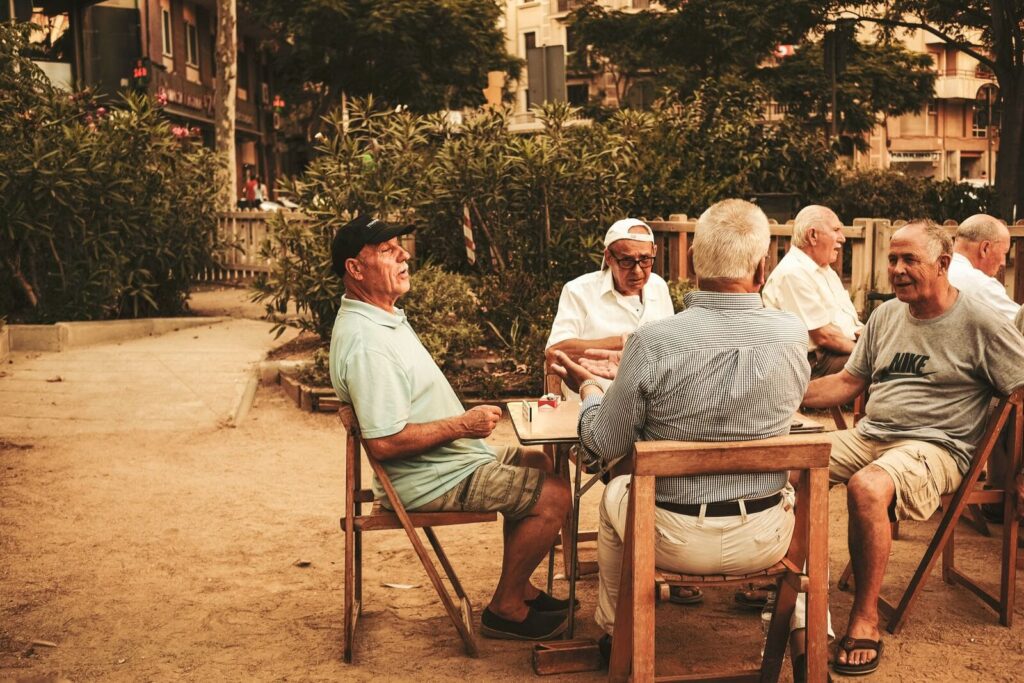
Another trait he highlights is openness and sociability. Meeting for coffee, chatting in the street, spending time with friends and acquaintances can all create natural reasons to leave the house and stay involved in other people’s lives.
But behind this outward activity lie less obvious circumstances. In winter and early spring, homes in Portugal are often cold and damp, and heating is expensive. So a walk or a café meetup is sometimes less a conscious choice in favour of a healthy lifestyle than a way to spend time somewhere more comfortable.
There’s another side to access to healthcare, too. According to Sergey, patients sometimes try to avoid going to A&E unless absolutely necessary, because they know the wait at the urgência can be several hours. In some cases, this means people only see a doctor once the problem has become fairly serious.
Finally, longevity exposes a problem that treatment alone can’t solve. After being discharged from hospital, an elderly person may have nowhere to go: relatives can’t always provide care, private carers are expensive, and there are no places in long-term care facilities.
“In our ward, out of 25 beds, say, seven or eight are occupied by people who have been treated and stabilised but have nowhere to be discharged to. They stay in hospital, taking up beds,” the doctor says.
According to him, social services can’t always meet older people’s needs, and some of the burden effectively falls on the healthcare system. This creates a paradox: medicine helps people live longer, but society isn’t always ready to provide the conditions for a dignified old age. Life expectancy is growing faster than the capacity of families, social infrastructure and the care system.
Sergey also warns against taking the outward wellbeing of smiling Portuguese pensioners too literally.
“It’s their culture: to the question ‘How are you?’ they answer ‘Tudo bem’ on autopilot. Yet they won’t even let their neighbours into the house — they’ll chat on the landing; only family gets close. And in hospital they’re not nearly so happy.”
The psychological factor
Clinical psychologist João Sousa names a sense of meaning in life — knowing what’s worth getting up for in the morning — as one of the key factors in ageing well. It needn’t be some grand goal: it can be caring for loved ones, gardening, meeting friends, a favourite pastime or simply enjoying familiar daily rituals.
“In Portugal we can see strong traditions of family ties, neighbourly relations and community life. These social connections can provide a sense of belonging and continuity, which becomes especially important with age,” Sousa explains.
Socialising: not just company, but a sense of mattering
Regular meetups with friends, family lunches, celebrations and chats with neighbours do more than help older people avoid loneliness. They help preserve familiar social roles and the sense of still being part of a community.
Socialising also provides cognitive stimulation: conversation, humour, memories and swapping news all keep the mind active. And arranging to meet someone can be a very concrete reason to leave the house, go for a walk — in short, keep up a daily routine.
However, the psychologist stresses, what matters is not the number of contacts as such but their quality. A few close, reliable relationships can matter more than many superficial acquaintances. And not every older person has family nearby or the physical ability to take part in community life.
Psychological flexibility: the ability to adapt to change
Another important factor is psychological flexibility. With age, physical condition changes; people have to give up some familiar activities, live through losses and accept new limitations.
“It’s the ability to adapt to life’s changes, accept what’s beyond your control and find meaning in life even in difficult times,” says Sousa.
Such adaptation doesn’t mean meekly putting up with any circumstances. Rather, it’s about being able to tell what you can influence from what you can’t change, and finding available ways to stay independent. In this sense, psychological resilience is not the absence of difficulties but the ability to get through them without losing touch with the world around you and the meaning of your own life.
The link between mental and physical health
Psychological wellbeing also affects everyday health decisions. Chronic stress, loneliness and untreated depression can disrupt sleep, sap motivation and make self-care harder. In turn, physical limitations and chronic illness can worsen mood and reduce opportunities for social contact.
The two feed into each other: someone who feels part of life may find it easier to keep up a routine, stay active and seek help. Meanwhile, declining physical health can set off the opposite process: the person goes out less, loses social contacts and feels increasingly isolated.
At the same time, a healthy psychological state doesn’t mean constant optimism.
“A healthy mindset doesn’t mean always being happy or ignoring difficult emotions. It means being able to feel sadness, uncertainty or disappointment without losing a sense of meaning and connection with the world around you,” Sousa stresses.
The psychologist suggests distinguishing a long life expectancy from a long healthy life expectancy. The goal isn’t simply to add a few years to someone’s life at any cost.
“Ageing with dignity isn’t just about prolonging life, but about preserving connections, autonomy, dignity and joy throughout all those years. When older people continue to feel that they belong to something, that they can contribute and that life still offers moments of pleasure, an important foundation is laid for psychological wellbeing and healthy ageing,” the psychologist concludes.
Movement as a way to stay part of life
What Sousa describes can be seen clearly in group classes for older people. Here, physical activity is both a way to look after the body and a chance to maintain social ties.
Clarisse teaches yoga for older people. Most of her students are over 70; the oldest is 82.
“Some have had a knee replaced, some have fragile bones, so doctors often recommend yoga to them. But despite their chronic conditions, they’re very lively people who happily exercise two or three times a week. Besides yoga they do other activities too, such as aqua aerobics and dancing,” she says.
She also notes that group classes build team spirit: her students make friends and see their fitness improve and their bodies grow stronger. This is the link between movement and socialising that the psychologist talks about. People come not just for the exercise but for the group they belong to. Regular sessions build habits, provide emotional support and help them stay engaged with life.
The flip side of active ageing
Dona Maria, 78, lost her husband seven years ago. She still works in the family shop: she would gladly retire, but she has to pay off her husband’s debts and needs more money.
At the same time, she says work helps her stay socially active, keep her business instincts sharp and talk to customers. Yet behind this activity lies more than a desire to keep moving: for Dona Maria, continuing to work is also a financial necessity.
“For me, the secret of a long life is being able to appreciate what I have and feeling genuine gratitude for every day I’ve lived. I’ve watched eras change, governments change, ways of life change, and I’m still afloat. My health hardly bothers me; I have three children, two grandchildren and friends I regularly get together with for dinners at home and celebrations. Their love and appreciation make me feel important and needed,” she says.
Her words can be read as a life philosophy that helps her cope with loss and stay interested in everyday life. But they are also a reminder that behind an older person’s outward vigour there may be obligations they cannot walk away from. And activity in itself says nothing about how freely a person can dispose of their time and resources.