There are restaurants that sell cuisine, and there are ones that sell memory. Akcentt in Lisbon’s Arroios is unmistakably the latter: a tiny place where the cooking feels like your Ukrainian grandmother is in the kitchen.
Arroios isn’t a touristy district — there are no postcard landmarks here, but there is arguably the most multicultural street in the country, Rua Morais Soares, where people from nearly 70 countries live side by side, and Portuguese cafés sit next to Nepalese, Indian, Brazilian and Eastern European spots. The restaurant itself is small and cosily cramped: wheat stalks and sunflowers in the window, two recognizable Ukrainian symbols, and on the door a sign reading “open” in three languages — Portuguese, English and Ukrainian. Inside, a yellow-and-blue flag brought straight from Kyiv, and walls where guests leave short notes for the owner after dinner.
Akcentt was opened by Daryna Denysyuk, whom everyone here calls Lana — a native of the Khmelnytskyi region, where her parents and sister still live. She’s lived in Portugal for over twenty years now, and she started cooking as a child, at her grandmother’s side; the dream of opening a restaurant took a long time to come true, while she worked as a nanny and dabbled in oil painting on the side. The restaurant opened in June 2020 — initially, due to pandemic restrictions, as a Portuguese takeaway spot, and only gradually, step by step, did the menu shift entirely to Ukrainian dishes.
After the start of the full-scale war in 2022, the restaurant took on an additional, more sombre mission: people started coming not just for the food, but for support — to learn about Ukraine, to talk, to feel at home. “We grew up on salo — we even joke that salo is the Ukrainian drug,” the owner admits, not without irony.
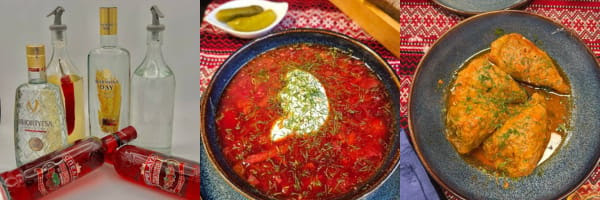
The menu is small in a homely way. Start with the appetizer plate: pickled cucumber, salo, sausage, marinated cherry tomatoes and a horseradish-beetroot sauce — Lana recommends eating it all together, with black bread. Next comes borscht (€5.80): meat, potato, beans, cabbage, beetroot and dill, with a bold, unmistakable flavor; be sure to order pampushky (garlic buns, €1.50) and smetana/sour cream (€0.60) alongside it. Among the cold starters, the Olivier salad (€6.50) stands out, along with “Shuba” (€7.50) — a layered salad with herring and beetroot.
For mains, don’t miss the pelmeni (€11) and holubtsi (€9.20) — cabbage leaves stuffed with rice, pork and cream. A separate story altogether is the vareniki: with potato (€8), with cabbage (€8.50), with cottage cheese (€10.50), or with potato and mushrooms (€9) — the vegetarian option on the menu. For dessert, syrniki, and among the drinks it’s worth trying kompot or kvass — both straight out of most Ukrainian guests’ childhoods.
My Brazilian friend, who once spent two years living in Siberia, was thrilled with the borscht, the pelmeni, and of course a shot of Gorilka ( Ukrainian vodka) .
At the end of the meal, if you’re lucky and the owner happens to be around, you might get treated to free Ukrainian chocolates. The average bill runs €20–25 per person — entirely fair for portions this generous and ingredients this good.