There is a legend at Prazeres cemetery in Lisbon about a man in a hat. He is said to have lived in the neighbouring quarter and to have liked walking among the graves. He carried on with his walks after his death — and now he vanishes if anyone comes too close.
On 31 October people celebrate Halloween, the best time of year for scary stories and ghost tales. The next day Portugal marks All Saints’ Day. For these dates we have picked three cemeteries where local legends sit alongside the architecture and history of their cities.
In Lisbon we chose Prazeres for its ensemble of 19th-century family mausoleums. In Porto we included two historic cemeteries to show different sides of the city’s memory. Prado do Repouso holds a monastic past and the republican movement. Agramonte holds stories of benefactors and of cinema, as well as the memory of the fire at the Baquet theatre.
Why families built chapels in cemeteries
In the 19th century, Portuguese cities began moving burials out of churches and into public cemeteries. Epidemics drove up the death rate and sped up the creation of new cemeteries. Prazeres in Lisbon opened in 1833, during a cholera epidemic. Two years later a law required public cemeteries to be created and banned burials inside churches.
Wealthy families commissioned their own mausoleums in the new cemeteries. Architects and sculptors worked on their design. The result was small buildings with doors, windows and family coats of arms. So the size of a tomb and its decoration could say as much about a family’s standing as its town house.
Prazeres in Lisbon
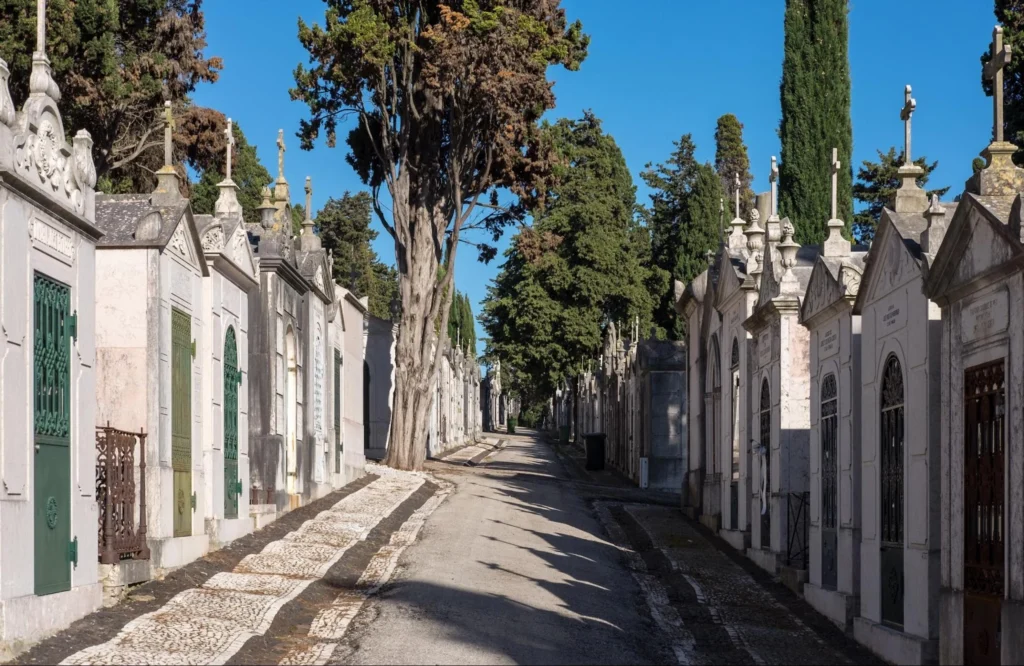
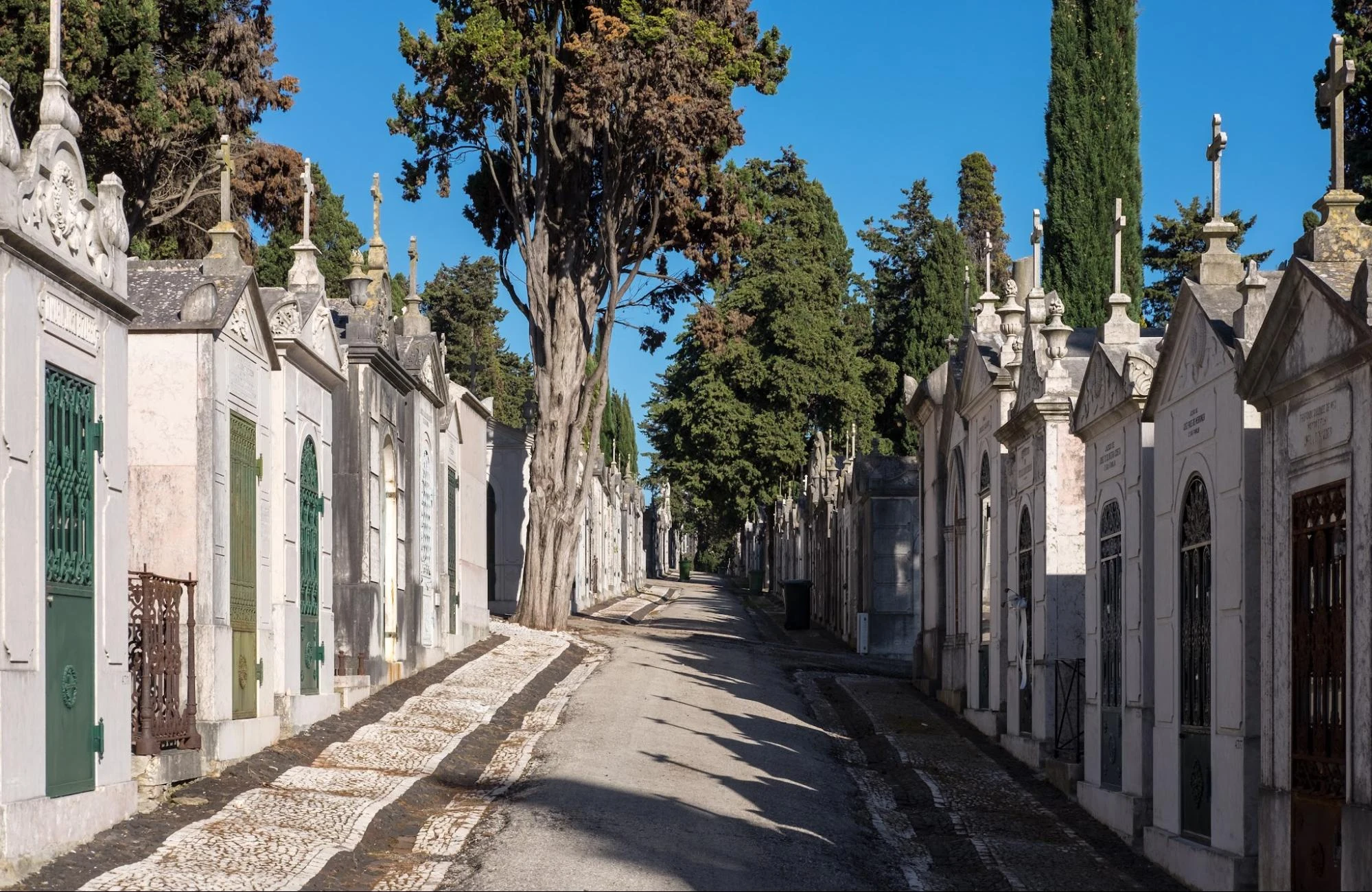
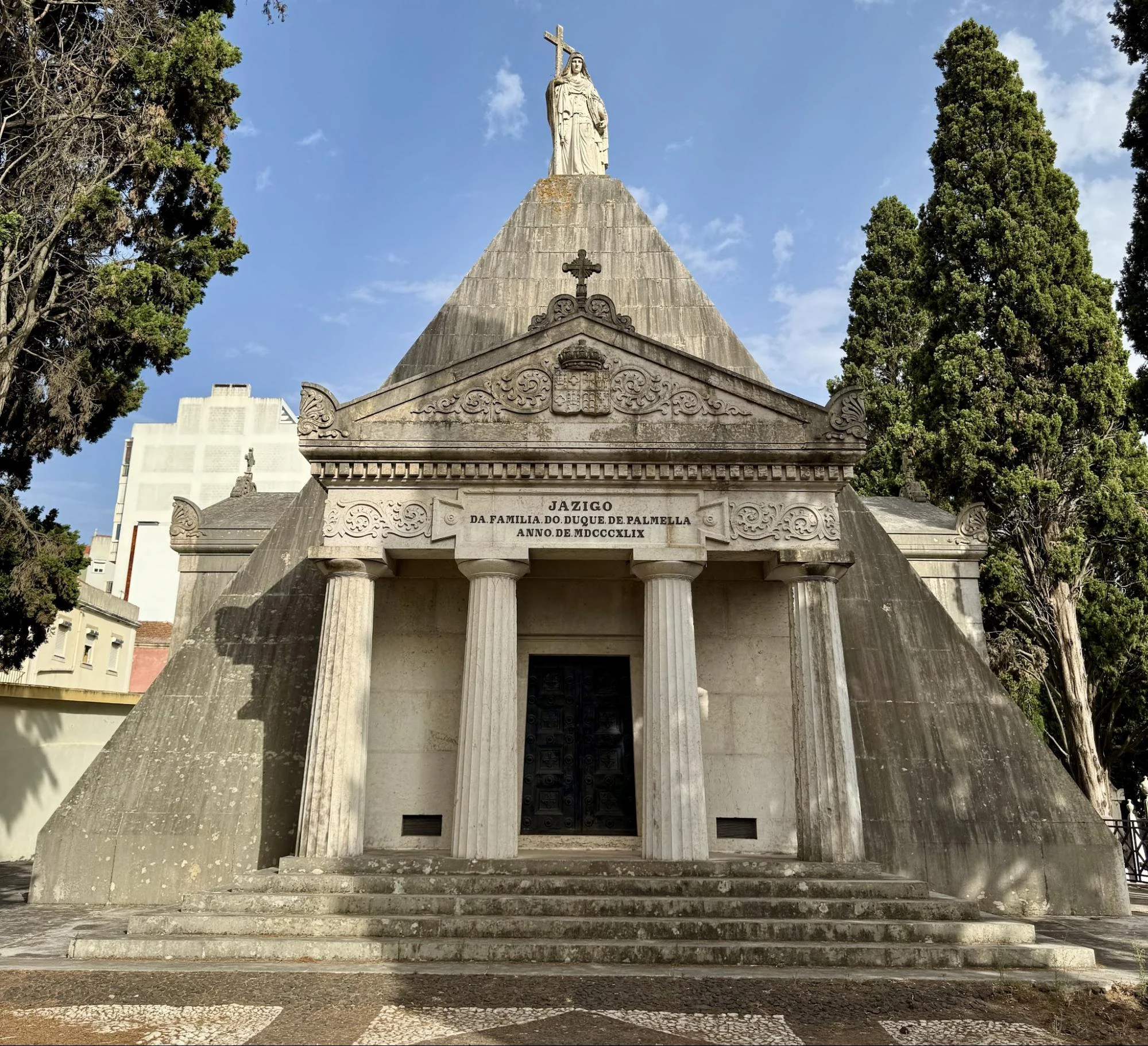
Prazeres cemetery lies in the western part of Lisbon, where the aristocratic quarters stood in the 19th century. Members of many influential families are buried here. Their private mausoleums define the look of the cemetery: small chapels form whole streets. The largest example of family funerary architecture here is the mausoleum of the Dukes of Palmela.
Streets of family tombs. Family mausoleums line the central avenue between the main entrance and the chapel. Some look like small classical temples with columns, others like Gothic chapels with pointed arches. The doors still have their decorative grilles, and family coats of arms sit above the entrances.
The mausoleum of the Dukes of Palmela. It came about through the cemetery’s expansion. In 1845 the first Duke of Palmela gave the city a neighbouring plot of land. In doing so, he kept the right to build a family mausoleum there. Relatives, friends of the family and servants are buried here.
The tomb with a die. The grave of the military engineer Aniceto da Rocha bears a cube with unusual markings. The numbers on opposite faces do not add up to seven, as they do on an ordinary die. In the historian Licínio Fidalgo’s playful reading, it is an attempt to play against death with a loaded die. What cannot be seen from outside is that the coffin stands upright. The engineer arranged this himself when he designed his grave.
A view of the Tagus. From the edge of the grounds facing the river you can see the Tagus and the 25 de Abril Bridge. The cemetery chapel houses a museum of objects from funeral rites. The old autopsy room has also survived in the chapel.
The main entrance to the cemetery is on Praça São João Bosco, next to the Campo de Ourique neighbourhood. You can pick up a map of the grounds at the entrance.
Prado do Repouso in Porto
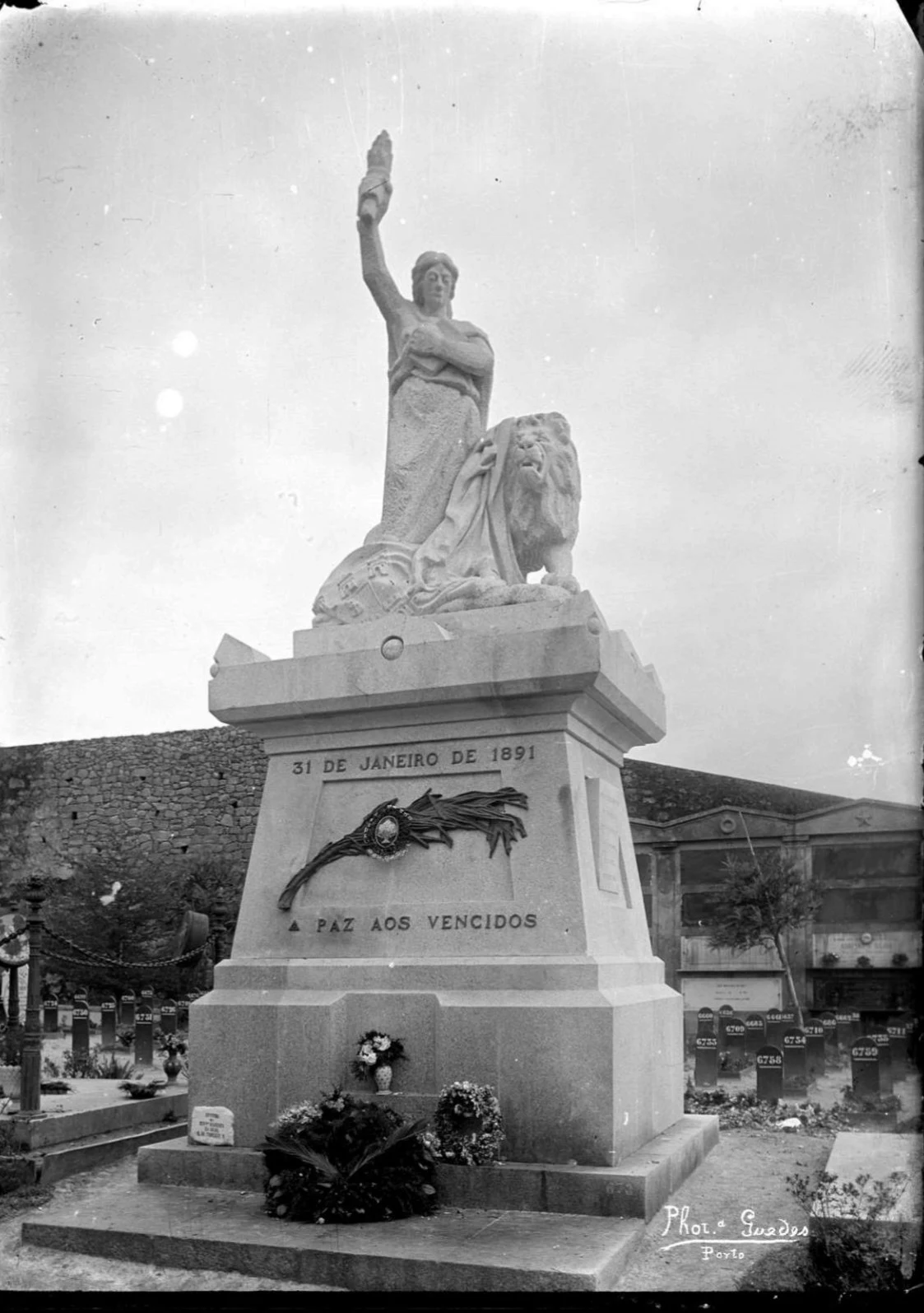
Prado do Repouso opened in 1839 and became Porto’s first public cemetery. It was laid out on land originally set aside for a seminary and the church of São Vítor. The plot already had walls and paths, which made it easier to set up. It still holds a memorial to a republican uprising and burials moved from a closed convent. One of the more recent tombs belongs to the poet Eugénio de Andrade.
The monument to the victims of the uprising of 31 January 1891. The rebels tried to establish a republic in Portugal. The uprising ended in defeat; the monarchy lasted another 19 years, until 1910. The memorial in the cemetery is dedicated to the rebels who died. The name of Rua de 31 de Janeiro in central Porto recalls the same event.
The ossuary of the nuns of the convent of São Bento de Avé-Maria. The Ossário das Freiras de S. Bento da Avé Maria stands in the northern part of the cemetery. An ossuary is a place where the bones of the dead are kept, including after they have been moved from earlier burials. When the convent was demolished, the nuns’ remains were moved to the cemetery.
The tomb of Teresa Maria de Jesus. The tomb is marked by a statue of Saint Francis on a granite pedestal, commissioned by Henriqueta Emília da Conceição. In October 1868 she had Teresa’s remains moved to a grave of their own. According to accounts from the time, once she was left alone with the coffin, Henriqueta took the dead woman’s head with her. The historian Francisco Queiroz links this episode to a love story between the two women. He also warns, however, that the details of their relationship may already have been romanticised in the 19th century.
The tomb of the poet Eugénio de Andrade. It is the work of his friend, the architect Álvaro Siza, who also designed the Serralves Museum of Contemporary Art in Porto. For the tomb, Siza chose a low slab of white marble. It is carved with lines by Andrade, including verses from the collection As Mãos e os Frutos.
The south entrance is on Largo do Padre Baltazar Guedes. On the city’s map of Prado do Repouso, the uprising memorial is marked K, the nuns’ ossuary N and Andrade’s grave number 36.
Agramonte in Porto
Agramonte opened in the west of Porto in 1855, 16 years after Prado do Repouso. Its chapel was built in 1870–1874. Family mausoleums and sculpted tombs line its avenues. The monuments here honour individual people of Porto as well as events that the whole city lived through.
The monument to the victims of the Baquet theatre fire. During a performance in 1888, a piece of scenery touched the flame of the gas lighting. The fire destroyed the theatre. The memorial to the dead was made from the building’s charred metal structure. Among the stone tombs, this monument stands out as a tangle of twisted iron. A large metal wreath is fixed at the top.
The tomb of the Count of Ferreira. It holds a copy of a statue by the Portuguese sculptor António Soares dos Reis. The marble original was moved to the Soares dos Reis National Museum. The count is shown in dress uniform, one hand resting on a pedestal with a cloak, the other holding gloves. The count was known for his philanthropy: in his will he left funds for 120 primary schools and a psychiatric hospital.
The grave of the film director Manoel de Oliveira. Oliveira was born in Porto and kept making films until he was 106. His first film, Douro, Faina Fluvial, came out in 1931. In it he showed the work of people on the Douro river and its banks. The Casa do Cinema at Serralves is devoted to his legacy.
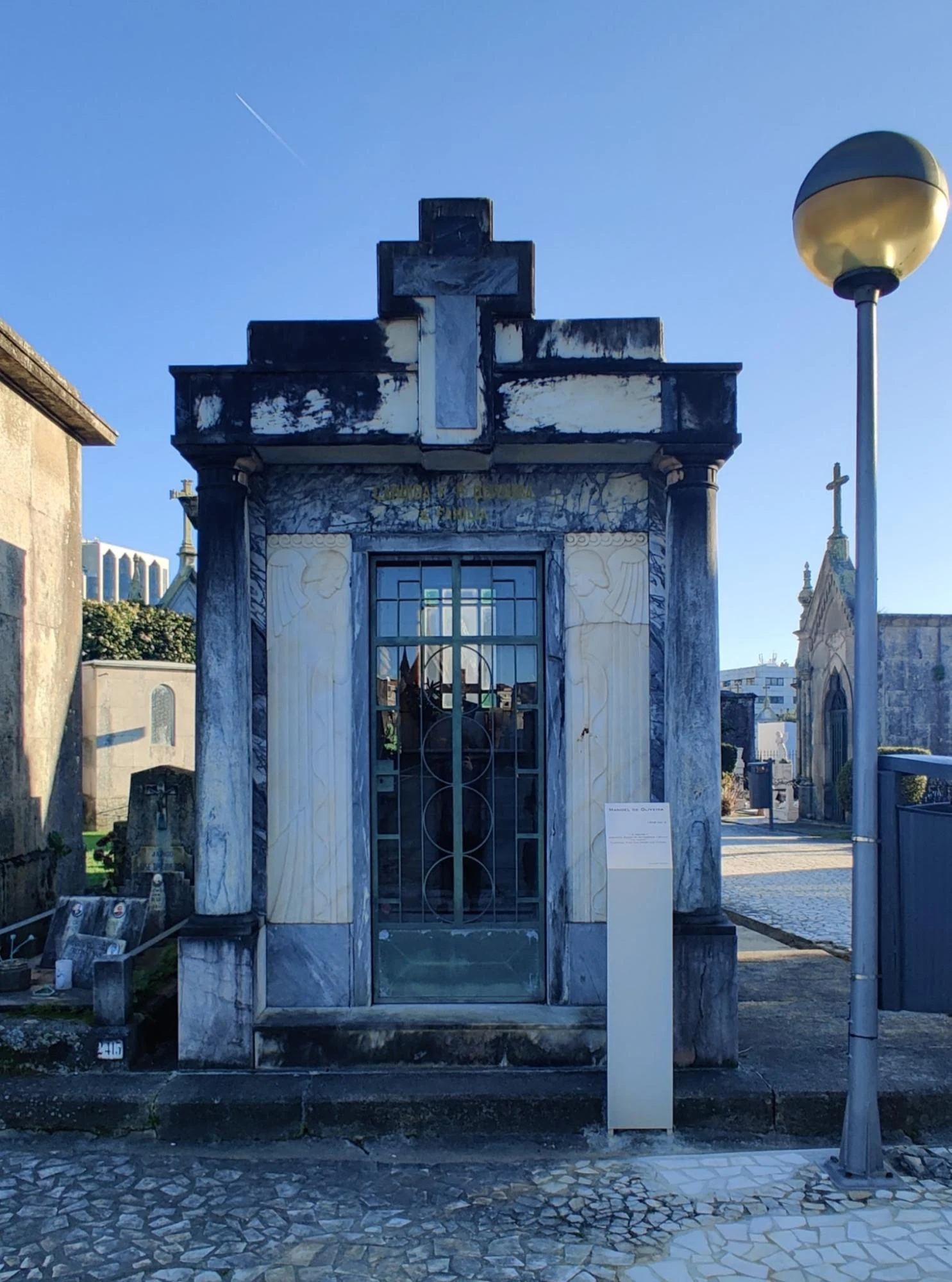
The main entrance is on Largo de Agramonte in the Boavista district. On the city’s map of the cemetery, the Baquet memorial is marked Z, the Count of Ferreira’s tomb Y and Oliveira’s grave number 60.
What the details on the tombs mean
The same images recur on the doors and façades of the tombs. An hourglass is a reminder of how quickly life passes. Wings on the hourglass underline the point: time flies. An upturned torch stands for a life that has gone out.
How to plan your walk
You can visit all three cemeteries on your own, without a guide, and no booking is needed. Allow about an hour to an hour and a half to see the main monuments of one cemetery.
In autumn, Prazeres is open daily from 09:00 to 17:00, and until 18:00 on 1 and 2 November. Last entry is half an hour before closing.
Agramonte and Prado do Repouso are open daily from 08:30 to 17:00. On 1 and 2 November both cemeteries stay open until 18:00. On these days families come to remember their loved ones. For a quiet look at the architecture, it is better to choose another date.
All three cemeteries are still in use. Funerals take place here, and relatives come to tend the graves.