From September 18 to 27, Portugal is hosting the Jornadas Europeias do Património (JEP), or European Heritage Days, when museums, palaces and buildings that are usually closed to the public offer free tours and open spaces that are normally off-limits. The official programme lists several hundred events across the country, and it is not easy to make sense of it: next to a palace that houses an embassy, you will find an “evening of Ribatejo folk music” and a “talk about water at Casa da Muda.” We went through the list, sorted it out and checked ticket availability — and some places are already filling up.
Let’s start with the question every expat asks: language. We found no events listed in English — the programme is almost entirely in Portuguese, with one exception: Santos Palace, which has two tours in French. So below we flag the places where language is not a deal-breaker: the interiors, gardens and azulejos speak for themselves, while a lecture about a 17th-century court musician without Portuguese will probably turn into an hour of polite nodding. We also have one workaround for English speakers — see Fronteira.
Must-go — and book today
Santos Palace, the French Embassy (Lisbon, Saturday, September 19). The main highlight of the programme. Palácio de Santos on Rua de Santos-o-Velho is a 15th-century palace that has been home to French diplomats since 1870. It is worth crossing the city for the “porcelain room,” whose pyramidal ceiling is decorated with 260 Chinese porcelain plates, and the Baroque chapel. To be fair, this is not the only chance to see it during the year: Patrimonium runs paid tours several times a month for around €12. But during Heritage Days, the same tour is free: in French at 10:00 and 17:00, and in Portuguese at 12:00 and 15:00, with groups of 20. Advance booking is required through the Patrimonium ticket office — remaining places are only visible inside the palace listing, so check it yourself and do not leave it until the last minute. Arrive 20 minutes early with your original passport or ID; copies and driving licences are not accepted. There is a security screening at the entrance. Language: if you speak French, take the French tour; otherwise, join the Portuguese one and enjoy the palace.
Fronteira Palace (Lisbon, September 18–19). This privately owned 17th-century palace in Benfica is still home to the Marquises of Fronteira and has Portugal’s largest collection of period azulejos preserved in their original setting. Highlights include the garden with its Gallery of Kings and the “Battle Room,” with panels depicting the war of independence from Spain. The Heritage Days programme here is paid, and availability is already shrinking. At the time of publication, the palace ticket office shows eight places left for the “Segredos do Palácio Fronteira” tour on September 19 at 10:00; the 12:00 slot is sold out, while the 14:30 and 16:00 sessions need to be checked under “Other Schedules.” The opening concert on September 17, featuring Mozart’s Requiem, is sold out. The good news: “Jardins Iluminados,” the night-time illumination of the Baroque garden on September 18 from 21:00 to midnight, still has more than 150 places available. It is the best option in the programme for anyone who does not need language at all. Another piece of good news for English speakers: Fronteira offers regular guided tours in English throughout the year, every day. So if you want a proper tour rather than just the visuals, book a regular ticket for another day.
The Natural History Museum Herbarium (Lisbon, Friday, September 18, 14:30). The Museu Nacional de História Natural e da Ciência on Rua da Escola Politécnica is opening its scientific collections — including a herbarium of preserved plants that has been assembled since the 18th century and is normally off-limits to visitors. At 12:00 that day, there is a botanical garden tour with a botanist; at 15:00, a visit-and-workshop at the Tropical Botanical Garden in Belém. Everything is free, with bookings by email at geral@museus.ulisboa.pt. The university tours are among the first to fill up, and remaining places are not shown publicly — you will only know from the reply to your email. Language: this one does require some Portuguese; without the explanations, a herbarium mostly looks like a cabinet full of papers.
São José Hospital (Lisbon, Friday, September 18, 15:00–17:30). A tour of the historic buildings of the working hospital, formerly the Jesuit Colégio de Santo Antão, where the royal hospital was moved after the 1755 earthquake. Places like this do not usually open to the public. Language: Portuguese, but the cloisters are easy enough to appreciate without a translation.
Museu de São Roque (Lisbon, September 19–20). The museum at São Roque Church in Bairro Alto is opening its Chapel of St John the Baptist — commissioned in Rome, consecrated by the Pope and brought to Lisbon piece by piece — as well as its collection of reliquaries. The chapel was declared a national treasure in 2026. There will be tours, talks and family activities on both days. Language: tours are in Portuguese, but the chapel is a visual experience in its own right.
Worth it if you have time
Ajuda Palace (Sunday, September 20, 10:30). A themed tour marking the 200th anniversary of the death of João VI, the king who fled Napoleon by moving the Portuguese court to Brazil, focusing on rooms decorated with mythological paintings. Worth seeing, but Ajuda is open year-round, and without Portuguese the themed tour loses much of its point. On Saturday, there is also a family open day based on stories about Queen Maria Pia’s cats.
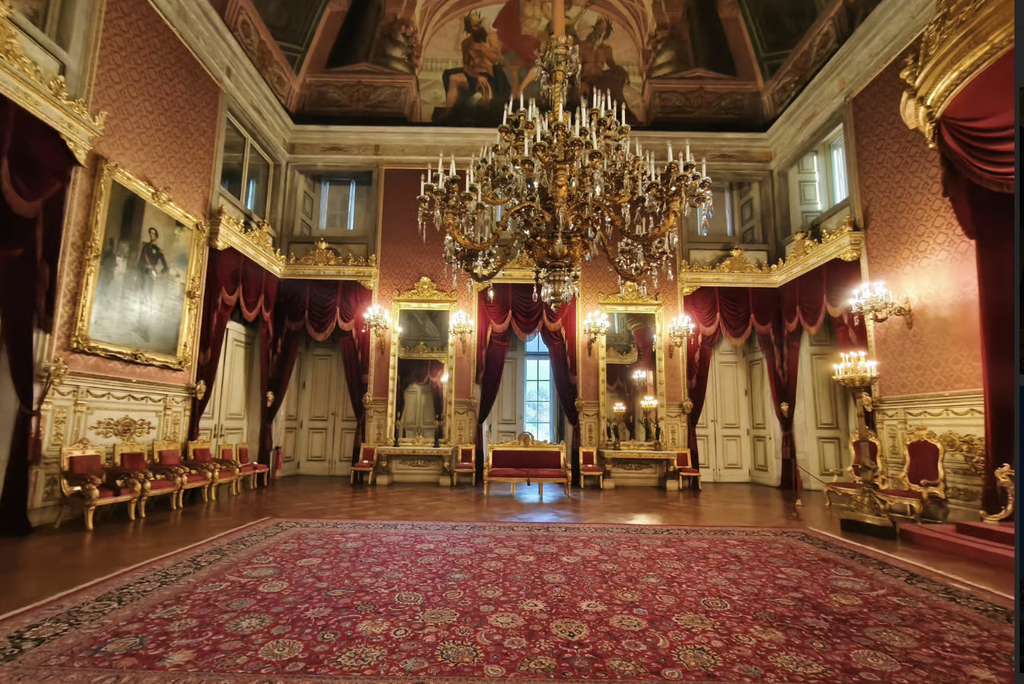
Ajuda Palace
Jerónimos Monastery (September 19–20, 10:30). A free guided tour, “Antigos Espaços, Novos Usos,” about the conversion of an old chapel into a museum. Mainly for those who have lived in Lisbon long enough to only visit Jerónimos when friends or family are in town. The queue at the entrance is not going anywhere.
Lesser-known discoveries in central Lisbon
- Palácio da Independência on Largo de São Domingos (September 18, 15:00): the conspirators’ pavilion in the garden where the 1640 uprising against the Spanish Crown was planned, plus access to part of the old city wall. An hour in the city centre and an unusual view over Rossio.
- Montepio Museu at Rua do Carmo 62 (September 24, 17:00) — a museum dedicated to the history of Portugal’s oldest mutual savings institution, opened in November 2025. The tour focuses on mutual aid and the “social economy.” Language required.
- “Águas de Alfama” at Casa dos Bicos (September 18, 09:30–18:00): a talk and walking tours about Alfama’s underground mineral waters, a little-known geological curiosity. The talk is for Portuguese speakers; the walks are open to everyone.
- Sé and São Vicente de Fora (September 26, 10:30): a walk titled “Two Monasteries, One Memory” linking the cathedral and monastery.
- Museu Nacional dos Coches (September 21, 18:00): an evening tour about ancient gods depicted on gilded royal coaches, followed by a book presentation. More than two hours in Portuguese — only for those who are comfortable listening to the language.
- Museu de Marinha in Belém is running a family treasure hunt, “Rotas da Memória,” throughout the week, while Padrão dos Descobrimentos is hosting a session on September 19 at 10:30 about the history of the monument’s construction. Both are aimed at families with children who can read Portuguese.
Worth checking. The same Patrimonium ticket office that sells tickets for Santos also lists tours of the private Palácio dos Marqueses de Olhão in Xabregas — a 17th-century palace built on the site of the homes of navigator Tristão da Cunha and one of the few surviving private palaces in Lisbon — and Basílica da Estrela. It is not clear from the ticket office whether they are officially part of the Heritage Days programme, but they are worth checking out: you cannot simply walk into the Xabregas palace.
Porto and the rest of Portugal
In Porto, it is worth booking a tour of Teatro Nacional São João (September 18, 12:30, with other dates available) for a look behind the scenes of the restored building by Marques da Silva. On September 19 at 10:00, Clérigos is opening its historic organs; on September 24 at 14:30, the university’s natural history museum will show visitors the work of restorers inside the historic rectorate building. The programme also includes Antiga Cadeia e Tribunal da Relação, a former prison that is now the Portuguese Centre for Photography.
Outside the major cities: Palácio da Brejoeira in Monção near the Spanish border (a 19th-century palace known for its Alvarinho wine; open from 09:00 to 11:30 and from 14:00 to 17:30, with tours every half-hour — an ideal stop if you are heading to Minho anyway), Paço Ducal in Vila Viçosa (September 19, 17:30 — a lecture about the court musician of João IV; the palace of the Dukes of Braganza is worth the trip, but the lecture is only for those who are fluent in Portuguese), Palácio Nacional de Sintra and Quinta da Regaleira, the Roman town of Tongobriga near Marco de Canaveses, Batalha Monastery and Museu Nacional Resistência e Liberdade in the former Peniche prison. Tavira has put together its own programme from September 19 to 27, with everything free and advance booking required.
What you can skip
The programme is packed with events aimed at locals: folk evenings, “tertúlias” (informal talks) about water and wine at local associations, book presentations and an exhibition of documents about Portugal joining the EU at a university library. Without the language and context, they do not really work. The peddy-paper activities at São Vicente de Fora are mainly for school-age children. Themed tours with a substantial lecture component — the Coaches Museum, Vila Viçosa and Montepio — only make sense if you are comfortable listening to Portuguese; otherwise, you can see the coaches on a regular day for €8.
How not to miss out on a place
Every event has its own rules — booking by email, tickets through a box office, or access restricted to school groups — and the details are listed on each event page in the official programme. You can filter by “Gratuitos” (free) and “Para Famílias,” and there is a “Gerar Rota” button that creates a route from your selected events. Where there is an online ticket office, such as Fronteira and Santos, remaining places are shown immediately. Where booking is by email, you will only find out when they reply — and that may take a while.
Fronteira is already half sold out, so the rest of the programme is unlikely to wait around either. If you want to visit Santos, email them now rather than Thursday.