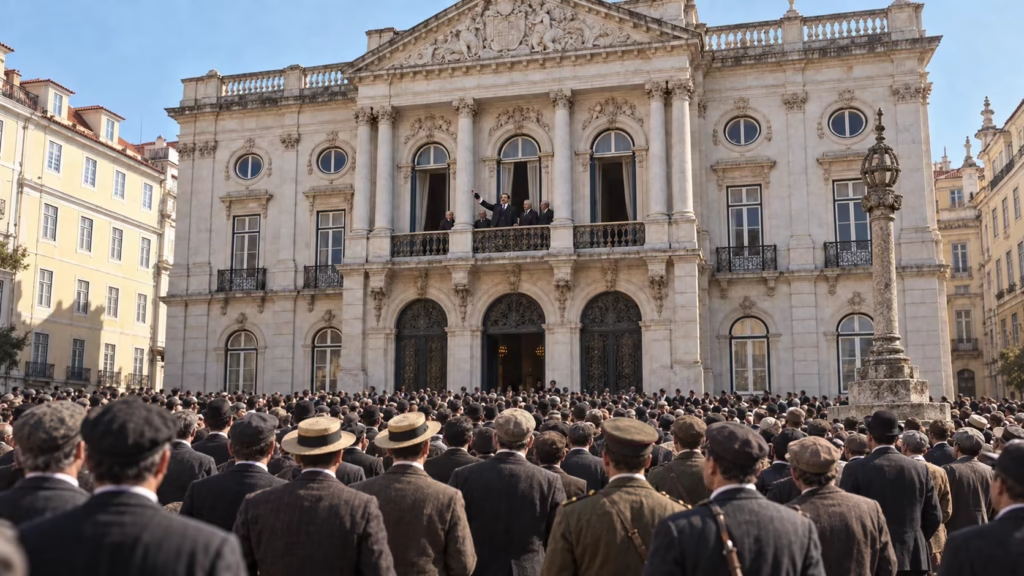
This year Republic Day, 5 October, falls on a Monday, which means a long weekend ahead. The holiday marks the morning in 1910 when the republic was proclaimed from the balcony of Lisbon’s city hall. The proclamation took a few minutes; the road to it took decades. By the autumn of 1910 the crown had already lost many of its supporters. But even when the republicans took to the streets of Lisbon, their victory was far from certain. Here is why the crown lost its support and how the events of 4–5 October played out in the streets of Lisbon.
How the Country Came to Revolution (The Short Version)
At the start of the 20th century Portugal was a constitutional monarchy. It had a parliament and held elections, and two parties took turns in power, but the king kept his influence over the government. Amid economic hardship and scandals over the royal household’s spending, more and more people doubted that yet another change of cabinet would make any difference. The republicans proposed doing away with hereditary power and electing the head of state.
The political crisis deepened over a dispute about colonial territory. Portugal claimed the lands between Angola and Mozambique; Britain had its own plans for the region. In 1890 London demanded that Portuguese troops withdraw. The government gave in. Many saw this as a humiliation, and the republicans turned that anger against the crown. This was when the song “A Portuguesa” appeared: today it is the national anthem, but back then it was a protest against the British Ultimatum.
The monarchy survived that crisis, but its problems did not go away. In 1907 King Carlos I backed the government of João Franco, which began to rule without parliament. The following year the king and the heir to the throne were shot dead in the center of Lisbon. Many republicans condemned the killing. The throne passed to the young Manuel II, but a new king could no longer restore trust in the system.
Republican clubs, newspapers and rallies drew supporters of change. At the same time, party activists, soldiers, sailors and members of secret societies were preparing an uprising. On the night of 3 to 4 October 1910, army units rose against the king. During the day on the 4th and in the early hours of the 5th, the rebels held the barricades at the Rotunda against attacks by troops loyal to the monarchy; sailors on ships in the Tagus shelled government positions. On the morning of the 5th, the royal headquarters on Rossio lost control of its troops, and at around nine o’clock José Relvas proclaimed the republic from the balcony of city hall. That is why the holiday falls on 5 October, even though the uprising began earlier. This history is easier to feel in the city than to retell, so we invite you to walk through the places where it happened.
How to Walk the Route
We have put the five main stops into a single Google Maps walking route. Open it in full on your phone: from Marquês de Pombal metro station, walk down Avenida da Liberdade past Restauradores and Rossio, then follow Rua Augusta to Praça do Comércio and finish at Praça do Município. It is about three kilometers; with stops, allow roughly two hours. The order follows the walk downhill rather than the strict sequence of events: after the morning of 5 October on Rossio, by the river we briefly go back to the day of the 4th. All the stops are on open streets and squares, and you do not need to go inside any buildings. Open the full route on the map.
1. The Rotunda — Today’s Marquês de Pombal Square. Where the Uprising Nearly Failed
At the top of Avenida da Liberdade, find Praça do Marquês de Pombal. Today it is a busy traffic hub with a monument to the marquis in the middle. In 1910 the monument did not yet exist: the open square was known as the Rotunda. On the night of 3 to 4 October, rebel infantrymen and artillerymen with their guns came out here. They were counting on support from the sailors, but communication between the plotters broke down.
Admiral Cândido dos Reis wrongly concluded that the navy’s rising had failed and took his own life; some of the officers left the Rotunda. Machado Santos, a naval supply officer, stayed with the soldiers, members of the secret society Carbonária and the townspeople who had joined them. They built barricades out of whatever they could find nearby.
From the square you can clearly see the avenue running down toward the center: that is where the troops loyal to the king stood, and from there they tried to climb up to the barricades. The defenders of the Rotunda held the high ground through the attacks on the 4th and in the early hours of 5 October. While the ships backed the uprising from the river, the barricades that held kept the royal troops from crushing it on land. On the morning of the 5th, Machado Santos was able to move into the center.
2. Avenida da Liberdade and Restauradores
The Avenue Was the Front Line.
Walk down Avenida da Liberdade to Praça dos Restauradores. The broad, tree-lined avenue already looked like this in 1910: it was opened at the end of the 19th century on the site of the old city promenade. At the bottom stands the Restauradores obelisk, dedicated to the restoration of Portugal’s independence in the 17th century. Look back: up the hill is the Rotunda with the republican barricades, and further down, beyond this square, is Rossio, where the headquarters of the loyalist troops was. It was along this line that they tried to break through to the Rotunda during the day on the 4th and at dawn on 5 October. The rebels drove back both attacks.
3. Rossio — Headquarters of the Loyalist Troops. Where a White Flag Was Taken for Surrender
From Restauradores it is only a few minutes’ walk to Rossio. You will come out on Praça Dom Pedro IV, which everyone calls Rossio: in 1910, as now, it was the lively heart of downtown, with the column of King Pedro IV and the National Theater on its north side. The government troops’ headquarters was near the square. By the morning of 5 October, its commanders were struggling to keep their soldiers in line. Then came a remarkable misunderstanding: a German diplomat asked to be let through to the rebels under a white flag to arrange for foreigners to leave the dangerous part of the city. On the avenue, the flag was taken as a sign that the royal troops were surrendering. Machado Santos came down from the Rotunda, entered the headquarters and secured the commander’s resignation.
There was no decisive assault on the headquarters: the barricades withstood the attacks, and the white flag and the collapse of discipline in the royal units opened the way into the center for the rebels.
4. Terreiro do Paço — the Revolution Came From the Water.
Walk along Rua Augusta to Praça do Comércio, also known as Terreiro do Paço, or Palace Square. Until the earthquake of 1755, the royal palace stood here; in its place rose a grand square with government buildings opening onto the Tagus. By 1910 the familiar arcades and triumphal arch were already here. It was here, in 1908, that King Carlos I and his heir Luís Filipe were shot. Turn toward the river: during the day on 4 October 1910, rebel sailors were active on the Tagus. The ships Adamastor and São Rafael shelled government positions, including the Palácio das Necessidades, where the new king, Manuel II, was staying. He left for Mafra and then went into exile from Ericeira.
The Palácio das Necessidades lies west of the center, outside this walk. You cannot see it from this waterfront, but here it is easy to picture why the uprising was decided not only in the streets: the ships pounded the monarchy’s positions and supported those holding the Rotunda. If you want to see the palace too, here is its location on the map.
5. Praça do Município — the End of the Monarchy. The Walk Ends in Front of City Hall
From the river, walk along Rua do Arsenal to Praça do Município. In front of you is the city hall, the Câmara Municipal de Lisboa: the municipal government was based here in 1910 and still is today. Find the balcony on the façade. On the morning of 5 October 1910, the politician José Relvas stepped out onto it and proclaimed the republic to the crowd gathered in the square.
What Remains From Those Days
After the walk, familiar symbols read differently. The new regime chose the red-and-green flag and “A Portuguesa” as the anthem. The 1911 Constitution established the office of president; Manuel de Arriaga was the first to be elected. The republic also changed the relationship between state and church. But equal voting rights did not come then: the 1913 electoral law gave the vote only to men who could read and write. The revolution changed the form of the state, but the struggle for a say in politics went on.
Today 5 October is a public holiday. If you walk the route on that day, you will be in the places where its history literally unfolded in the streets.