In the very heart of Bairro Alto, on the narrow Rua da Rosa, there is a restaurant that local Brazilians call a piece of home. Acarajé da Carol is one of the few Brazilian places in Lisbon where there is barely room to move at weekends.
The story of this place is essentially the story of one woman. Carolina Silva, known as Carol, was born and raised in Salvador, in the Itapuã district — one of the main centres of the baianas do acarajé tradition, the street vendors who make the famous bean fritters. Carolina learned to cook from her family and began working as an acarajé vendor while still a teenager.
Her life changed by chance when she was 18. A Portuguese couple visiting Salvador tried her acarajé and invited Carolina to move to Portugal. That is how she arrived in Lisbon about twenty years ago and gradually became one of the city’s most prominent representatives of Bahian cuisine.
At first, Carol made acarajé once a week at Casa do Brasil and took part in Brazilian festivals and food events. After many years of success, she decided to open her own restaurant in Bairro Alto, a neighbourhood whose narrow historic streets reminded her, she said, of Salvador’s old centre. The first Acarajé da Carol opened on Rua da Rosa in 2016.
The restaurant later opened a second, more spacious Lisbon location at Rua de Santa Marta, 78, near Marquês de Pombal.
Paradoxically, the brand devoted to Bahian cuisine was born in Lisbon rather than Brazil. It was only on 1 August 2025 that Carol opened the first Acarajé da Carol in her native Salvador, at Mercado do Rio Vermelho, also known as Ceasinha. The restaurant marked Carolina’s symbolic return home after two decades of living and working in Europe.
Today, Carol remains directly involved in running the restaurants: she cooks, welcomes visitors and talks to regular guests. She is the chef, host and soul of the project all at once.
The main dish that draws people here is, of course, acarajé: a fritter made from bean paste, fried in red dendê palm oil, split in half and filled with vatapá, a tomato and onion vinaigrette and dried prawns.
For people from Bahia, however, acarajé is much more than street food. It is one of the most important symbols of Afro-Brazilian culture, with a history spanning centuries and close ties to the Candomblé religion. On the streets of Salvador, it is traditionally sold by baianas do acarajé — women in white lace dresses, layered skirts and headwraps who have long been among the city’s most recognisable symbols. In 2004, their craft was officially recognised as part of Brazil’s intangible cultural heritage.
This is the tradition that Carol is working to preserve in Lisbon. The beans for acarajé are still peeled and ground by hand here, while the dried prawns are brought from Salvador — the owner refuses to compromise on authenticity. Acarajé with prawns and abará with prawns each cost about €10. Abará is made from a similar bean paste, but unlike fried acarajé, it is wrapped in a banana leaf and steamed, giving it a milder flavour and a soft, moist texture.
Among the desserts, the modest but iconic bolinho de estudante stands out: a fried cassava and coconut fritter coated in sugar and cinnamon. It costs about €6 and provides a fitting end to a meal built around the vivid flavours of dendê oil, chilli and seafood.
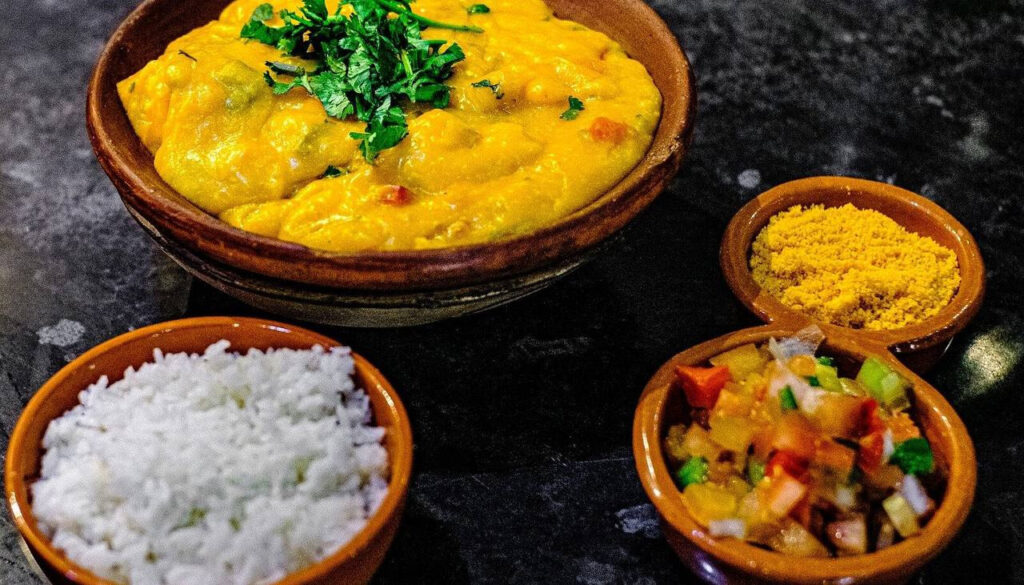
One of the most important main courses is moqueca, one of Bahia’s best-known dishes. Acarajé da Carol prepares it according to a classic Bahian recipe: fish, prawns or a selection of seafood are slowly simmered in a thick sauce made with coconut milk, dendê palm oil, tomatoes, sweet peppers, onions and fresh coriander.
Compared with the more restrained moqueca from the state of Espírito Santo, the Bahian version is rich, creamy and intensely aromatic. Coconut milk softens the spices, dendê oil gives the dish its characteristic golden-orange colour and deep nutty aroma, while coriander and chilli add freshness and heat.
Moqueca is usually served with white rice, farofa and a hot pepper sauce. The rice absorbs the rich sauce, while farofa made from toasted cassava flour adds a crumbly texture. At the restaurant, you can order either Moqueca de Peixe with fish or Moqueca Mista with several types of seafood.
On Sundays, the restaurant makes traditional Brazilian-style feijoada, a thick dish of black beans and several types of meat served with rice, farofa, greens and orange. Many regulars specifically plan a weekend visit for it.
The interior of the Rua da Rosa restaurant has no pretensions, which is precisely its charm. The room is small, with simple tables, white plastic chairs, vivid Afro-Brazilian paintings, photographs of Bahia and national symbols on the walls. The restaurant occupies a former fado house, so the space retains the feeling of an old Lisbon home, with a compact dining room and closely packed tables.
In the evenings, the space fills with Brazilian music, lively conversation and the laughter of regular guests. Many people come not only for dinner but also to meet friends, so the atmosphere feels more like a family celebration or a bustling Bahian bar than a conventional European restaurant.
At peak times, particularly on Friday and Saturday evenings, the small Bairro Alto kitchen cannot always keep up with the number of visitors. Dishes may take 30–40 minutes to arrive, but most guests accept this calmly: people come here not for fast service but for the feeling of authentic Bahia, where conversation around the table matters as much as the food itself.
With main courses averaging about €15–20, Acarajé da Carol remains one of Lisbon’s most honest and heartfelt restaurant projects.