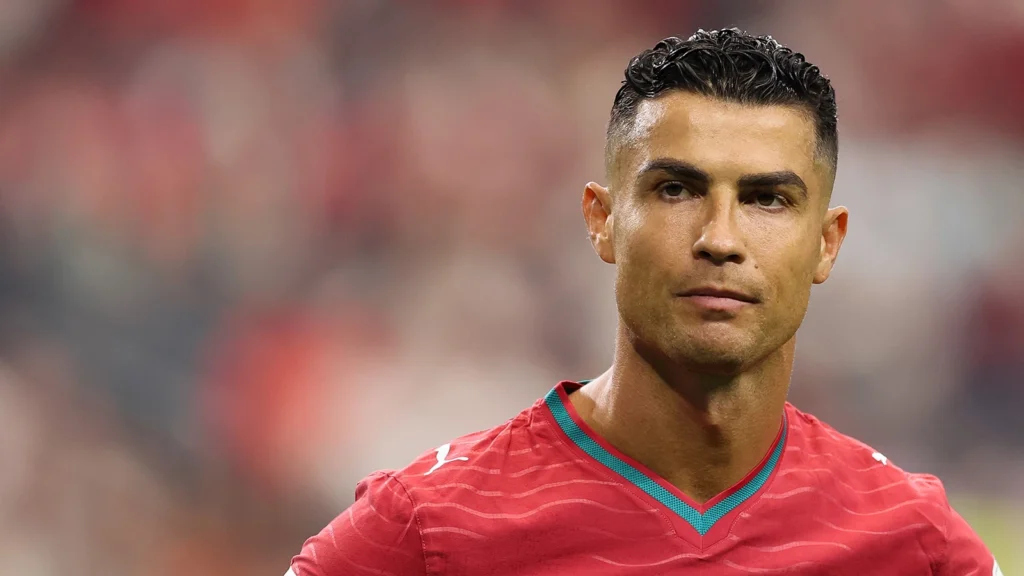
“This is probably my last season in football, and I want to leave an impressive legacy. I already have all my plans for the future mapped out,” Cristiano Ronaldo said in an interview with Vogue right after his wedding.
Statements like this — especially paired with “probably” — often carry a whiff of unreliability.
Lionel Messi retired from the Argentine national team, then came back and won the World Cup. Dick Advocaat ended his coaching career seven times, but each time found new challenges. Even at 78, in Curaçao. José Mourinho, during his Chelsea days, threatened to be done with clubs at 55 — and to take charge of Portugal. The Special One is now 63, and for all these recent years he has been working nonstop with clubs, of all things.
Even in Cristiano’s case something doesn’t add up. In 2024 he declared he would end his career at Sporting Lisbon — including if it meant hanging on in football for another season.
On top of that, there’s an unclaimed record — 1,000 goals across all competitions. He’s 24 goals short — usually less than a season is enough, but you never know. And let’s not forget the 2030 World Cup, which will be hosted by three countries, Portugal among them. Who, if not Cristiano, would seize the occasion and, at 45, lead the team out onto the pitch at José Alvalade?
And then, out of nowhere — words about a last season.
But however you take them, Ronaldo has named a deadline for the first time. Both that, and his likely departure, are an event.
With Ronaldo’s exit, football won’t just be losing a local superstar or the best (okay, one of the two) player of our time. The most popular person on the planet will be leaving the profession.
Right now Ronaldo leads the world in Instagram followers. 680 million followers — that’s 150 million more than Messi and 250 million more than Selena Gomez. The gap over Dwayne “The Rock” Johnson and Kylie Jenner (4th–5th place) is nearly twofold.
Ronaldo’s total social-media audience tops a billion follows. Because of him, Chinese fans fly 13 hours from Shenzhen to Leipzig, Armenians shell out 700 euros, and the Portuguese churn out souvenirs — from towels and mugs to playing cards and rugs (I personally saw a carpet with Ronaldo’s face on it in Cascais).
With Portugal it’s especially easy to understand. A small country deeply cherishes its global heroes. Once, it was da Gama who opened up worlds in its name, Camões who wrote The Lusiads, and Saramago who won the Nobel Prize. Today the leading Portuguese figure known to the whole world is Ronaldo. Of course he’s been elevated to a cult and had an entire airport named after him while still alive.
But how did Cristiano become the world’s leading celebrity? Especially next to Messi, who has won more (an extra three Ballons d’Or, plus one World Cup) and has stayed in his prime longer.
Explaining popularity is a strange business. It’s like searching for the formula of a hit: you break it down into molecules, assemble your own — and it doesn’t grab anyone.
But there are a few observations as to why it worked out specifically for Ronaldo. And why a billion people will miss him.
Of course, Ronaldo landed in the right time. With the arrival of television, and then the internet, world stars were often actors and musicians — people from the entertainment industry. For decades, football remained above all a sport. Its stars were global celebrities, but niche ones, comprehensible only to certain people.
In the 21st century, football broke down the barriers between sport and global entertainment. Tickets for the 2026 World Cup reached the level of the biggest concerts in the world, and more often turned out to be pricier. Clubs like Barcelona or Liverpool go on preseason tours to America and Asia as if on tour dates. The Arab world is willing to pay for top clubs’ matches in their countries as if booking them for a corporate party. The revenues of the giants approach — and sometimes break through — a billion euros a season, thanks to advertising, tickets, and broadcasting rights.
Football has turned into full-fledged entertainment regardless of gender, age, or country, and Ronaldo into a very compelling storyline within it.
A kid from a distant island, from a poor family. His father drank, his mother wanted to have an abortion. From that environment he made it into a local team, and at 12 into Sporting Lisbon, where he scrounged for food at McDonald’s.
Then came the first money (10 euros a shift as a ball boy), the first successes, and the great Manchester United. After that — a record transfer to the royal Real Madrid, a great many trophies, personal records, and luxury. Luxury cars, luxury real estate, luxury women, a luxury smile.
What is that, if not the perfect story of overcoming the odds?
But the movie doesn’t end, because the hero doesn’t rest on his laurels. Cristiano wants to keep winning, and it doesn’t matter where: being first at the World Cup and in the Saudi Arabian league matter to him equally.
“Ronaldo works incredibly hard. He’s the first to arrive at training and the last to go home,” Juventus coach Andrea Pirlo said about the 36-year-old Ronaldo, who had won practically everything.
“He changed the mentality of a lot of players at the club” — and that’s confirmation from his former Al-Nassr teammate Anderson Talisca.
In other words, Ronaldo didn’t just make it from the bottom to the top — for a decade and a half he’s been showing how, through hard work, you can hold on to it.
The Beatles lasted 10 years, yet they’re still considered the greatest band of all time. Marilyn Monroe’s spell of global superfame lasted even less. Cristiano captured our attention 18 years ago (2008 brought his first Champions League title and first Ballon d’Or) — and still hasn’t let go. Even when he has long had nothing left to prove to anyone.
In many ways, Cris fuels the interest in himself. All the more so because the image of a swarthy Ken lands perfectly with the audience. Some people, of course, are irritated by the ego and the obsession. Sometimes it even gets in the way and turns him into meme fodder. But it’s precisely the ego that made him Ronaldo. He doesn’t know how to simply be great. He absolutely has to be the best, the most famous, the most talked-about.
In this, he’s an almost perfect hero of the social-media era, one who understood that fame, too, is a job.
He didn’t just happen to be handsome and rich: he turned his own body, family, workouts, cars, houses, records — and even his aging — into content.
The quiet Messi, less muscular and fixated on football, may against this backdrop win two more World Cups, yet in the media race he’ll forever remain second.
But the rivalry with Leo is another reason for his greatness. Ronaldo didn’t collect trophies lying at his feet — he gnawed them out in competition, the fiercest in the history of football. On one side, talent kissed by the heavens. On the other, someone less gifted who leveled himself up to the stature of an antagonist.
And it doesn’t matter whose side you’re on. Either way, Ronaldo stirs emotions. You can love him, you can hate him, you can laugh, but it’s hard to be indifferent. And popularity is, among other things, a reaction — not necessarily love.
“The year is 2004, I’m in the army. I remember the quote from the newspaper like it was yesterday: Ferguson is turning this Portuguese fledgling into a footballer. I’m already past forty. Here’s what came of it. I’m glad I lived through this era,” reads one of the comments under the news of his career coming to an end.
Soon the career will be over. And with it will end a reality show that ran live for almost 20 years and became part of our lives.
Just as it’s hard today to imagine the late USSR without Alla Pugacheva, so in a few decades the first quarter of the 21st century will be remembered as the Ronaldo era. Only not across the territory of a couple of countries, but all over the world.