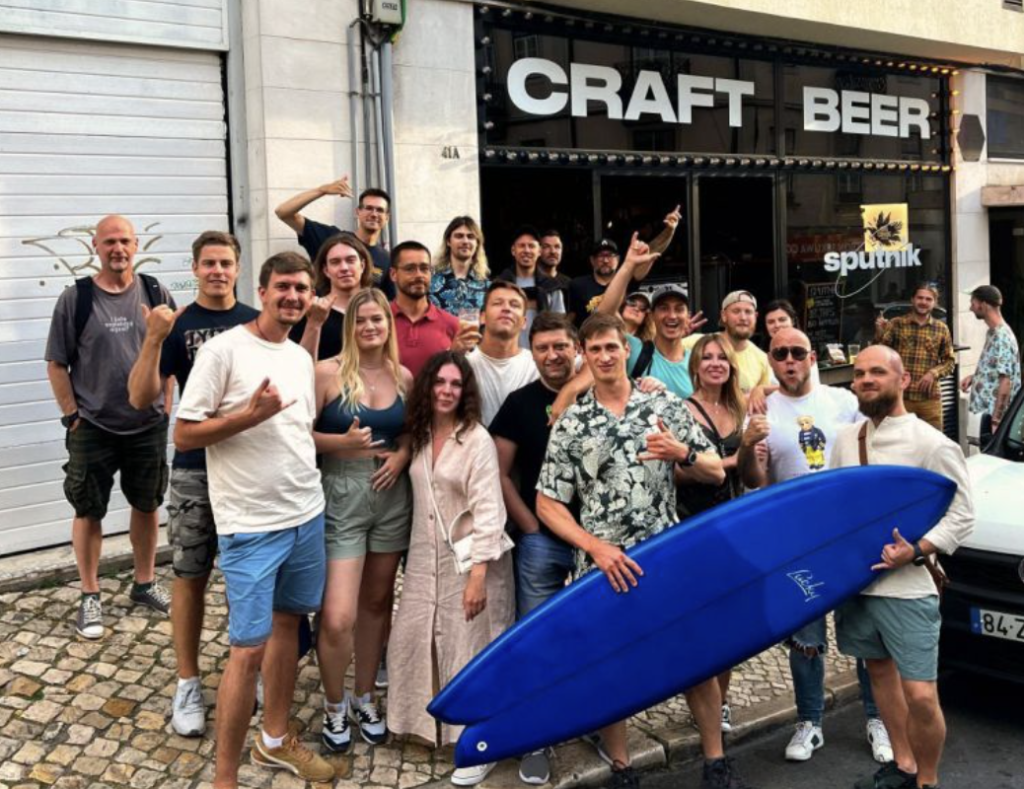
Beer flowing like a river, a queue at the bar, endless laughter, celebrity faces, and a crowd of patrons who don’t fit inside the small space of the bar and spill out onto the roadway of Rua Andrade — a little street in Arroios, the most multinational district of Lisbon. That is how patrons remember the heyday of Sputnik Craft Beer, perhaps the loudest project of Lisbon’s Russian-speaking community, which its co-founder Mikhail “Shym” Epifanov of the group Kasta talked about in an interview with journalist Dmitry Kolezev.
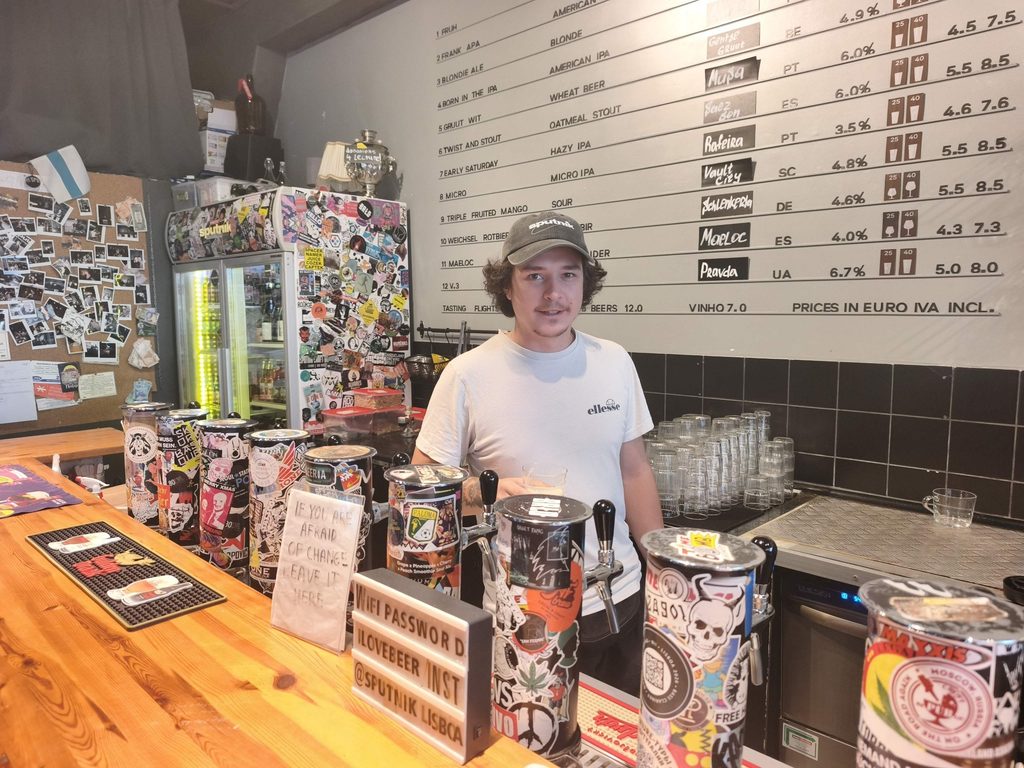
At the end of summer 2026, the bar greets an Xpat.Land correspondent looking rather deserted. Behind the counter, the ever-cheerful bartender Alexander pours local craft beer — more than 10 varieties — smiles at Russian-speaking patrons, and at the same time exchanges a few words in English with a casually dressed Brazilian. But the familiar events are no longer held at the bar, and the audience has changed a great deal. The usual crowds are gone; Russian-speaking expats are being replaced by others.
What happened to one of the main gathering points of the Slavic community, the leading craft spot of the Intendente district — and once of all Lisbon?
The COVID trial
In 2019, St. Petersburg bar entrepreneur Evgeny Zakharov moved to Lisbon and discovered that beer craft in the city was far less developed than in Russia. He proposed to his old friend, the well-known rapper Shym, that they invest together in opening such a bar in Lisbon.
The initial investment, as Zakharov recalls, was around 30,000 euros, with Shym contributing about 26,000. The first nine thousand euros went to renting the space they had found: they had to pay six months in advance. And right away the new business ran into Portuguese specifics: “I ran into unscrupulous local builders and spent a huge amount of money. We went through five crews in a month and a half.”
The bad streak didn’t end with the renovation: a couple of months after the bar opened, the coronavirus and lockdown began. According to Zakharov, the bar was closed for a full seven months over two and a half years. “I sat in a closed bar and piled up enormous debts. I asked Shym to keep his distance for a while — there was nothing to show.”
The only visitor who came every day, even to the closed bar, was Simon — a craft connoisseur who, by Zakharov’s own admission, “practically saved the place.” He drank five or six glasses of craft every day. Besides him, on the days when the bar could open on a limited basis, other regulars came, a core group that had managed to form around the bar in its first months of operation. Thanks to them, the place had just enough money to cover its minimal needs.
Zakharov also ran into a stubborn landlord: “Local landlords let everyone either skip the rent or gave wild discounts (during the coronavirus — Xpat.Land note). We weren’t given discounts like that. The owner of the space, a Chinese man, just said: you signed the contract — be so kind as to pay.”
In early 2022, Zakharov was seriously thinking of telling his partner that the bar would be closing by April. By that point the debts totaled about 65,000.
The diaspora’s main beer bar
The bar was saved and taken to a new level by the explosive wave of emigration after February 2022. The number of the bar’s patrons began growing just as fast as the number of Russians, Ukrainians, and Belarusians in Lisbon. The bar became the main — and almost the only — gathering point for emigrants lost in a new reality. “Back then Sputnik was the only place with a Russian name. And all the people who moved here kept asking in the Telegram chats: ‘Guys, where do we go, where do we meet people?’ Everyone was always sent here,” Zakharov recalls. “From summer 2022 to mid-2024 it was almost always full. That’s how the bar climbed out of debt.”
And this is where the celebrity partner became actively involved. Shym gave numerous interviews in which, among other things, he talked about the bar, and he invited public figures who were visiting Lisbon — Ivan Dorn, Mikhail Shats, Ilya Varlamov. He also brought in Evgeny Kim, who took over all the management duties: from selecting the craft beer to putting together the cultural program.
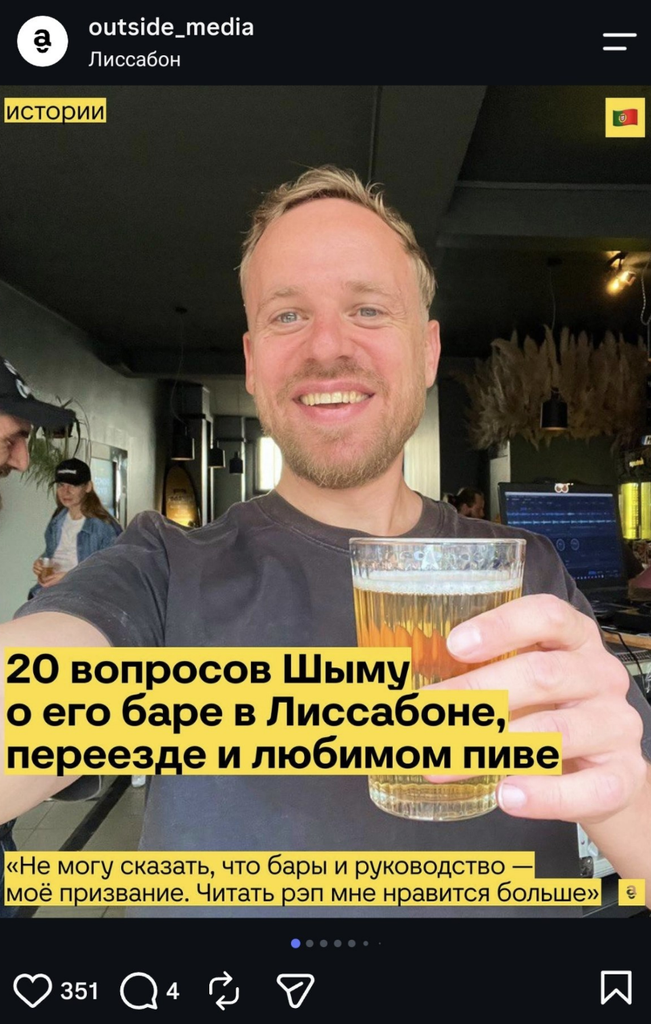
During this period the bar introduced many entertainment formats that drew visitors: open mics, stand-up, concerts and poetry evenings, chess club meetings, tastings. Patrons knew that if they had nothing to do in the evening, they could always come to Sputnik and have fun.
“In the spring of 2024 we turned a profit for the first time,” Zakharov sums up. But it was precisely then that the entrepreneur himself began gradually cooling toward his project.
I was ashamed of what was going on here
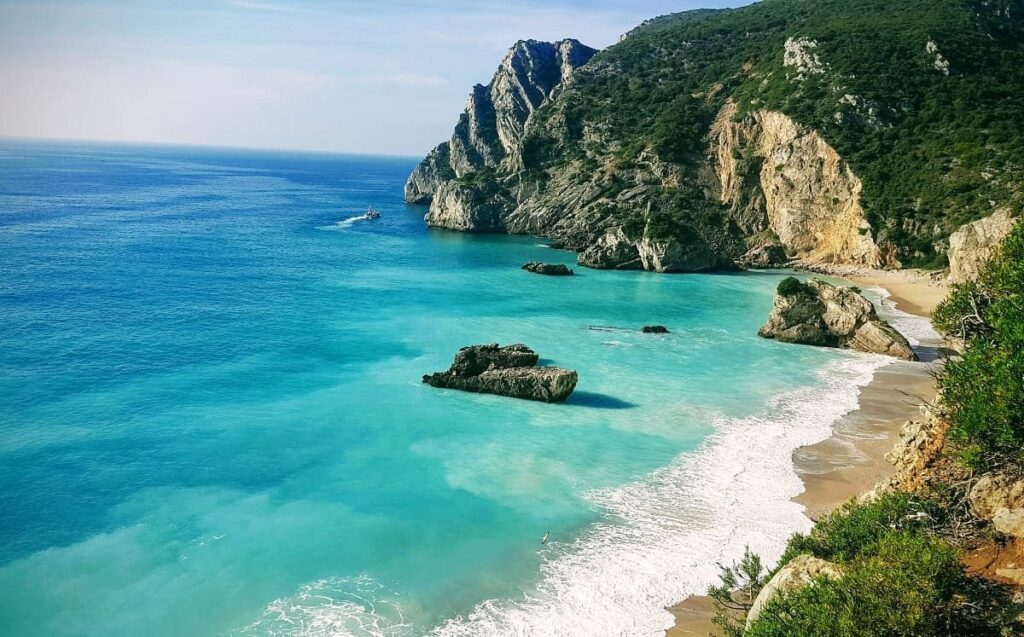
By the autumn of 2024, Zakharov had effectively stopped running the Sputnik business, shedding even his most pleasant duties — selecting new varieties of quality craft. The reason was simple: he simply stopped drinking alcohol altogether, took up surfing, and moved closer to the ocean. Manager Kim also moved to another job. And Shym once again focused on music: he recorded a successful album with Kasta and set off on a big tour.
By the end of 2024, Zakharov and Shym decided to leave the project. The bar was quietly sold to a new owner without telling the audience anything. The new owner was an expat, Vitaly, who had made his main capital in the IT sector. Something about how deals happen among emigrants is captured by the fact that Zakharov can’t even recall the new owner’s last name. The exact sale price isn’t disclosed, but the former owners confirm they “came out even and doubled up.”
The new owners, in turn, didn’t run the bar hands-on but entrusted the process to their manager, Alexey Danilenko, whom they hired on friends’ recommendations. And the bar began gradually falling into decline. As Zakharov claims, the reason was that the manager liked other ways of relaxing, not just beer. “Alexey made a really great impression. But in the end he just blew the bar’s entire revenue on powders. In a year he drank and snorted away 30,000 euros. The selection dropped badly, the music dropped, dark times set in,” laments the entrepreneur, who even after the sale continued to jealously follow the fate of his brainchild. “I’ve worked with people who were seriously addicted to cocaine, and I understood that these people are fundamentally uncontrollable.”
Xpat.Land approached Danilenko for comment more than once, asking him to confirm or deny Zakharov’s version, but he did not respond to the requests.
Alexander Malyshkin, a 28-year-old with curls poking out from under his baseball cap, standing behind the bar, recalls that period with pain. “The problem was that the person standing behind the bar wasn’t always sober,” says Malyshkin, taking a sip of craft beer. “And when a guest sees that person, they immediately form an opinion of the place. The Russian-speaking public here is small, rumors spread instantly: why go there, it’s a den.”
Malyshkin says the main damage was done not even to the till but to the establishment’s reputation. According to him, he was even ashamed to post photos of himself on the bar’s Instagram. “I was just ashamed of what was going on here.”
As a result, over the course of 2025 the bar accumulated enormous debts. In that same period, the bar’s tight-knit team began to break up, including the people handling marketing and SMM. The bar started losing patrons and partners — for example, event organizers. Many of the events previously held at Sputnik that had drawn crowds migrated to other venues.
“On the one hand, the new owners told me they didn’t want to keep developing formats like mine, that they’re not about events anymore but geared toward the concept of a bar specifically. On the other hand, I myself got tired of Sputnik: there was a point when 60 people would show up for stand-up, and there’s no room and the bar is noisy. I decided to take a risk and change venues,” shares Yaroslav Kapustinsky, who once organized the popular Open Mic format at the bar.
Everyone back
When the embezzlement came to light, Danilenko left for Belarus, and his place was taken by a former bartender — the very same Alexander Malyshkin. He’s been in craft since the age of 18. He began his bartending career back in St. Petersburg and then moved to Lisbon, where he happened to work under Danilenko. He says he’s gradually managing to pay off the accumulated debts.
As Zakharov told it, the new owner found a way to pin the accumulated debts on the previous owners by exploiting a technicality: as it turned out, registering the deal had been entrusted to that very same manager, who simply forgot to do it. And now the new owner has the opportunity to contest the deal, which he intends to do through the courts. Xpat.Land tried, through the bar’s representatives, to reach the owner or his lawyer, but Vitaly and his representatives declined to comment on the disputed situation.
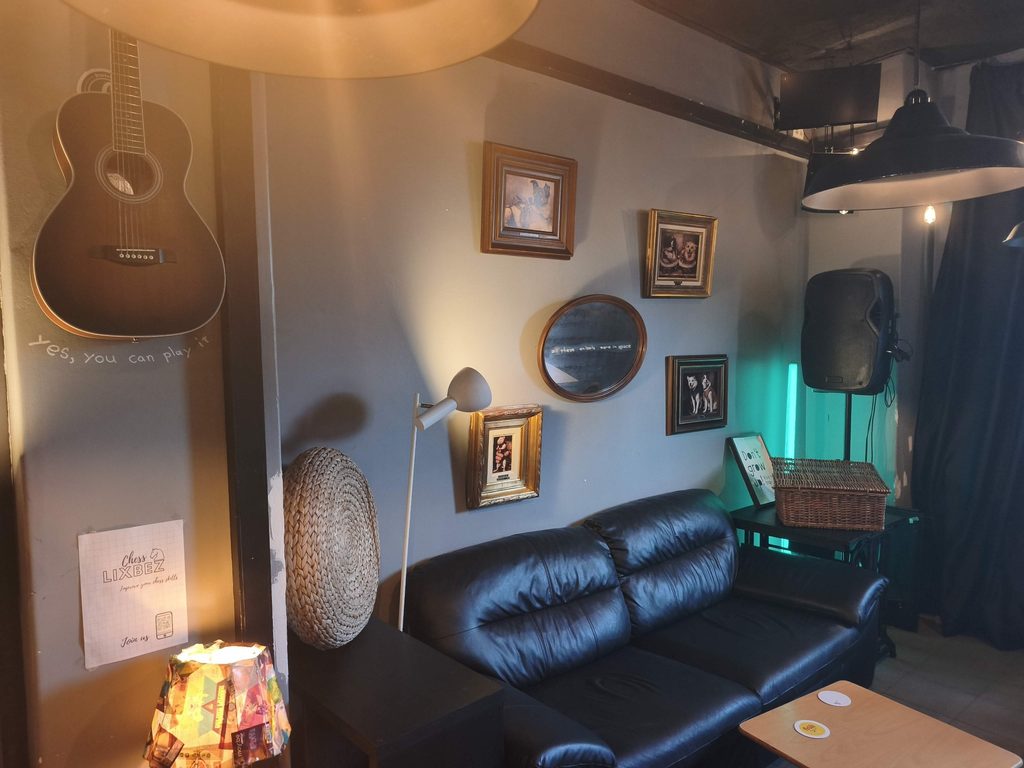
Meanwhile, Malyshkin confirms that the bar is still operating at a loss.
“There’s no operating profit: we’re paying off debts. I know what the profit would be without them, and on the whole it’s not bad. It depends on the season, of course, but you can always prepare for the season. Unfortunately, we were never prepared,” he says.
The events aren’t coming back yet, either. By Malyshkin’s observation, some organizers still don’t know the manager has changed. “They still think Alexey (Danilenko — Xpat.Land note) is running the bar, even though he’s been gone for six months now,” he says.
Though Zakharov has stepped away from the business, he’s still somewhat up to date on his brainchild’s affairs: the businessman claims that former manager Danilenko went a whole year without paying rent. “But recently I talked with the landlord, and it turned out that Sasha (the new manager — Xpat.Land note) has already cleared all of last year’s rent, and on top of that they somehow manage to pay salaries too.”
The successes are all the more surprising against the backdrop of the outflow of patrons. The Xpat.Land editorial team has repeatedly observed that the former “place of power” of the Slavic community fairly often stands half-empty. However, a regular of the bar, the creator of several Telegram channels for those who have moved to Portugal, Andrey Telegraf, says he sees not so much an outflow as a change of clientele.
“I see that there are fewer Russian speakers, but the bar is gradually filling up with an English-speaking audience,” Telegraf shares his observations.
Malyshkin confirms this shift and says it’s deliberate. “It used to be a Russian-speaking bar, now it’s already fifty-fifty. We’re trying to become a good bar not for Russian speakers, but for immigrants in general. And for locals,” Malyshkin explains.
Telegraf suggests that there’s also a general decline in the Slavic community’s activity at play — a community that made up the core of the establishment’s audience. “It’s like that with all the scenes, not just Sputnik. People started going out less, everyone’s talked themselves out. It’s a normal, natural plateau that any immigrant group reaches a few years after it starts.”
Competition among craft beer establishments has also grown sharply. Whereas in 2019 the media counted about a dozen craft bars in Lisbon, in 2026 aggregators like Wanderlog count more than 40 spots in Lisbon in the “craft beer bars & breweries” category.
Malyshkin sums up the main lesson of this whole story briefly:
“The biggest piece of advice in the restaurant business is to open and run it yourself. Don’t leave the place on autopilot. We’re not in the CIS; that won’t fly here.”
That, in his version, is exactly how it all happened: the owner bought the bar as an investment and stayed outside the operational loop. “He didn’t appear in the reports, or in the bank account, anywhere. He just couldn’t see what was happening. And he was told everything was great. Understanding came only when it became obvious there was no money.”
The question of the bar’s survival remains open, but it’s clear that betting on Russian speakers is no longer the main play. And perhaps the bar’s fate will be decided by an entirely different crowd of expats who also like craft beer. But the founders will no longer have anything to do with it. Unless, of course, the court decides to return the bar to Shym and Zhenya. Which might be for the better. As the well-known joke goes: “A case of beer — and put everyone back.”
Ilya Zhegulev contributed to the preparation of this material.