If your Portuguese cannot yet keep up with dialogue on stage, that is no reason to give up on theatre. Contemporary dance, physical theatre and circus offer productions where the story is told through movement, music and objects. And some drama productions in Lisbon and Porto are performed with English surtitles. Xpat.Land looks at the venues, independent companies and festivals of Lisbon and Porto — with upcoming shows and the stories of the people who make them.
Lisbon
Dance in Belém
The Centro Cultural de Belém, or CCB, houses concert halls and theatres, a museum of contemporary art and an architecture centre. Dance has its own section on the website, and performances take place both in the halls and in the foyers.
On 14 November, the foyer of the Grande Auditório will host Save the Last Dance for Me, a twenty-minute duet by Alessandro Sciarroni. In 2019 the Italian choreographer received the Golden Lion of the Venice Biennale’s dance programme (Biennale Danza) for lifetime achievement. His work sits between choreography and performance and draws, among other things, on circus and sports practices.
The duet is built on the Polka Chinata, a dance for two men from Bologna dating back to the early 20th century. When Sciarroni became interested in it in 2018, only five people in all of Italy still danced it. Holding on to each other, the two performers spin, sink almost to the floor and rise again. The piece continues the work of preserving a tradition that has nearly vanished from everyday life.
From 20 to 22 November, CCB presents Ch’ttahh. Moroccan choreographer Bilal El Had, a graduate of the Brussels contemporary dance school P.A.R.T.S., returns to chaabi — the music and dance of weddings, street festivities and gatherings at home. Drawing on his own experience, he shows how men use dance to break with familiar gender norms. The spoken parts are in English and Arabic, with English and Portuguese surtitles. The piece runs for 45 minutes.
Physical theatre at Chapitô
Lisbon’s Companhia do Chapitô has been working since 1996 and creates its shows collectively, building on gesture, stage imagery and the physical abilities of the actor. The company’s productions have been staged in more than three hundred venues in Portugal and abroad. Here, well-known tragedies turn into physical comedy.
Chapitô’s repertoire includes Electra, Hamlet and Macbeth. The action rests on movement, interplay between the actors, rhythm and visual transformations: the performers invite the audience to complete what is happening in their own imagination. Knowing the plot in advance will help you recognise the characters and follow the play, even if some lines remain unclear.
The company tours a great deal in Portugal and beyond. To find the nearest show, select Portugal in the calendar on the website, then check the city and the venue: Chapitô’s performances are not tied to its Lisbon address.
Plays with dialogue and English surtitles
São Luiz in central Lisbon opened in 1894 as the Teatro D. Amélia. Sarah Bernhardt performed on its stage, and the main hall still keeps the look of a late-19th-century Italian-style theatre, with red velvet, gilding and a large chandelier. Today its programme includes international productions with English surtitles.
From 23 to 25 October, São Luiz is staging Under the Shade of a Tree I Sat and Wept. The production was created jointly by Qendra Multimedia in Pristina, the Market Theatre in Johannesburg and several European theatres, São Luiz among them. The cast comes from Kosovo, Albania, North Macedonia and South Africa.
The piece sets two experiences of public reconciliation side by side: the movement against blood feuds in Kosovo in 1990 and the work of South Africa’s Truth and Reconciliation Commission, set up after apartheid in 1995. Archive material is combined with new testimonies from people who lived through violence. On stage you will hear English, Albanian and South African languages; English and Portuguese surtitles are provided. The running time is about 70 minutes.
One festival, several venues
Both November performances at CCB are part of the Alkantara programme. The festival grew out of Danças na Cidade, a project launched in 1993 to support the first generation of Portuguese contemporary choreographers. Over time the programme expanded to theatre and performance, and international co-productions became an important part of its work. In 2026 the festival runs from 13 to 29 November at several Lisbon venues, including CCB, Culturgest and Teatro do Bairro Alto.
Among the participants is Lebanese choreographer Ali Chahrour, whose work has repeatedly featured at the Avignon Festival. His When I Saw the Sea will be performed on 27 and 28 November at the Teatro Nacional D. Maria II. Three women tell stories of migration and work in Lebanon: on an almost bare stage, their words merge with dance and live music. The show is in Arabic and Amharic with English and Portuguese surtitles and lasts 75 minutes. A talk with the artist in English is scheduled after the second performance.
Brazilian director and performer Carolina Bianchi received the Silver Lion of the Venice Biennale’s dance programme in 2025. Her The Brotherhood is the second part of the Cadela Força trilogy; it premiered the same year at the Kunstenfestivaldesarts international festival in Brussels.
Culturgest will show the work from 26 to 28 November. Bianchi explores relationships between men, power and sexual violence, combining text and physical performance with reflections on art history. The production is in Portuguese with English subtitles and runs 3 hours 40 minutes with an interval.
Porto
Rivoli and Campo Alegre
The Teatro Municipal do Porto brings together two venues: Rivoli on Praça D. João I and Campo Alegre on Rua das Estrelas. Its programme gives particular weight to contemporary dance. The same municipal department runs the DDD festival — Dias da Dança, or Days of Dance — and artist residencies: the theatres do not just host touring shows but take part in creating new work.
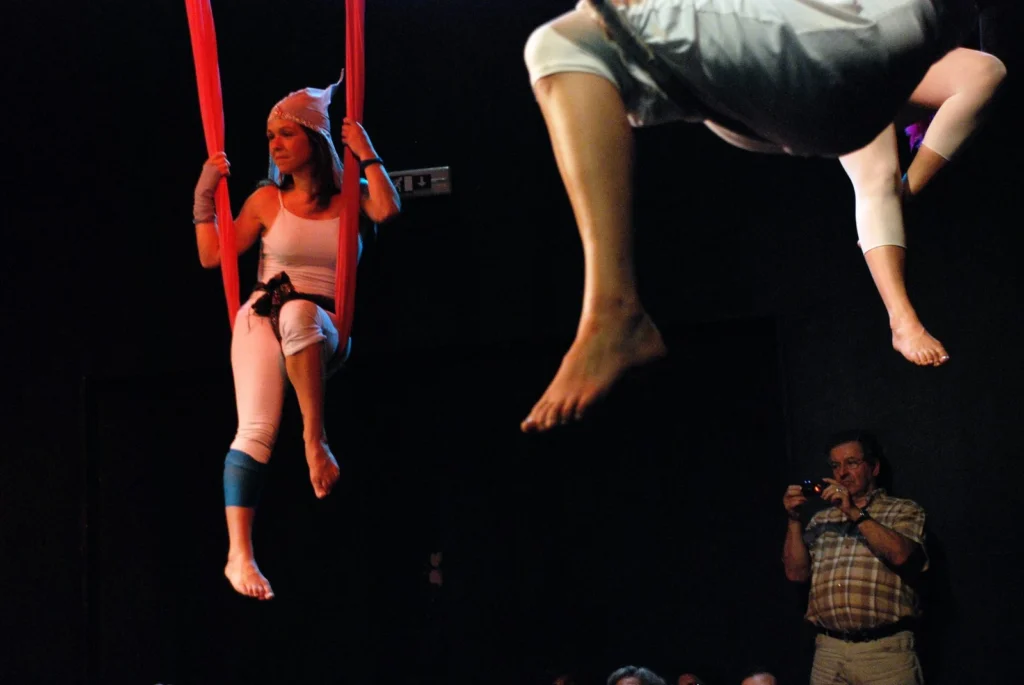
On 6 and 7 November, Campo Alegre hosts Mostra Estufa, the final edition of a contemporary circus showcase that the company Erva Daninha has run since 2018. The programme centres on balance and object manipulation: the material, its weight and the way it behaves become the basis of the stage action.
In Albatroz, a half-hour solo, Vasco Gomes handles shiny sheets to build an image of flight held back by an accumulated burden. The event page states that it is a Sem texto production — in other words, a show without words.
Portuguese classics at São João
The Teatro Nacional São João (TNSJ) in Porto stages Portuguese and world classics, inviting directors with different artistic approaches. This season, together with the Centro Dramático Galego, the theatre is producing Gil Vicente’s Auto da Barca do Inferno, a 1517 play whose title translates roughly as “The Ship of Hell”. It will run from 12 November to 13 December.
The production is directed by Galician director Marta Pazos, who also works as a set designer and visual artist. After death, the play’s characters find themselves on a quay before an angel and a devil, and each must explain why they deserve heaven. Pazos combines the story with dance and the visual arts. The play is performed in Portuguese with English surtitles and lasts about an hour and a half.
Besides the main São João building, TNSJ also includes the Teatro Carlos Alberto and the São Bento da Vitória monastery. Check the programme of all three venues: each has its own line-up.
How to read a listing before you buy
Portuguese listings use words such as dança, teatro físico, circo contemporâneo and marionetas — dance, physical theatre, contemporary circus and puppets. They help narrow the choice but do not replace information about language. Even a performance piece can be built almost entirely on a performer’s spoken account.
Information about the language of the performance and surtitles is usually found under Idioma, Língua or Acessibilidade. Teatro do Bairro Alto, for example, uses the label Pouco/Nenhum texto: the production has few words or none at all.
| Label in the listing | What it means |
|---|---|
| Sem texto or sem palavras | A show without words |
| Pouco/Nenhum texto | Few or no words; if there are some, check the language |
| Legendagem or sobretitulagem em inglês | English surtitles are provided |
| Em inglês | The performers speak English |
| LGP | Interpretation into Portuguese Sign Language |
| Duração / intervalo | Running time / interval |
If surtitles are listed for only one date, you need to choose that specific performance. The word conversa usually refers to a discussion: a post-show talk may be held in another language.