
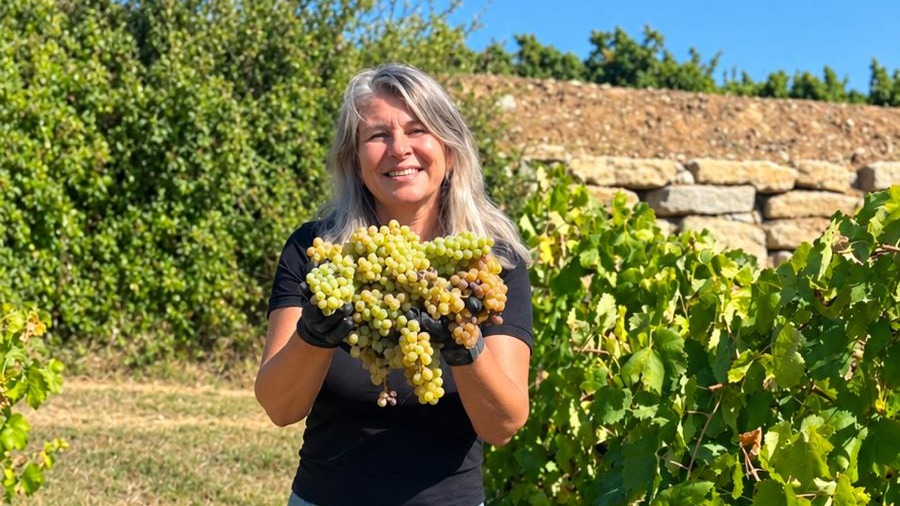
Olena Cherkashyna arrived in Portugal in 2000 and started out on a bottling line, earning €500 a month. Today, she organises harvest celebrations that attract more than 2,000 people a year and has received an award for her contribution to wine tourism. Xpat.Land correspondent Anna Sadova spent a day with her at Quinta do Boição, a winery outside Lisbon, as the grape harvest season drew to a close.
Guests make their way from Lisbon and Cascais to Bucelas, a wine-growing region in the municipality of Loures, about half an hour from the capital. The small, unassuming village of Boição is surrounded by rolling hills, with Quinta do Boição tucked away among them. In Portugal, quintas are traditional country estates, many of them associated with wine production.
Music is already playing when the guests arrive. Wine is being poured, local cheeses are served, and Olena Cherkashyna is there to greet everyone. A couple of hours later, they will be picking grapes, kicking off their shoes, climbing into a vat and stomping on the grapes to Italian music — just like Adriano Celentano in The Taming of the Shrew. Cherkashyna came up with the idea for the celebration herself. Twenty-six years ago, she spoke no Portuguese and had never worked in the wine industry.
“All that’s missing is your energy”
Back in Ukraine, Cherkashyna spent five years teaching English at a secondary school and was considered a successful teacher. The idea of leaving had been on her mind since her university days. She imagined herself living somewhere in Europe or America.
“After the Soviet Union collapsed, a lot of people left. At some point, I simply got bored and wanted a change. I’m a dynamic person — I need something new,” she says.
She and her husband first travelled to Germany, but soon realised they did not want to live there. That was when Cherkashyna remembered something an acquaintance who had visited Portugal had told her: “Lenochka, come to Portugal. There’s wine, sunshine and the sea — everything you love. All that’s missing is your energy.” In 2000, at the age of 26, they moved to Portugal.
Her husband, a veterinarian, managed to have his qualifications recognised and found work in his profession. Cherkashyna had no such luck with her teaching degree. To teach in Portugal, she would have needed to speak Portuguese at a native level and without an accent. So she decided to look for another line of work. Portugal has a long agricultural tradition, and she saw an opportunity in wine.
Five Hundred Euros and a Bottling Line
Her first job was at Companhia das Lezírias, a large winery where she worked on the bottling line. She earned around €500 a month. At weekends, she took on extra work in a shop. Portuguese was a struggle, but she was helped by the fact that almost everyone around her spoke English and explained things in simple terms.
She compares the move from teaching to working in production to tending vines: sometimes grapevines are deliberately left without water so that the grapes develop a more intense flavour. “I knew this was just a stepping stone,” she says.
Then an enologist — a specialist in wine production and quality — noticed that Cherkashyna had a good nose and began calling her in when they were putting together lots: separate batches of wine grouped by grape variety, origin and vintage. That was when she suggested organising wine tastings at the winery.
There was no time for systematic study, so Cherkashyna learned directly from winemakers. She travelled to wine regions, tracked down producers and arranged hands-on experience during vindima — the grape harvest — or in the laboratory. In 2006, Portugal launched its first postgraduate programme in wine tourism and marketing, and she completed it. Afterwards, Cherkashyna worked with Companhia das Lezírias to develop her own vindima programme.
An Ancient Sea and Arinto
Today, the celebration at Quinta do Boição begins in the vineyard. Guests are handed crates and pruning shears and spread out between the rows, while Cherkashyna tells them about the grape variety grown here: Arinto.
It is one of Bucelas’ signature white varieties — fresh and citrusy, with high acidity. Cherkashyna compares it to modelling clay: you can shape it into many different styles. Arinto is used for both still and sparkling wines, and sometimes for orange wines; it is also blended with other varieties. As these wines age, they develop greater complexity.
The place itself also gives the wine its character. The soils around Bucelas were formed on the bed of an ancient sea and contain plenty of limestone and fossils. Quinta do Boição sits in a low-lying area, with the surrounding hills protecting the vineyards from wind, cold and frost. The Boição River, after which the winery is named, flows nearby, and there is plenty of groundwater beneath the surface, meaning the vines need very little irrigation. This is what gives the local wines their distinctive minerality and acidity.
The crates gradually fill with bunches of grapes. Guests take photos, compare who has picked the most and taste the fruit. For many, it is their first time working in a vineyard, and the harvest quickly becomes a spirited competition.
“They thought it was wild”
Then everyone heads over to a large vat filled with grapes. The music changes, and the opening chords of The Taming of the Shrew begin to play. The participants take off their shoes and climb into the vat one by one. Some are cautious at first; others start dancing almost immediately. Before long, everyone is stomping the grapes with enthusiasm, and the scene becomes one of the defining photo moments of the day.
Cherkashyna’s first tasting guests were Russian- and Ukrainian-speaking immigrants. She says that at the time, she was almost the only person offering winery tours in those languages. Later, international wine fairs and work with the US market brought Portuguese visitors and tourists from other countries to her tastings as well.
Over time, tastings alone were no longer enough. She was invited to work as an events organiser for a wine company that produces 20 million bottles a year. There, Cherkashyna proposed a new take on the Festa da Vindima (harvest festival): guests would pick the grapes themselves, stomp them with their feet, sing, dance, watch the winemaking process and taste the wine with food.
Her Portuguese colleagues were puzzled by the idea. Locals were used to being paid to harvest grapes, not paying for the privilege of doing the work themselves.
“They thought it was wild, they really did. But they let me give it a try. People from the post-Soviet world didn’t need any explanation of what the event was about. They immediately embraced the whole Taming of the Shrew vibe. They climbed into the vats without any coaxing and happily stomped the grapes,” Cherkashyna recalls. The first festival of its kind was held in 2015.
In 2023, Cherkashyna received an award for her contribution to wine tourism from Maria João Almeida, founder of the Portuguese Wine Tourism Association.
Why Wineries Need Festivals
While the guests are stomping grapes, the harvest is being prepared for transport to the winery. A truck pulls up at the quinta, the crates are loaded into the back, and the grapes set off for the next stage.
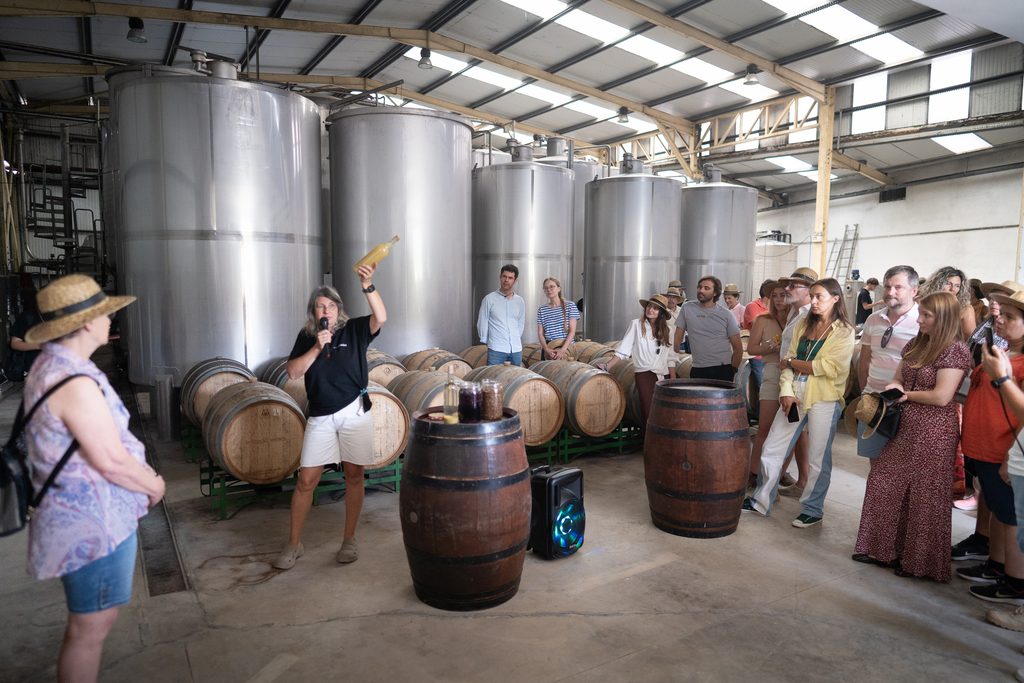
The guests follow them into the production area. Cherkashyna explains how the grapes are sorted and processed, how the juice is extracted and why temperature is so important to the quality of the wine. In the past, grapes were crushed by foot in underground tanks and large vats. Today, the juice is extracted using stainless-steel presses, which are easier to clean and make temperature control simpler.
At one stage, the participants are given fresh grape juice and asked to guess the notes they can detect. They discuss its freshness, acidity and citrus flavours. It feels like a game, but it also helps them understand how the characteristics of the grapes shape the style of the wine they will eventually produce.
Cherkashyna sees the demand for events like these as partly driven by changing drinking habits in Portugal. Younger people are embracing healthier lifestyles and choosing alcohol-free or low-alcohol drinks, leaving wineries looking for new ways to attract visitors.
The festival itself, however, is an old tradition. In the past, the whole village would turn out for the grape harvest, and afterwards everyone would gather around a communal table. Once the first wine was ready, they would celebrate with an Adiafa — a harvest-ending feast with dancing, music and young wine. In Bucelas, some quintas still do not organise events for tourists. Instead, the owners’ relatives come together for the harvest.
A Season That Lasts a Month
The vindima itself lasts only through September. In October, Cherkashyna organises events for private groups, setting aside some of the late-harvest grapes for them. A kindergarten will soon be visiting the quinta: children aged four and five will pick grapes and drink the fresh juice. In October, neighbouring Quinta de São Sebastião will host an Adiafa in its cellar, surrounded by wine barrels and accompanied by fado. For the rest of the year, Cherkashyna’s calendar is filled with tastings and private celebrations, from birthdays to gender-reveal parties. In total, more than 2,000 guests take part in her events each year.
Cherkashyna limits the number of participants so that she has time to speak to everyone. “My events aren’t about tasting a few wines and then leaving. They’re a fully immersive experience,” she says. In her view, the location alone is not enough to keep people engaged. You need someone who can tell the story behind the wine, explain how to pair it with food and show why the same wine can express itself differently in different glasses.
“There are no bad wines in the modern world,” Cherkashyna says boldly — although perhaps she means Portugal rather than the entire world. “These days, what matters is hospitality, atmosphere and people who can introduce guests to the Portuguese festa.”
She tries to welcome guests as if they were coming to her home, keeping groups small and making an effort to speak to everyone before and during the event. A beautiful location, Cherkashyna believes, is not enough:
“People don’t come just because of the place. The location is only part of the experience. What matters is being able to convey the philosophy of wine, create the right atmosphere and introduce guests to the Portuguese tradition of Festa da Vindima.”
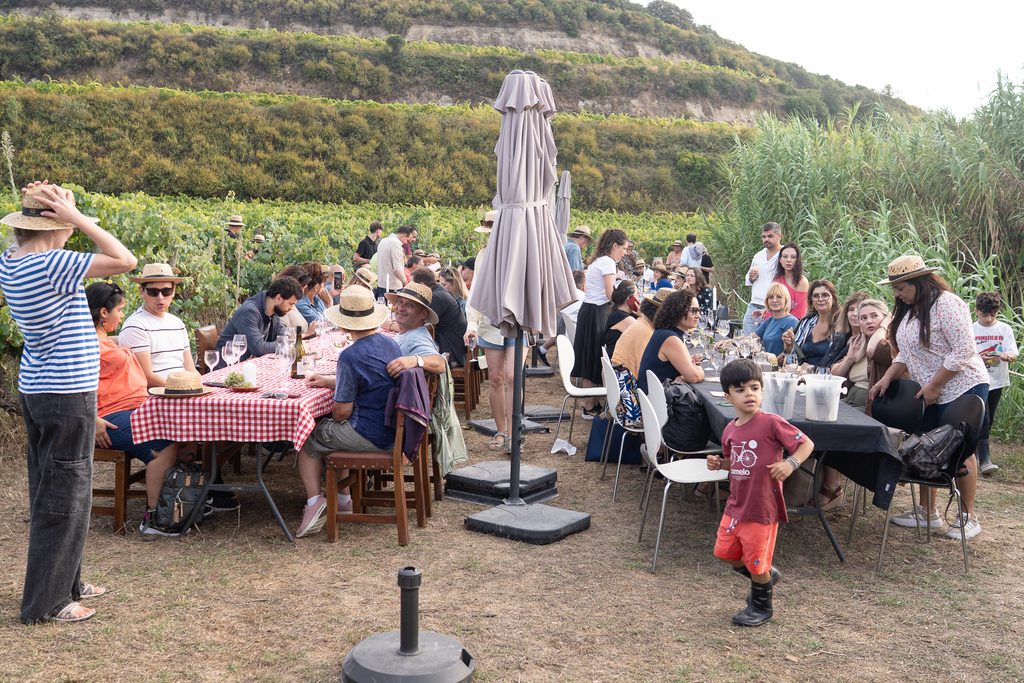
After the tour, the guests move to a large table set up right in the vineyard, decorated with grapevines and candles. The sun begins to sink, and the light turns softer. On the table are the quinta’s best wines: white, orange and rosé.
Nearby, a paella large enough to feed around 50 people is being prepared. After the vineyard and the tour, the guests finally relax. They discuss the wines, compare impressions and share photos. Russians, Ukrainians, Portuguese, Italians and Brazilians sit around the same table, and by evening they have become one group. The paella is served at sunset.
A day that began with the grape harvest ends around a communal table — much as village vindima celebrations once did.