
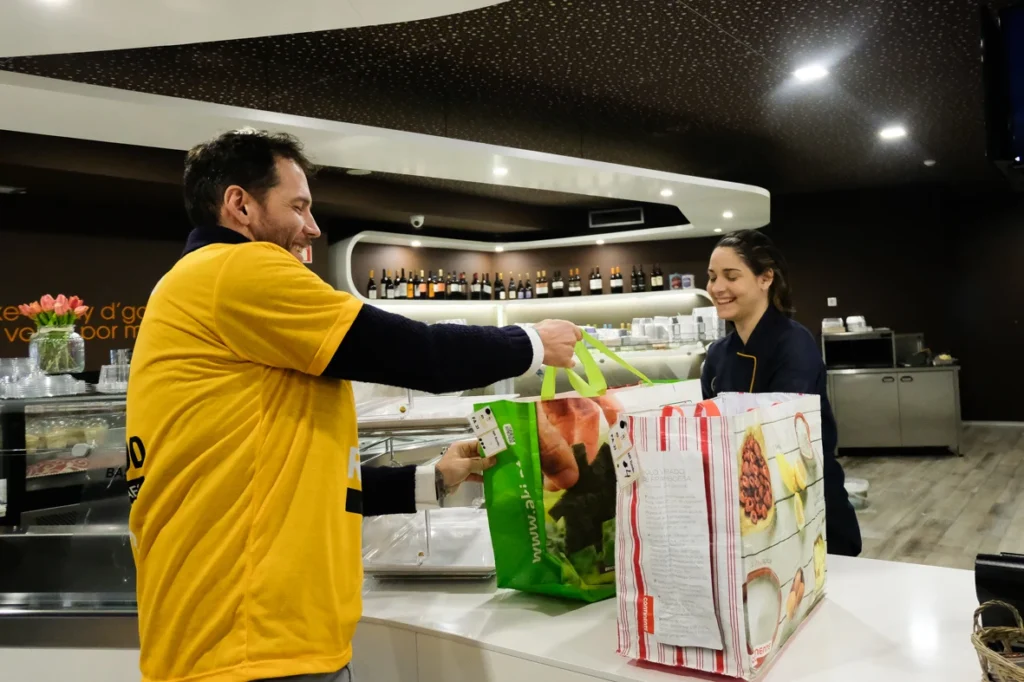
After moving to Portugal, you have to work out all over again where groceries are cheaper and what the labels on the packaging mean. And if money for food runs short, you also have to find out where to turn for support. One way to save is to buy unsold food. It is not necessarily spoiled: a bakery may have fresh pastries left over, a restaurant a few extra portions. To keep this food out of the bin, Portugal has apps, cooperatives and charity networks. Some find buyers for the surplus, others collect food for people who need support. You can take part in different ways: buy groceries for less, ask for help, or help with collecting and handing out food.
How to save on groceries
Too Good To Go: bags from cafés and shops
Too Good To Go started in Copenhagen in 2016 and has grown into an international service. Today it operates in countries across Europe and North America.
The app lets you buy food for half the usual price or less. A map shows offers from bakeries, cafés, restaurants and shops near you.
Businesses offer a Surprise Bag made up of their leftover food. You choose an offer, pay for it in the app and collect it at the time given. What is inside depends on what the seller has left: you cannot pick a dish in advance.
Equal Food: seasonal boxes delivered to your door
If collecting a box from a pick-up point is inconvenient, there is Equal Food. The service finds buyers for fruit and vegetables that were also rejected by shops for their looks or were left over from production. You can place one-off orders or take out a subscription that can be paused.
Equal Food delivers to Lisbon, Porto and the surrounding municipalities. Before ordering, check whether your address is in the delivery area. You choose one of the ready-made boxes in the catalogue. The service decides what goes in, according to the season and the harvest: you cannot swap or leave out particular fruit or vegetables.
GoodAfter: discounted long-life groceries
The online shop GoodAfter sells grains, pasta, tinned food and biscuits at a discount. Some items are reduced because their best-before date is approaching, and some are sold after it. This date should not be confused with the use-by date on perishable food.
DGAV, the Portuguese authority for food and veterinary matters, explains the difference between the two kinds of labelling.
Consumir até, “use by”, marks the expiry date of a perishable product. After this date it may not be sold.
Consumir de preferência antes de, “best before”, marks how long the product keeps its stated qualities if stored correctly. After this date it may still be sold as long as it remains safe. The seller is responsible for the food still being safe and must also tell the buyer that the date has passed.
GoodAfter shows the date on each product page, so you can check it before you pay.
How to get food support
Refood: free food from cafés and shops
Refood volunteers collect food from restaurants and shops, put together parcels that meet each family’s needs and hand them out for free. This way, unsold food reaches people who need it.
The project began in Lisbon in 2011. Hunter Halder cycled around several neighbourhoods with baskets, collecting surplus food from restaurants. Local church parishes helped him find people to give it to. Over time, a network of neighbourhood teams grew around this work.
To apply to Refood, fill in a form on its website. Choose a neighbourhood team and give your contact details and information about your household. Once you send the application, the local team will get in touch.
The form asks for your passport or Portuguese ID card number, your NIF (tax number) and your NISS (social security number).
Banco Alimentar: help through local organisations
The network of food banks receives surplus from producers and retailers, as well as donations from private individuals. During collection campaigns, shoppers hand over food they have bought specially.
At the warehouses the food is sorted and stored, then passed on free of charge to charities in the region. These charities hand out family parcels, cook meals or deliver food to people’s homes.
To ask for help through Banco Alimentar, leave your phone number and address. The network will refer your request to the organisation nearest to where you live.
FoodConnect: free food through an app
In September 2026 the environmental association ZERO launched FoodConnect in Portugal, a platform for giving away surplus food for free. Businesses post the food and the pick-up time, and users reserve it in the app. Both private individuals and charities can register as recipients.
The app is available for Android and iPhone. You collect the food directly from the business with a unique code. First check whether there are any pick-ups near your address.
How to help people who do not have enough food
Collect, pack and hand out food
At Refood you can collect food from businesses, pack parcels at the centre or hand them out to recipients. The basic commitment is two hours once a week. Find your neighbourhood team on the website and apply, saying when you are available. Teams operate in Lisbon, Porto and the surrounding municipalities.
To take part in running a team, Refood asks for at least four hours a week. If you do not speak Portuguese yet, ask when you sign up which language you will be able to use with the coordinator.
Sort food and join collection campaigns
At Banco Alimentar you can sort food at the warehouse or take part in collection campaigns. In supermarkets, volunteers ask shoppers to give part of their shopping to families in need. In the form, you can choose a local food bank, the days you are available or a campaign to join. Your NIF is requested to cover you with accident insurance as a volunteer.
Help with IT, communications and marketing
Banco Alimentar in Porto lists help with IT, communications and marketing among its volunteer tasks. If you have experience in these areas, offer it when you get in touch.
Buy food for people in need
During Banco Alimentar campaigns you can buy food and hand it to the volunteers, or pay for a food voucher at the till. Another option is to donate food online, choosing, for example, milk, rice or tinned food. Food bought this way adds the basic staples that families need and that surplus food does not cover.
For other ways to volunteer in Lisbon, read our article on volunteering.
If you run a café, restaurant or shop
To sell your surplus, register your business with Too Good To Go. The form asks for the business name, city and contact details. You then create Surprise Bag offers and set the price and the pick-up time. Customers come to your premises to collect their orders.
To give food away for free, you can become a Refood partner. The network works with restaurants, cafés, canteens, shops, distributors and farmers. In the form, choose a neighbourhood team and give your company name and contact details. Agree with the team which food you can pass on, in what quantities, how often and at what time.
If you want to post free offers yourself, create a donor account on FoodConnect. List the food, the quantity and the time it can be collected. For surplus that comes up regularly, the platform lets you create a listing template and then just update the quantity. For now, private individuals can register here only as recipients.
Refood also welcomes other kinds of support: the project needs refrigeration equipment, packaging, transport and professional services. This is an option for businesses that want to support a neighbourhood team but do not work with food.